



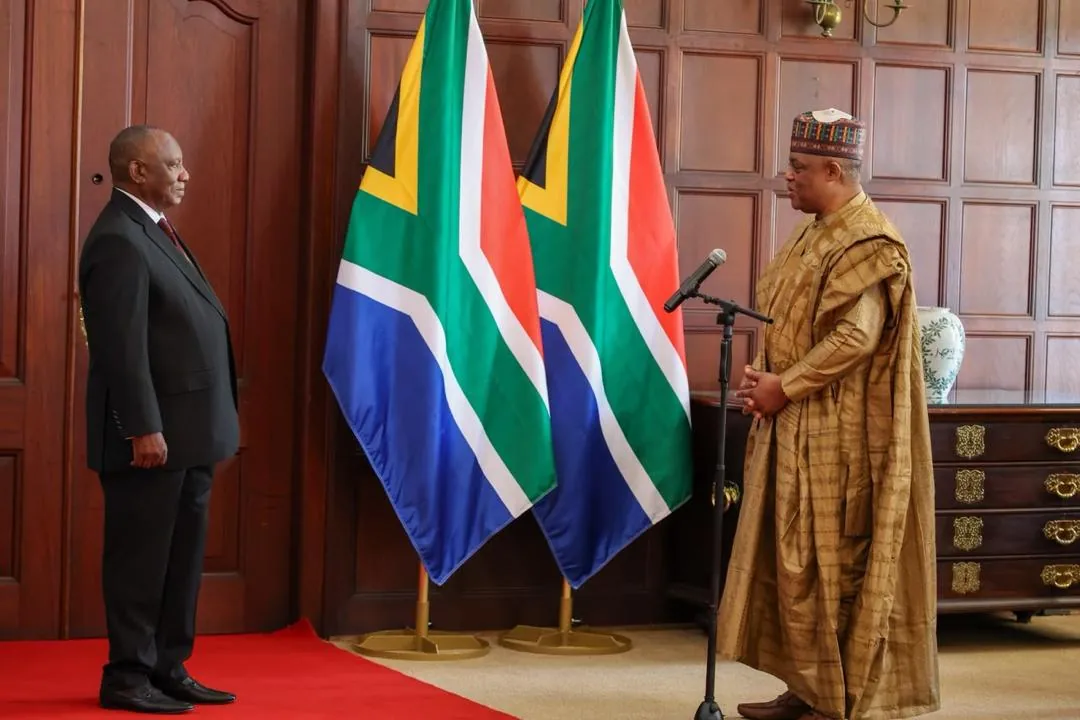
The diplomatic relationship between Nigeria and South Africa has come under fresh strain following a public disagreement over the omission of Nigeria’s Ambassador, Femi Fani-Kayode, from a televised ceremony in Pretoria, with officials of both countries exchanging accusations over whether President Cyril Ramaphosa intervened to address the incident.
The controversy escalated on Saturday after Vincent Magwenya, spokesperson to Ramaphosa, accused Nigeria’s High Commission of giving a false account of the South African President’s involvement, insisting that neither the President nor his office interfered with the editorial decisions of the South African Broadcasting Corporation (SABC).
Magwenya dismissed the Nigerian mission’s account as untrue, arguing that Ramaphosa had merely referred Fani-Kayode to the appropriate official to resolve his complaint and did not personally intervene in the broadcaster’s operations.
The Nigerian High Commission, however, stood by the ambassador’s account, insisting that he was treated with contempt and that Ramaphosa personally intervened after the matter was brought to his attention.
The exchange has turned what initially appeared to be a complaint over the coverage of a diplomatic ceremony into a public disagreement involving the presidential office of one of Africa’s most influential countries and Nigeria’s diplomatic mission in Pretoria.
In a strongly worded response on X, Magwenya said, “Even when it’s institutionalised, a lie remains a lie.
“There was no such intervention from the President or the Presidency and there will never be,” he said.
He further challenged the Nigerian mission to familiarise itself with South Africa’s constitutional provisions and the SABC’s editorial code, arguing that the President had no authority to dictate what the public broadcaster should transmit.
“Read our constitution and laws and familiarise yourself with the SABC editorial code. Stop disgracing yourself and your country,” he said.
The presidential spokesperson had earlier taken issue with Fani-Kayode’s public account of the incident, saying the Nigerian envoy had wrongly attributed the handling of his complaint to presidential intervention.
According to Magwenya, Ramaphosa directed the ambassador to Sophie Mokoena, whom he identified as the appropriate official to address the grievance.
He said Fani-Kayode declined to engage Mokoena, who could have provided clarification on the circumstances surrounding the broadcast.
Magwenya also described the ambassador’s approach to what he considered a minor operational issue as grossly inappropriate, urging him to establish a professional relationship with the public broadcaster.
The response suggested that the South African Presidency viewed the disagreement as an issue between the Nigerian mission and the broadcaster rather than a matter requiring direct presidential intervention.
However, the Nigerian High Commission rejected the criticism and maintained that the incident amounted to an affront not only to Fani-Kayode but also to Nigeria as a sovereign country.
“Our Ambassador, H.E. Chief Femi Fani-Kayode, was treated with contempt and disdain and by extension so was Nigeria,” the mission said.
It added that Ramaphosa, whom it said Nigeria held in high regard, “did the right thing by intervening.
“We got the result we wanted. End of story,” it added.
The sharp language employed by both sides has raised the stakes in a disagreement that could otherwise have been handled through established diplomatic channels, particularly given the historical and strategic importance of relations between the two African countries.
The disagreement originated from Friday’s ceremony at the Presidential Guest House in Pretoria, where Ramaphosa received letters of credence from 15 ambassadors and heads of diplomatic missions.
Letters of credence are formal documents through which a head of state accredits a foreign diplomat to represent his or her country. Their presentation marks an important stage in the establishment of official diplomatic relations between an envoy and the receiving country.
Fani-Kayode had protested that while the introductions and speeches of 14 other diplomats were broadcast live, Nigeria’s presentation was excluded from the transmission.
He alleged that the livestream was deliberately suspended when it was Nigeria’s turn to speak and resumed after he had delivered his address, an omission he considered particularly troubling given the importance of Nigeria’s relationship with South Africa.
The ambassador subsequently said he confronted the matter directly with Ramaphosa during a photo session after the ceremony.
According to him, the South African President summoned officials responsible for the broadcast and directed them to resolve the problem immediately.
“Right there in my presence he questioned them and directed them to resolve the issue immediately. Sadly, by then it was too late and Nigeria had been left out,” Fani-Kayode said.
He had also expressed appreciation to Ramaphosa for the “timely intervention”, despite his disappointment over the exclusion.
Hours after the protest, the South African Presidency published the full ceremony, including the Nigerian envoy’s speech, on its official YouTube channel.
The development, however, did not settle the disagreement, as the central issue shifted from the missing broadcast to conflicting accounts of the President’s response and the respective responsibilities of the Presidency and the public broadcaster.
The South African Broadcasting Corporation subsequently entered the controversy, offering its own explanation of its coverage and expressing disappointment that Fani-Kayode declined an interview invitation from its news division.
In a statement issued on Sunday, November 15, the broadcaster said it remained open to engaging with the Nigerian envoy and the High Commission, despite his decision not to grant the interview.
The SABC maintained that it was committed to fairness, impartiality and editorial independence in its coverage, while also expressing its desire to preserve its longstanding relationship with Nigeria.
It also clarified that its editorial coverage and the South African Presidency’s livestream arrangements were separate matters, an important distinction in the dispute over who was responsible for the omission.
The broadcaster said it had covered aspects of the ceremony through its news platforms, including showing Fani-Kayode’s arrival and publishing a clip of him speaking with Ramaphosa.
However, its response did not directly explain why the Nigerian ambassador’s address was absent from the Presidency’s livestream, which was the specific complaint that triggered the controversy.
Fani-Kayode had earlier disclosed that he declined an interview offered by SABC News at the venue because of his displeasure with the treatment of Nigeria’s delegation.
The SABC said it respected his decision and remained willing to engage with him and the Nigerian mission.
The exchange has therefore introduced another institutional dimension to the disagreement, with the broadcaster defending its editorial independence while the Nigerian mission maintains that its ambassador’s complaint deserved appropriate attention.
The controversy comes at a particularly sensitive period in relations between Nigeria and South Africa, which have been strained by recurring xenophobic attacks against Nigerians and other African nationals living in the country.
The two countries, despite their longstanding political and economic relationship, have repeatedly faced diplomatic disagreements over the safety of foreign nationals, allegations of discrimination and the treatment of Nigerian-owned businesses in South Africa.
In September, Nigeria’s National Assembly suspended official visits to South Africa and directed lawmakers to boycott legislative meetings and activities hosted or organised by South African institutions over concerns about attacks on Nigerians.
The decision followed reports of renewed anti-immigrant hostility, with Nigerian officials citing the deaths of 98 Nigerians in mob or hate-related incidents in South Africa since 2022. Reuters also reported that 1,695 Nigerians had voluntarily returned home in 2026 amid xenophobia-related tensions.
The diplomatic strain had prompted engagements between both governments in July, when South African Foreign Minister Ronald Lamola led a delegation to Abuja for discussions with Nigerian officials.
The talks, according to the South African government, focused on restoring mutual goodwill, strengthening bilateral relations, migration, governance and regional security.
Both sides also acknowledged the need to address security concerns without allowing allegations against individuals to become grounds for hostility towards entire communities. South Africa reiterated its condemnation of xenophobic violence and maintained that criminal activities should be addressed through lawful procedures rather than vigilante attacks.
Against this background, the dispute over Fani-Kayode’s speech carries implications beyond the immediate disagreement over a television broadcast. It has placed another test before diplomatic efforts to rebuild confidence between the two countries.
Fani-Kayode, who arrived in South Africa in October to assume his diplomatic assignment, had repeatedly pledged to rebuild relations and promote cooperation between the two countries.
In his address at the credentials ceremony, he recalled Nigeria’s historical support for South Africa during the struggle against apartheid and presented his appointment as an opportunity to restore confidence, address areas of disagreement and strengthen cooperation between the two African countries.
His presentation of letters of credence marked the formal commencement of his diplomatic engagement with Ramaphosa and was expected to provide an opportunity to advance the relationship at a difficult time.
Interestingly, the Nigerian High Commission subsequently sought to lower the temperature of the controversy, urging restraint and reconciliation while maintaining its position on the President’s intervention.
In a further statement reported on Sunday, November 15, the mission said it wanted cordial relations between both countries preserved and argued that the disagreement should have been handled through diplomatic channels.
It also urged Magwenya to exercise restraint in his public comments, describing his remarks as provocative and diplomatically inappropriate.
The mission’s appeal for reconciliation suggests that, despite the strong language exchanged publicly, it recognises the importance of preventing the incident from developing into a wider diplomatic confrontation.
For Nigeria, the immediate concern is not only the omission of its ambassador’s address but also the perception of how its diplomatic representation was treated at an official ceremony. For South Africa, the issue has raised questions about the distinction between presidential authority and the editorial independence of its public broadcaster.
Whether the omission was an operational error or something requiring further explanation, the public disagreement has exposed the sensitivity surrounding the relationship between the two countries.
The controversy is also one of Fani-Kayode’s earliest public disagreements with the South African Presidency since assuming his diplomatic assignment. His stated mission of rebuilding relations will require navigating such disagreements without allowing them to overshadow the broader interests of both countries.
With trade, investment, security cooperation and the welfare of millions of citizens at stake, the two governments have considerable reasons to ensure that the latest disagreement does not undermine efforts to restore mutual confidence.
For now, the Nigerian mission says it wants the matter closed, while Magwenya has maintained that the President did not intervene in the manner claimed. The conflicting accounts remain unresolved, leaving diplomatic engagement, rather than further exchanges on social media, as the more constructive route towards settling the dispute.


