



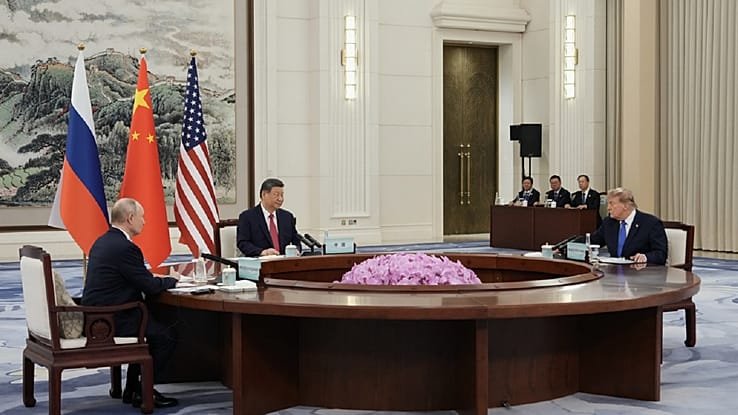
The first-ever trilateral meeting between United States President Donald Trump, Chinese President Xi Jinping and Russian President Vladimir Putin has raised fresh questions about the prospects of ending the wars in the Middle East and Ukraine, as the three leaders seek to navigate their competing interests in an increasingly volatile global environment.
The leaders met on Thursday in Shenzhen, China, on the sidelines of the Asia-Pacific Economic Cooperation (APEC) summit, in a gathering widely regarded as historic because of the strategic influence wielded by the three countries and their enormous nuclear arsenals.
Although expectations were high that the meeting could open a new diplomatic pathway towards resolving some of the world’s most pressing conflicts, analysts remained cautious about the prospect of an immediate breakthrough, given the deep political, military and economic divisions separating Washington, Beijing and Moscow.
Addressing the two leaders, Trump called for open dialogue despite political disagreements, arguing that previous administrations had missed opportunities to engage rival nations.
“Together, we are choosing a different course,” he said, expressing optimism that the three countries could work towards reducing nuclear risks, promoting global stability and finding solutions to the conflicts in Ukraine and Iran.
Trump described the United States, China and Russia as uniquely positioned to influence global security, particularly because of their nuclear capabilities and their roles in international diplomacy.
Xi, in his remarks, also emphasised the importance of dialogue and cooperation in promoting peace, while Putin highlighted the shared responsibility of the three countries in maintaining international stability.
The meeting, however, comes at a time when relations among the three powers remain complicated by geopolitical rivalry, competing security interests, trade tensions and disagreements over the international order.
The war involving Iran has further heightened tensions in the Middle East, with its consequences extending beyond the region to global energy supplies, shipping routes and international economic stability.
The Strait of Hormuz, a strategic waterway through which a significant portion of global oil shipments passes, has become a major concern amid the conflict, particularly for China, one of the world’s largest energy importers.
Trump’s engagement with Xi and Putin is therefore seen as an opportunity to explore whether the influence of the two leaders could help ease tensions surrounding Iran and create room for diplomatic efforts towards ending the conflict.
But the extent to which either China or Russia can persuade Tehran to make concessions, or how far Washington is prepared to adjust its position, remains uncertain.
China has consistently called for diplomatic solutions to international conflicts and has expressed concern about the consequences of instability in the Middle East for its economic interests and energy security.
Russia, meanwhile, maintains strategic relations with Iran, giving Moscow a potential diplomatic channel to Tehran, although its own interests in the region and wider confrontation with Western powers could complicate efforts to secure a lasting settlement.
The trilateral meeting also placed nuclear arms control prominently on the agenda, amid concerns over the growing risks of a new arms race.
The expiration of the New Strategic Arms Reduction Treaty, known as New START, between the United States and Russia earlier this year has removed the last major framework limiting the strategic nuclear arsenals of the two countries.
Trump has advocated a new arms-control arrangement that would also involve China, arguing that the three nuclear powers should work towards reducing the dangers posed by their weapons.
However, Beijing has been reluctant to join negotiations on equal terms with Washington and Moscow, maintaining that its nuclear arsenal is considerably smaller than those of the two countries and that it should not be subjected to similar restrictions at this stage.
The disparity in nuclear capabilities remains one of the major obstacles to any comprehensive agreement.
Beyond the Middle East, the war in Ukraine also remains a major test of the diplomatic ambitions of the three leaders.
Russia’s invasion of Ukraine has strained relations between Moscow and Western countries, while China’s position and its economic relationship with Russia have continued to attract international attention.
Although Trump has repeatedly expressed his desire to bring the war to an end, the conflicting demands of Russia and Ukraine, particularly over territory, security guarantees and the future of their relationship with the West, have made negotiations difficult.
The trilateral engagement could potentially provide an avenue for discussions on the conflict, but any lasting peace arrangement would require the involvement of Ukraine and consideration of its security concerns.
The absence of a direct Ukrainian role in the three-way meeting has also raised questions about the extent to which the leaders can shape the outcome of a war involving a country not represented at the table.
Analysts say the significance of the meeting may ultimately lie less in immediate agreements and more in the willingness of the leaders to maintain communication at a time when mistrust among major powers has heightened the risks of confrontation.
The meeting followed separate engagements involving Trump and Xi, as well as Trump and Putin, providing the American president an opportunity to pursue his diplomatic ambitions through both bilateral and multilateral channels.
Nevertheless, the differences among the three countries remain substantial, ranging from military alliances and territorial disputes to trade, technology and competing visions of global governance.
While the gathering could create opportunities for further negotiations, expectations of an immediate resolution to the wars in Iran and Ukraine remain low.
The challenge before the three leaders is not simply to agree that peace is desirable, but to translate their diplomatic engagement into concrete commitments capable of addressing the underlying causes of the conflicts.
Whether Thursday’s historic meeting will mark the beginning of a meaningful peace process or remain largely symbolic may depend on the willingness of Washington, Beijing and Moscow to sustain dialogue beyond the summit and engage other parties whose interests and security are directly affected by the wars.
The reporting on the summit indicates that the meeting concluded without an immediate major breakthrough, reinforcing the uncertainty surrounding its ability to produce a concrete peace agreement.


