



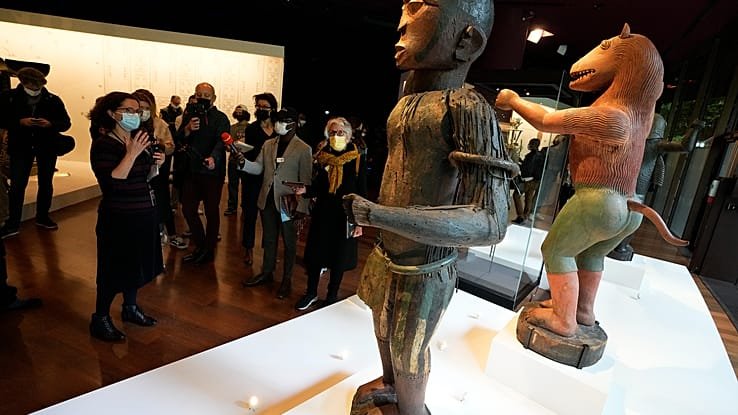
Five years after France returned 26 looted royal treasures to Benin, the West African country is renewing its demand for the restitution of 35 other cultural objects held in a French museum, reopening the debate over Europe’s colonial-era acquisitions of African heritage.
The artifacts, currently held by the Musée du Quai Branly-Jacques Chirac in Paris, include a divination tray, weapons and other objects of cultural significance. But central to the latest demand is a 19th-century iron sculpture of Gou, the deity associated with iron, war and craftsmanship in the Vodun tradition.
President Romuald Wadagni reportedly raised the matter with French President Emmanuel Macron during an official visit to France in October, signalling that the return of cultural heritage remains a priority for Benin despite the landmark restitution in 2021.
The renewed request also underscores the limitations of France’s restitution efforts, which have been widely welcomed but criticised for their slow pace and the relatively small number of objects returned compared with the vast collections accumulated during colonial rule.
For Benin, the return of the 26 treasures in November 2021 was an important moment in reclaiming a part of its history. The objects, which included royal thrones, altars and statues, had been seized by French troops during the invasion of the Kingdom of Dahomey in 1892.
Their return was the result of years of diplomatic engagement and growing international pressure on former colonial powers to confront the circumstances under which African cultural objects were taken and transferred to European museums.
The restitution was also regarded as a symbolic acknowledgement of the violence through which much of Africa’s cultural heritage was acquired. Yet the return of the 26 objects did not resolve the wider question of the thousands of other artifacts still held in foreign institutions.
The latest demand places that unresolved issue firmly back on the diplomatic agenda.
France has taken some legislative steps towards addressing the problem. In May, it passed a law designed to facilitate the return of cultural property acquired illegally through theft, looting or violence during the colonial period.
The legislation is significant because the country’s existing legal framework has historically made restitution difficult. Cultural objects held in public collections are generally protected by the principle of inalienability, meaning they cannot simply be transferred to another country without specific legal authorisation.
The new law is intended to create a pathway for the restitution of objects whose acquisition can be established to have been unlawful, although questions surrounding provenance, ownership and the implementation of restitution requests remain complex.
France’s approach has attracted scrutiny because Macron, in 2017, pledged during a visit to Burkina Faso to make the return of African cultural heritage a priority, declaring that he did not want a large part of African cultural heritage to remain in France.
That commitment raised expectations across the continent, particularly among countries whose royal, religious and historical objects were removed during colonial conquest and now form part of prominent European museum collections.
The new French restitution law could offer Benin a more direct route to recovering the 35 objects. Under the framework, requests for cultural property unlawfully appropriated during the colonial period can be assessed through a process that no longer requires Parliament to enact a separate law for every individual restitution.
The objects must, however, meet the law’s criteria, including evidence of acquisition through theft, looting, coercion or other unlawful means. A scientific assessment is expected to examine the historical circumstances surrounding each object’s removal.
A bilateral scientific committee is expected to review Benin’s request, with the process potentially taking up to two years before a formal restitution decision.
The sculpture of Gou is particularly significant. The iron work, measuring about 1.65 metres, is associated with the deity of metalworking and war and is regarded as an important expression of the artistic and spiritual traditions of the former Dahomey kingdom.
Its return would go beyond the recovery of an artwork. It would represent the restoration of an object connected to the religious beliefs, craftsmanship and historical memory of a people whose cultural institutions were disrupted by colonial conquest.
Benin has also been investing in cultural infrastructure to accommodate returned objects and strengthen its museums. The country is developing new institutions dedicated to the history of the Dahomey kingdom, slavery and Vodun heritage, reflecting a growing effort to make restitution meaningful beyond the diplomatic announcement of an object’s return.
The argument frequently raised by European museums that African countries lack adequate facilities for the preservation of returned objects has increasingly been challenged by these developments.
France is not alone in confronting demands for the return of colonial-era collections. Germany has also undertaken restitution programmes, including the return of thousands of objects associated with colonial-era acquisitions, particularly the Benin Bronzes taken from present-day Nigeria.
The debate has increasingly shifted from whether restitution should happen to how it should be conducted, what evidence should be required and whether museums should continue to retain objects whose acquisition was closely tied to colonial violence.
For African governments and cultural advocates, the issue is not simply about the ownership of valuable artworks. It is about the right of communities to access their history, religious objects and cultural symbols without having to travel thousands of kilometres to foreign museums.
The return of the Djidji Ayokwe, a sacred talking drum taken from the Atchan people of Ivory Coast by French colonial administrators in 1916, earlier this year was another important development.
The drum, which was returned after a lengthy process, demonstrated that objects taken during colonial rule could be restored to their communities of origin. Its restitution also reinforced calls for France to address outstanding requests from other African countries.
The Senegalese government has similarly recovered the sword associated with resistance leader El Hadj Omar Tall, another example of the gradual movement towards restitution.
But the pace remains slow, with many objects still held in European collections and individual requests subjected to lengthy historical, legal and diplomatic processes.
The debate over restitution is also increasingly tied to how Europe remembers its colonial past. Museums that once presented African objects largely as trophies, ethnographic specimens or evidence of distant cultures are now facing questions about the circumstances of their acquisition and the voices of the communities from which they originated.
For Benin, the latest request represents a continuation of a process that began long before the return of the 26 treasures in 2021. The country is seeking not only the recovery of individual objects but also recognition of the historical circumstances in which its cultural heritage was taken.
The return of the 35 objects would test France’s new legal framework and the sincerity of its commitment to restitution. It would also send a signal to other African nations pursuing similar claims.
Five years after the return of the Abomey treasures, the question remains whether Europe’s museums and governments are prepared to move beyond symbolic gestures and confront the scale of cultural loss suffered by African societies during colonial rule.
For Benin, the demand is clear: its heritage should not remain permanently separated from the people whose history, identity and traditions it represents.


