


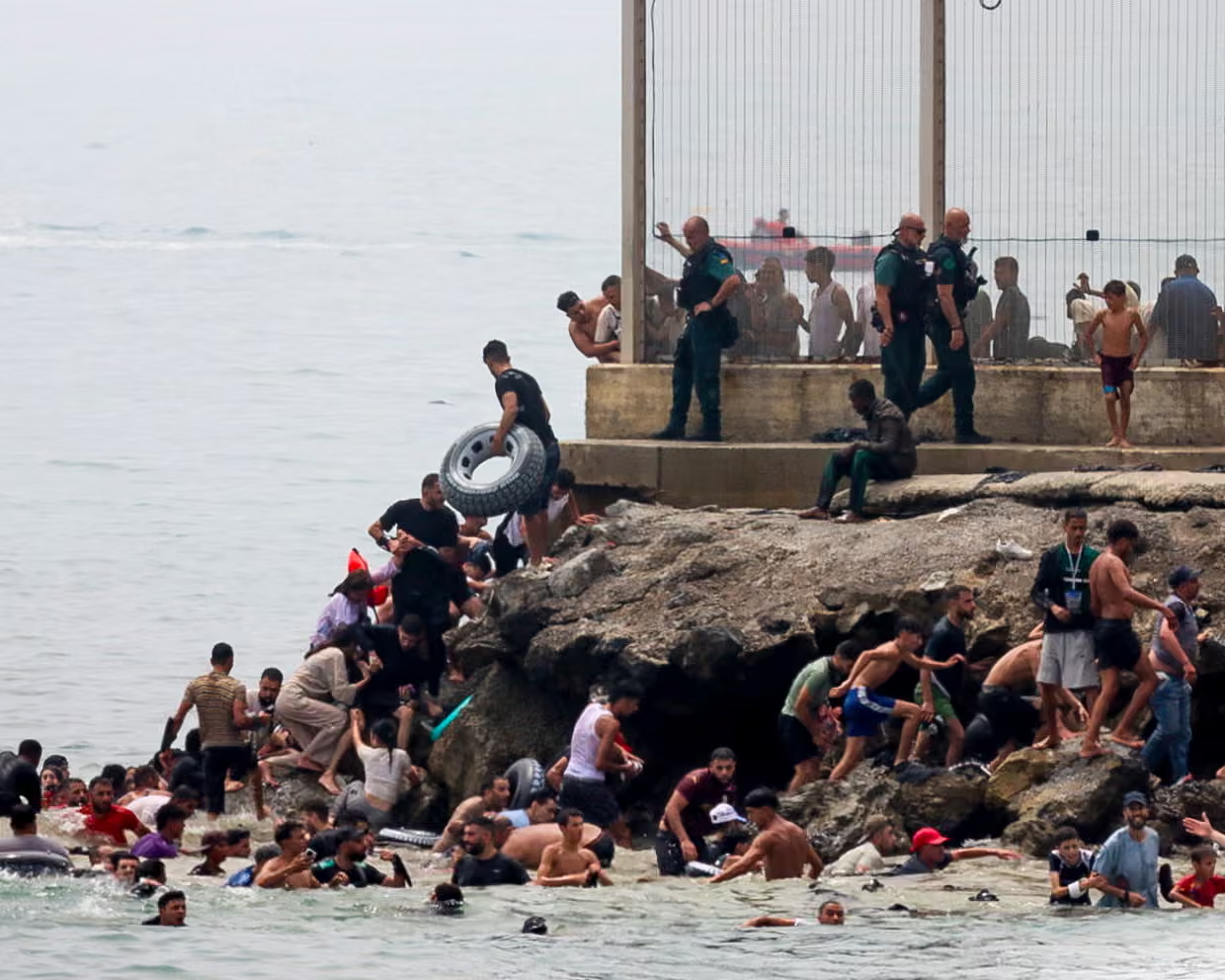
Spain has rushed police and military reinforcements to its North African enclave of Ceuta after thousands of migrants crossed into the tiny territory from neighbouring Morocco in one of the biggest sudden border surges since the 2021 migration crisis.
The mass crossings, which took place on Thursday, prompted Ceuta’s regional president Juan Jesús Vivas to urge the government in Madrid to declare a national emergency, warning that local authorities were struggling to cope as reception centres reached breaking point.
Videos shared on social media and by international news agencies showed hundreds of people wading around the Tarajal breakwater, swimming ashore and running along beaches and roads into the Spanish territory. While the majority appeared to be young men, families with women and children were also seen among the crowds. Some shouted “Viva España” as they entered Ceuta.
Spain’s Guardia Civil confirmed migrants were entering “en masse from the sea” through the Tarajal crossing, although officers said it was impossible to provide an accurate figure while the situation remained fluid. Spanish broadcaster TVE estimated between 2,000 and 3,000 people entered the enclave within hours, while news agency EFE reported others climbed the heavily fortified border fence separating Morocco from Ceuta.
“The situation is absolute chaos,” said Rachid Sbihi, head of the association representing Guardia Civil officers in Ceuta. “The border has completely collapsed. There are thousands crossing and it is impossible to establish precise numbers.”
Moroccan human rights activist Achraf Maimouni described the events as “exceptional”, claiming the Tarajal crossing had been opened under unusual circumstances, allowing large numbers of people to pass into the Spanish territory.
The sudden influx has once again exposed the vulnerability of Ceuta and nearby Melilla, Spain’s two autonomous cities on the North African coast that together form the European Union’s only land border with Africa. Both territories have long been flashpoints for irregular migration into Europe, with organised attempts to breach border fences and sea crossings occurring periodically.
Ceuta has struggled for months to accommodate growing numbers of migrants. Earlier this week, Vivas warned that reception facilities had exceeded capacity, forcing hundreds of people to sleep outdoors.
“We need more resources, more infrastructure, clearer regulations and effective coordination between every level of government,” he said. “We are not asking for privileges. We are asking for a fair and responsible solution that reflects our reality.”
Spain’s Interior Minister, Fernando Grande Marlaska, travelled to Ceuta on Friday following the emergency, although the central government rejected calls to declare a national emergency. Officials said Spain’s emergency legislation only allows such declarations for disasters such as major wildfires, volcanic eruptions or nuclear incidents, rather than migration events.
Prime Minister Pedro Sánchez pledged an immediate response, saying authorities were deploying all necessary resources while coordinating closely with Moroccan officials and international partners.
“We are mobilising every available resource and working to restore normality as quickly as possible,” Sánchez wrote on X after speaking with Vivas.
The latest crisis comes only weeks after Spain’s Supreme Court ruled that migrants intercepted at sea while attempting to reach Ceuta or Melilla cannot automatically be returned under the enclaves’ special border rejection rules. Border officers told Reuters there had been a gradual increase in attempted crossings following the ruling, but described Thursday’s events as an unprecedented escalation.
Opposition politicians accused the Socialist government of failing to protect Spain’s borders.
People’s Party leader Alberto Núñez Feijóo said ministers could no longer “look the other way”, describing the situation as a national security issue.
Vox leader Santiago Abascal went further, calling the mass arrivals “an invasion” and accusing the government of encouraging illegal migration, claims that have not been supported by evidence.
Moroccan officials blamed criminal trafficking networks for organising the crossings and insisted cooperation with Spain on border security remained “exemplary.”
The events inevitably drew comparisons with the dramatic Ceuta crisis in May 2021, when more than 8,000 migrants crossed into the enclave within just 48 hours after Morocco relaxed border controls during a diplomatic dispute with Spain over Madrid’s decision to provide medical treatment to Western Sahara independence leader Brahim Ghali.
That episode prompted one of the largest military deployments to the enclave in recent years, with Spanish soldiers helping border police return thousands of migrants. Relations between Madrid and Rabat have since improved following Spain’s support for Morocco’s autonomy plan for Western Sahara, leading to closer cooperation on migration control.
The latest surge also reflects wider migration pressures across southern Europe. Spain has experienced a sharp increase in irregular arrivals over the past year, particularly through the Canary Islands route, where tens of thousands of migrants from West Africa have undertaken dangerous Atlantic crossings. European Union officials have repeatedly warned that conflicts, poverty, organised smuggling networks and political instability continue to drive migration towards Europe’s external borders.
Despite improved cooperation between Spain and Morocco in recent years, the latest crossings underline how quickly pressure can build at Ceuta, a territory of just over 18 square kilometres that remains one of Europe’s most sensitive migration frontiers.


