



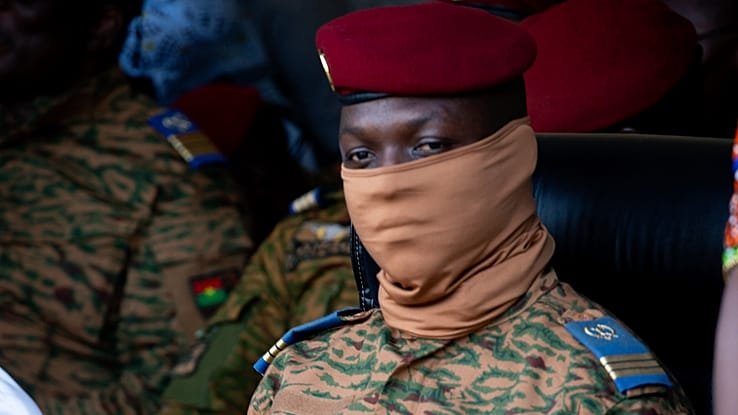
Captain Ibrahim Traoré has marked four years in power in Burkina Faso, the same period Thomas Sankara ruled the West African country before his assassination in 1987.
Both military leaders came to power as young army captains and have presented themselves as advocates of national sovereignty, Pan-Africanism and greater economic independence.
Sankara seized power in 1983 and launched what he described as a “democratic and popular revolution”, focusing on education, women’s empowerment, self-reliance and local production.
Nearly four decades after his death, Traoré has repeatedly invoked Sankara’s legacy while pursuing his own political and economic agenda under markedly different circumstances.
Since taking power, Traoré’s government has nationalised gold mines, promoted local industries and launched Faso Mebo, an infrastructure programme focused on road construction and urban development using local resources.
Security, however, remains a major challenge for the country. Burkina Faso continues to face attacks by jihadist groups, with violence affecting large parts of the country and some communities facing prolonged blockades.
Traoré’s government has also adopted a more restrictive approach towards political dissent. Journalists, magistrates and civil society figures have reportedly been forcibly recruited and deployed to the front lines, while political opposition has faced restrictions.
The military government has also significantly changed Burkina Faso’s foreign relations.
Traoré has distanced the country from France, its former colonial power, while strengthening relations with Russia.
Burkina Faso has also deepened regional cooperation with Mali and Niger through the Alliance of Sahel States, a new regional confederation formed by the three military-led countries.
As Traoré reaches the four-year mark, his government continues to frame its policies around sovereignty, economic self-reliance and Pan-African cooperation, while facing persistent security challenges and criticism over restrictions on political and civic freedoms.


