



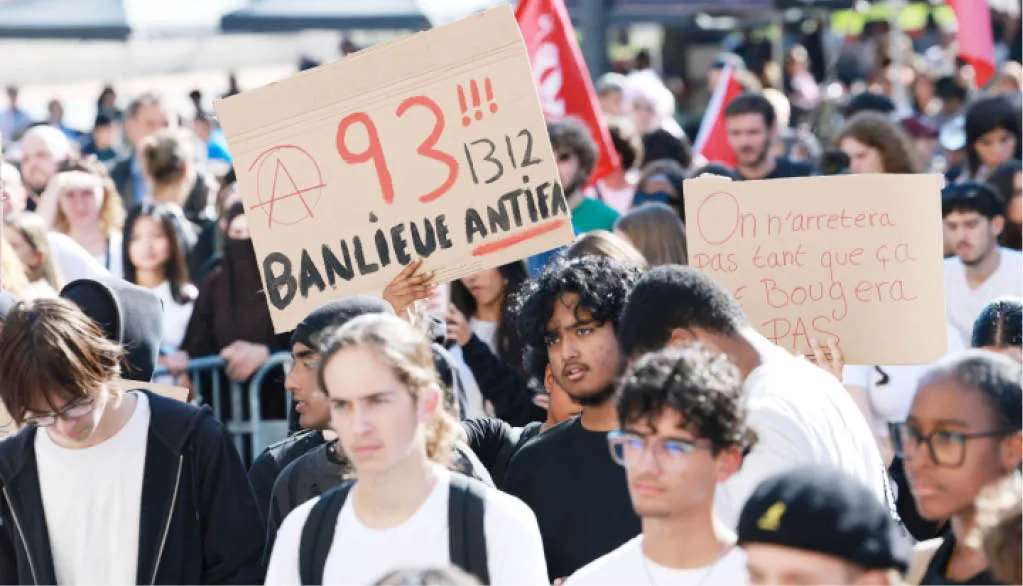
Up to 500 schools across France are expected to close fully or partially as authorities respond to a wave of student protests that has spread across the country.
Education Minister Edouard Geffray said on Sunday that between 400 and 500 high schools, known as lycées, would suspend classes either completely or partially because security conditions could not be guaranteed.
He said 24 schools had been “burned or ransacked” since the protests began, describing Monday’s closures as a precaution ahead of further demonstrations planned for Tuesday.
The protests began on September 17 at a high school in the Paris suburb of Créteil and have since spread nationwide. Students are protesting over teacher shortages, long school days, deteriorating facilities and other concerns about the quality of education.
Geffray said the number of schools affected on Monday would be similar to that recorded on Friday, but promised a gradual return to normal teaching.
The minister also alleged that far-left activists had infiltrated the student movement and contributed to outbreaks of violence.
“There are activists – particularly from the far-left – who have infiltrated the high school student movement, hijacked it from the students themselves, and engaged in extreme violence,” he said.
Geffray said 78 education workers had been injured during the unrest, describing the figure as unprecedented.
The organisers of the protests have called for demonstrations to continue on Tuesday, saying the government has failed to introduce “concrete measures” to address the students’ concerns.
More than 5,000 people, about 85 per cent of them minors, have reportedly been arrested since the protests began.
The unrest has also sparked controversy over the conduct of security forces. Amnesty International’s France branch has accused police of using disproportionate force and called on authorities to allow students to express their grievances peacefully.
Amnesty France president Anne Savinel-Barras urged authorities to ensure young people could protest without being subjected to tear gas, batons or arbitrary detention.
Interior Minister Laurent Nunez, however, defended the police response, saying security forces were not targeting young people but protecting students who wanted to express their demands peacefully.
The protests have also been marked by incidents of violence against teachers and police officers.
A 16-year-old was detained on Sunday over an attack on a 59-year-old teacher in La Ciotat. The teacher was reportedly doused with gasoline and assaulted during a protest on Friday.
In Belfort, eastern France, footage showing youths beating and kicking a police officer who had fallen to the ground triggered widespread condemnation. Two Bulgarian nationals, aged 15 and 17, were arrested and placed under investigation for suspected aggravated violence, according to prosecutors.
Meanwhile, a student injured during clashes with police in Tours reportedly lost the use of his right eye, according to the city prosecutor.
The protests have been amplified by social media platforms, particularly TikTok, where students and other users have circulated videos of burning rubbish bins, clashes and police deploying tear gas.
French sociologist Valerie Becquet said the protests reflected wider inequalities within the country’s education system, particularly affecting students from low-income communities.
“High-school students – particularly those from low-income neighbourhoods – feel they are receiving an inferior education,” she said.
The demonstrations have also become a source of political tension ahead of France’s presidential election, with the government accusing the hard-left France Unbowed (LFI) party of supporting or encouraging the movement.
LFI senior official Manuel Bompard rejected the allegation, accusing the government of resorting to “conspiracy theories”. Veteran LFI leader Jean-Luc Mélenchon has backed the students’ demands while calling for non-violent protests.
Despite the unrest, authorities have reported improvements at some schools where students initially launched protests. At the Saint-Exupéry high school, where the movement began, the situation reportedly returned to normal after education authorities agreed to provide additional staff, including a deputy principal and a nurse.
The protests have highlighted longstanding concerns over teacher shortages, overcrowded timetables, school facilities and inequalities between different categories of French high schools.


