


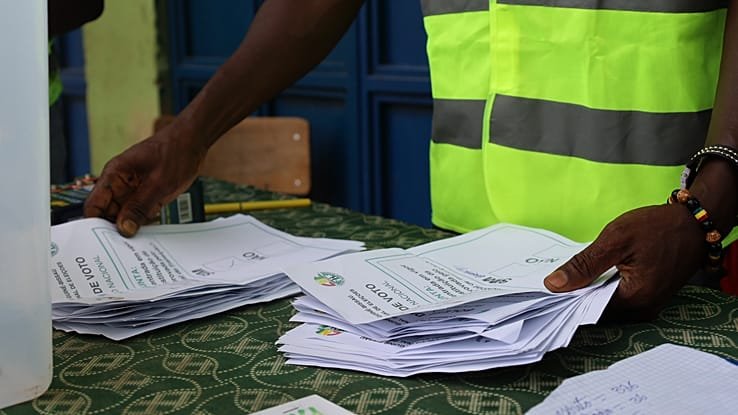
Guinea-Bissau went to the polls on Sunday to vote on a proposed new constitution that would significantly strengthen presidential powers and reduce the size of parliament, in a referendum seen as a major test of the military government’s plans to reshape the country’s political system ahead of elections scheduled for December.
The proposed constitution would replace the current semi-presidential system with a stronger presidential model, giving the head of state greater control over the executive branch.
Under the draft, the president would chair the Council of Ministers and have the authority to appoint and dismiss the prime minister. The number of parliamentary seats would also be reduced from 102 to 65, while electoral constituencies would be cut from 29 to 12.
Government supporters say the reforms are designed to end recurring power struggles between the presidency, government and parliament, which have contributed to years of political instability.
General Tomás Djassi, head of the armed forces, defended the proposed changes, saying the new constitution would establish a clearer hierarchy of authority and reduce repeated conflicts between the president and prime minister.
The opposition has strongly rejected the referendum and urged citizens to boycott the vote.
The African Party for the Independence of Guinea and Cape Verde (PAIGC) said the proposed constitution would weaken the office of the prime minister, subordinate parliament and political parties, and concentrate excessive powers in the presidency.
Critics have also questioned whether the transitional military authorities have the legitimacy to undertake fundamental constitutional changes.
Political analyst Paulino Quadé questioned the origins of the draft constitution and whose interests would ultimately be served by the proposed reforms.
Despite opposition calls for a boycott, Guinea-Bissau’s National Electoral Commission said voter participation could exceed 55 per cent.
The commission’s secretary-general, Idriça Djaló, said voting was conducted peacefully without any major incidents.
He reported strong participation in regions including Bafatá, Gabú and Oio, although turnout was lower in parts of the capital, Bissau, and some other areas.
The commission acknowledged logistical and organisational challenges at some polling locations but said the problems were gradually resolved.
Voting was scheduled to end at 5 p.m., after which counting and the centralisation of results were to begin.
The electoral commission said preliminary results could take between three and seven days to emerge.
The vote comes less than four months before a presidential election scheduled for December 6, which is intended to restore civilian government following the latest military takeover.
The military seized power on November 27, 2025, three days after a disputed presidential election in which then-President Umaro Sissoco Embaló and opposition candidate Fernando Dias both claimed victory.
The army subsequently halted the electoral process and installed a transitional military administration headed by General Horta N’Tam.
The takeover further deepened a democratic crisis in West Africa, where several countries have experienced military coups in recent years.
Guinea-Bissau has struggled with political instability since gaining independence from Portugal in 1973, experiencing repeated coups and attempted coups.
The country’s challenges have also been compounded by widespread poverty and its emergence as a major transit route for cocaine trafficking between Latin America and Europe.
The World Bank estimates that more than half of Guinea-Bissau’s approximately 2.2 million people live in poverty, despite the country’s significant natural resources.
For some residents, political stability and improved living conditions are more pressing concerns than constitutional reform.
Bacar Camará, a high school teacher, said the transitional authorities should focus on reconciliation and creating a more stable political environment.
Another resident of Bissau, Carolina Djeme, said she intended to vote against the proposed constitution because she did not have sufficient information about its provisions to support it.
Supporters of the reforms, however, argue that concentrating executive authority could reduce institutional disputes and establish a more stable political system.
The referendum result will determine whether the proposed constitutional changes are adopted as Guinea-Bissau moves towards its planned return to civilian rule in December.


