


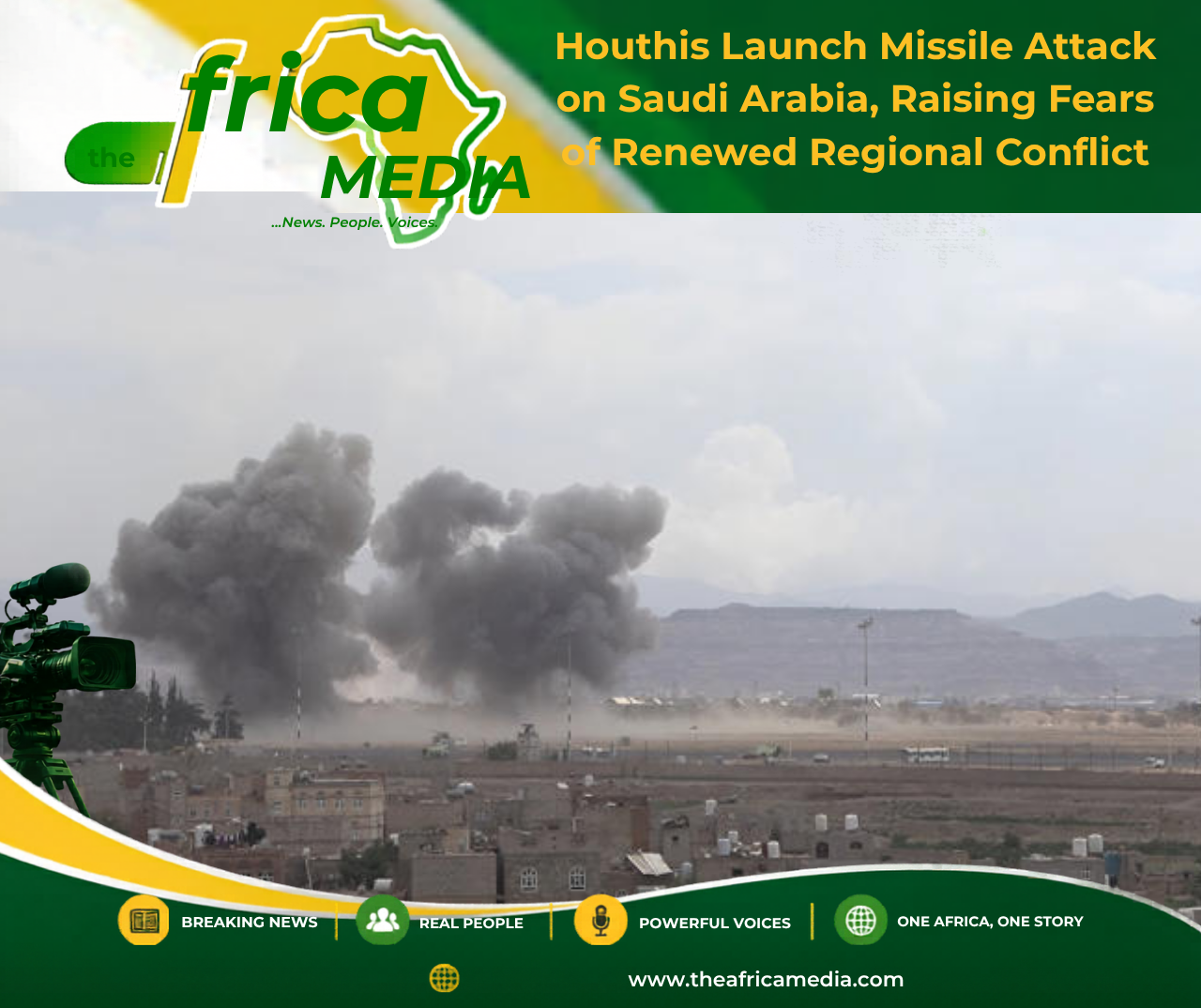
SANAA/RIYADH — Yemen’s Houthi movement has launched missiles toward Saudi Arabia, marking the most significant escalation between the Iran-backed group and the kingdom in more than four years and threatening to unravel a fragile truce that has largely held since 2022.
Saudi Arabia said its air defence systems intercepted missiles fired by the Houthis toward the country’s southern region. A spokesperson for the Saudi-led military coalition confirmed the interceptions, describing the launches as attacks by the Houthi militia.
The Houthis later claimed responsibility, saying the missiles targeted Abha International Airport in Saudi Arabia’s southwestern Asir Province, a region near the Yemeni border.
Escalation Follows Airport Strike Allegations
The missile attack came just hours after the Houthis accused Saudi Arabia of carrying out airstrikes on Sanaa International Airport, which is under the group’s control.
Houthi officials described the alleged strikes as “blatant aggression,” declaring that a period of de-escalation had come to an end. The group also warned airlines against operating in Saudi airspace until what it called the “siege” on Sanaa airport is lifted.
However, the reported strikes on the airport were claimed by Yemen’s internationally recognised government, which is backed by Saudi Arabia.
Yemeni Government Defends Military Action
Yemen’s Ministry of Defence said government forces targeted the runway at Sanaa International Airport to prevent an Iranian aircraft from landing, arguing that the flight violated the country’s sovereignty.
The ministry added that security forces would respond to any unauthorized aircraft entering Yemeni airspace and held Iran responsible for what it described as continued interference in Yemen’s affairs.
Military officials later confirmed that the Iranian aircraft landed instead at Hodeidah Airport, a Houthi-controlled facility on Yemen’s Red Sea coast. It remains unclear whether any effort was made to prevent the aircraft from reaching its alternative destination.
Humanitarian Concerns Persist
The latest escalation also comes amid reports that the Houthis are holding an aircraft belonging to the International Committee of the Red Cross (ICRC) at Sanaa airport.
An ICRC spokesperson confirmed that all staff members and the aircraft crew were safe but declined to provide additional details.
The incident follows the collapse of a prisoner exchange agreement mediated by the ICRC between the Houthis and Yemen’s internationally recognised government, with both sides blaming each other for the failed negotiations.
Fragile Truce Under Pressure
Monday’s exchange of attacks represents the first publicly claimed Houthi missile strike on Saudi Arabia since an informal ceasefire took effect in March 2022, ending years of cross-border attacks that had targeted Saudi cities and critical energy infrastructure.
The renewed hostilities raise concerns over the future of the truce, particularly as tensions across the Middle East remain elevated.
Saudi Arabia had largely avoided direct confrontation with the Houthis in recent years despite broader regional conflicts, including hostilities linked to Iran and the Israel-Gaza war.
Regional Stability at Risk
Analysts warn that a prolonged escalation could threaten security along Saudi Arabia’s southern border and disrupt maritime trade routes in the Red Sea, where the Houthis have previously launched attacks on commercial shipping.
Saudi Arabia has continued exporting oil through pipelines connecting its eastern oil fields to ports on the Red Sea, reducing reliance on the Strait of Hormuz. However, renewed conflict involving the Houthis could create fresh security challenges for regional trade and energy supplies.
Conflict Enters a New Phase
Yemen has endured more than a decade of civil war since the Houthis seized the capital, Sanaa, forcing the internationally recognised government to relocate to the south.
A Saudi-led military coalition intervened in 2015 in support of the government, triggering a prolonged conflict that has contributed to one of the world’s worst humanitarian crises.
Although the 2022 truce significantly reduced cross-border violence, the latest missile exchange signals a potentially dangerous shift, raising fears that the conflict could once again spill beyond Yemen’s borders.


