



Iran’s growing missile capabilities and its decision to abandon a long-standing restriction on the range of its ballistic missiles are raising fresh concerns for the United States and its allies, as the eight-month-old war between Tehran and Washington remains unresolved despite diplomatic efforts to end the conflict.
The latest indication of Iran’s military ambitions came on Friday when the Islamic Revolutionary Guards Corps (IRGC) claimed that it had targeted and destroyed a United States early-warning radar installation in Bahrain. The alleged attack, which Iran said was in retaliation for an airstrike on a telecommunications facility in southern Iran, marked the first such claim involving American military assets in a Gulf country since early September.
However, the United States disputed Iran’s account. The US military said it intercepted two Iranian attack drones heading towards Bahrain, adding that there were no injuries or damage. The Iranian claim that the radar had been destroyed could not be independently verified.
The development nevertheless highlights the continuing threat posed by Iran’s missile and drone arsenal to American military installations across the Middle East, particularly as Tehran signals its readiness to resume large-scale hostilities if diplomatic efforts collapse.
The latest confrontation comes amid a fragile lull in the war, which began on February 28, 2026, following coordinated US-Israeli strikes on Iran that killed the country’s then-Supreme Leader, Ayatollah Ali Khamenei.
Iran retaliated with waves of ballistic missile and drone attacks against Israel and American military installations in several Gulf countries. The conflict also drew in armed groups aligned with Tehran in Lebanon, Yemen and Iraq, widening the confrontation beyond the immediate battlefield.
While Washington has maintained military and economic pressure on Iran, Tehran has continued to demonstrate its weapons capabilities, particularly its ballistic missile programme, which has become one of its most important instruments of military deterrence.
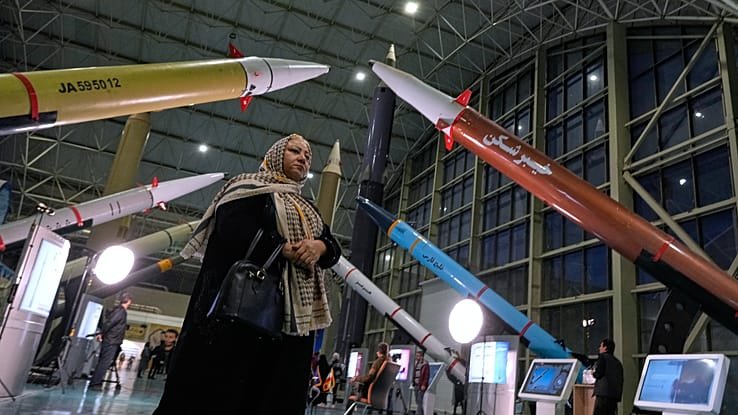
Days before the latest claim involving Bahrain, Iranian state media broadcast footage of an underground missile facility described as a ‘missile city’, showing ballistic and cruise missiles alongside their launch systems.
The exhibition followed the unveiling of another underground missile facility by the IRGC Aerospace Force on November 10. Iranian military commanders, including the Chief of Staff of the Armed Forces, Major General Ali Abdollahi, and the commander of the IRGC Aerospace Force, Brigadier General Majid Mousavi, attended the event.
Iranian officials said the country had moved significant portions of its missile and drone production facilities underground to protect them from American and Israeli airstrikes. The military also claimed that its production capacity would remain intact despite sustained attacks on its defence infrastructure.
The facilities are particularly significant because they suggest that Iran is seeking to protect not only its existing weapons stockpile but also the industrial capacity required to replenish missiles and drones during a prolonged conflict.
However, the footage released by Iranian state media does not independently establish the size of the country’s remaining arsenal, the production capacity of the facilities or how effectively they could withstand sustained bombardment.
Among the weapons displayed at a recent exhibition near Tehran were the Emad ballistic missile, which has a reported range of approximately 1,700 kilometres, and the Khorramshahr missile, whose estimated range is about 2,000 kilometres.
Both weapons are part of an arsenal that gives Iran the capacity to strike targets across much of the Middle East, including Israel, the Arabian Peninsula and American military installations hosted by countries in the Gulf.
The Emad is a medium-range ballistic missile developed from Iran’s Shahab-3 missile family, while the Khorramshahr is another medium-range system with a reported capacity to carry a substantial warhead.
According to the Missile Threat project of the Washington-based Centre for Strategic and International Studies (CSIS), Iran possesses one of the most diverse missile arsenals in the Middle East, comprising thousands of ballistic and cruise missiles.
The organisation identifies the Emad as having an estimated range of 1,700 kilometres and the Khorramshahr approximately 2,000 kilometres. Other weapons in Iran’s inventory include the Sejjil ballistic missile, with a reported range of 2,000 kilometres, and the Shahed series of attack drones.
The significance of these weapons lies not simply in their destructive capacity but also in the geographical reach they give Iran. American military bases, naval installations, logistical facilities and other strategic assets across the region are potentially within the range of its existing missile systems.
More concerning for Washington is Tehran’s recent announcement that it has abandoned its self-imposed 2,000-kilometre restriction on ballistic missile development.
The IRGC disclosed the decision on November 7, with its spokesman, Brigadier-General Hossein Mohebbi, saying the limitation had been lifted.
Although Iran did not provide details of any operational missiles with ranges exceeding 2,000 kilometres, the announcement represents a significant shift in its military posture.
For years, Iranian authorities had maintained that the country did not need missiles capable of travelling beyond 2,000 kilometres because that range was sufficient to cover Israel and other perceived regional threats.
The decision to abandon the restriction suggests that Tehran may now be considering a broader geographical reach for its military deterrence, potentially bringing American military facilities farther from the Middle East and parts of Europe into its strategic calculations.
Al Jazeera, in an analysis of the development published on November 10, reported that Iran already possessed technologies that could potentially support longer-range missile development, although it currently does not have an operational intercontinental ballistic missile capable of striking the United States.
The report also recalled Britain’s accusation in March that Iran had fired missiles towards the joint US-UK military base at Diego Garcia in the Indian Ocean, approximately 4,000 kilometres from Iran. Tehran denied targeting the installation.
The distinction between technological potential and an established operational capability remains important. Developing a missile capable of travelling thousands of kilometres requires more than increasing its fuel capacity. It involves advances in propulsion, guidance, warhead technology and the ability to withstand the demands of a much longer flight.
Nevertheless, the removal of the range restriction sends a political and military message to Washington and its European allies that Iran is no longer willing to confine its missile ambitions to the immediate region.
For the United States, Iran’s missile development presents a challenge that extends beyond the possibility of individual attacks on military installations.
American military operations in the Gulf depend heavily on a network of bases, naval facilities, radar systems and logistical installations spread across several countries. Bahrain, for instance, hosts the headquarters of the US Navy’s Fifth Fleet, making it an important component of Washington’s military presence in the region.
The reported targeting of an early-warning radar in the country, whether or not Iran’s claim is accurate, draws attention to the vulnerability of installations that support the detection and interception of incoming missiles and drones.
Early-warning radar systems are essential to modern air defence because they help military commanders identify incoming threats, establish their trajectories and coordinate interception efforts. Damage to such facilities could reduce the time available to respond to an attack and complicate the protection of other military assets.
Iran’s strategy of combining ballistic missiles, cruise missiles and relatively inexpensive attack drones also presents a challenge for American air defence systems.
A coordinated attack involving different types of weapons could force defenders to engage several threats simultaneously, potentially stretching interception capabilities. Even when incoming weapons are successfully intercepted, the cost of defending against repeated attacks can become considerable.
The experience of the conflict has also demonstrated that Iran does not necessarily need to defeat the American military conventionally to impose significant costs on Washington.
Its ability to threaten military installations, disrupt shipping and create uncertainty around critical energy infrastructure gives Tehran additional leverage in the confrontation.
The Strait of Hormuz is particularly important in this calculation. The narrow waterway connects the Persian Gulf to international shipping routes and serves as a major passage for global oil and gas supplies.
Iran has previously restricted shipping through the strait during the conflict, while Washington imposed a naval blockade on Iranian ports. Any renewed confrontation could therefore have consequences far beyond the military balance, affecting energy prices, international trade and the economies of countries dependent on Gulf oil supplies.
Despite the military posturing, diplomatic efforts to end the conflict have continued, with Qatar and Pakistan playing important intermediary roles.
Qatar’s Prime Minister, Sheikh Mohammed bin Abdulrahman Al Thani, said on November 7 that mediation efforts between Washington and Tehran were continuing to prevent further escalation.
Qatari officials subsequently disclosed that both countries had given positive responses to the ongoing diplomatic initiatives.
The negotiations, however, remain complicated by disagreements over Iran’s nuclear programme, American sanctions, the US military presence in the region and the future of shipping through the Strait of Hormuz.
Iran has demanded concessions from Washington before agreeing to a comprehensive settlement, while the United States wants assurances over Tehran’s nuclear activities and its regional military capabilities.
The latest developments surrounding Iran’s missile programme could further complicate the negotiations by increasing Washington’s concerns about Tehran’s long-term military ambitions.
For Iran, displaying its weapons and announcing the expansion of its missile range may be intended to demonstrate that American military pressure has not eliminated its capacity to retaliate.
For Washington, however, the same developments reinforce the argument that Iran’s military capabilities remain a threat requiring sustained attention.
Ultimately, the impact of Iran’s new missile ambitions on the war will depend on whether Tehran can translate its technological claims into reliable operational capabilities and whether the United States can maintain an effective defence against increasingly sophisticated attacks.
The immediate danger is not necessarily that Iran will strike the American mainland, but that its expanding missile capabilities could make US military operations across the Middle East more difficult and costly.
As both countries maintain their military readiness while diplomatic negotiations continue, the prospect of another escalation remains a serious concern. The missiles displayed in Tehran may therefore represent more than a demonstration of military strength; they are also part of Iran’s attempt to influence the balance of power and the terms of any eventual settlement with Washington.


