



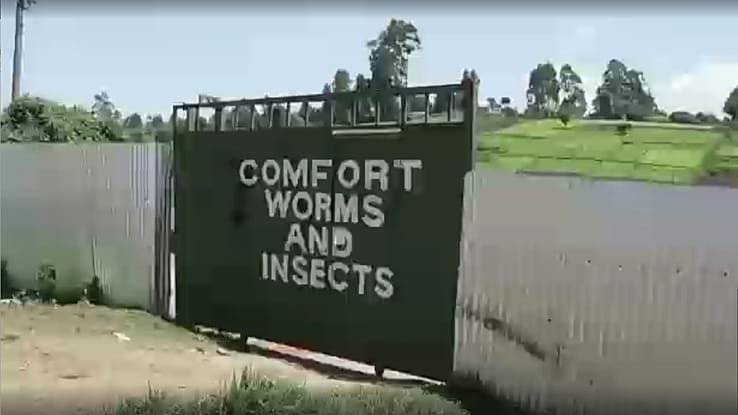
Agriculture is a major driver of East Africa’s economy, but the region is facing a growing soil degradation crisis, with farmers increasingly turning to insects and worms to restore soil health and reduce dependence on chemical fertilisers.
A 2025 soil report by the Heinrich Böll Foundation, a German think tank, found that more than 40 per cent of East Africa’s soils had been degraded, partly due to the excessive use of chemical fertilisers. The report estimated that soil degradation costs the region more than $65 billion annually in lost productivity.
The cost of fertilisers has also risen in 2026 amid disruptions linked to the war in the Middle East, intensifying the search for cheaper and more sustainable alternatives.
In Kenya, 32 per cent of cropland was classified as strongly acidic, with intensive farming and changing climatic conditions also contributing to declining soil quality.
For farmers such as George Muturi Kamau, worms have offered a practical solution.
On his farm in Lari, about 50 kilometres from Nairobi, Muturi has turned to vermicomposting — a process in which redworms transform food and crop waste into nutrient-rich organic fertiliser.
He says the practice has helped restore soil damaged by years of chemical fertiliser use while improving crop yields.
“Vermicomposting was a breakthrough for us … our soil is much better in a way that we can be able to plant and sustain the crop even during dry season,” he says.
Muturi operates about 70 vermicompost beds, each containing at least 5,000 redworms. The beds are filled with layers of food and agricultural waste mixed with cow dung, which the worms break down over roughly six weeks to produce the compost.
Studies have shown that vermicompost can improve soil structure, increase organic matter and enhance the soil’s ability to retain water.
Muturi admits that vermicompost is still some way from being used on an industrial scale because large quantities are required to produce effects comparable to synthetic fertilisers.
However, he says the results on his vegetable farm have been encouraging. He has also begun selling the compost to farmers in other parts of Kenya.
Agro-ecologist Harun Warui says chemical fertilisers address only certain aspects of soil nutrition, while organic compost supports a wider range of biological processes within the soil.
“Vermicompost is providing a solution of farmers’ dependency on synthetic input. It’s saving our soils in terms of improving the health,” he says.
Warui believes adoption will take time, but says farmers will increasingly recognise the limitations of relying on chemical fertilisers year after year.
“Farmers are going to realise that year in, year out dependence on (chemical) fertiliser is not the solution,” he says.
About 200 kilometres away in Nakuru County, another farmer, Robert Mwangi, is using a different type of bug to tackle the problem.
Mwangi collects food waste from the city’s main market and feeds it to black soldier fly larvae. The larvae consume the waste and produce frass, an organic fertiliser that can be returned to the soil.
The mature larvae are also dried and processed as animal feed, creating an additional source of income.
Inside a nylon-covered structure, a pungent smell hangs over drums filled with shredded food waste. The waste is transferred into plastic boxes, where black soldier fly larvae feed for about two weeks before the resulting frass is harvested.
Mwangi says excessive use of conventional fertilisers can contribute to soil acidity and damage the microorganisms needed to maintain soil fertility.
“With conventional fertilisers, the more you use it, the more the productivity of the soil goes down, because (it) creates an acidic environment which is not good for the microbes that are responsible for maintaining and improving the soil fertility,” he says.
He says organic fertilisers can improve soil fertility and productivity, reduce production costs and provide a solution to the growing problem of food waste.
As demand for organic food increases both in Kenya and internationally, farmers are increasingly exploring alternatives to chemical inputs.
Muturi currently processes about 40 tonnes of food waste every month, turning it into compost for farmers across the country.
For Mwangi, however, demand has already outpaced production.
“Demand has overwhelmed what we can produce,” he says.
With soil degradation threatening agricultural productivity across East Africa, Kenya’s growing use of worms and insects could offer farmers a more sustainable way to restore their land while turning food waste into valuable agricultural inputs.


