



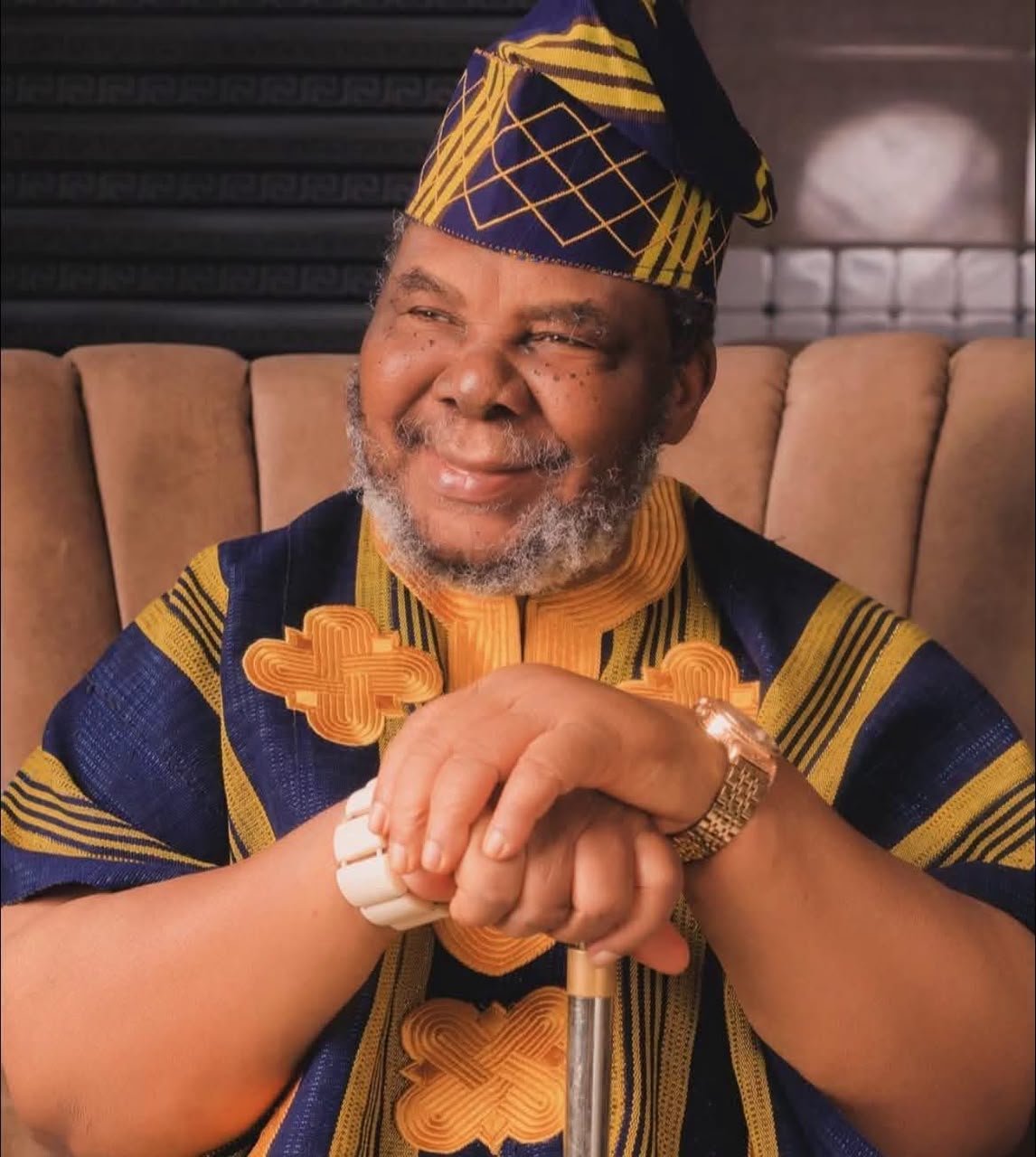
Veteran Nigerian actor and broadcaster, Chief Pete Edochie, whose commanding performances and memorable portrayal of traditional Igbo patriarchs made him one of the most recognisable faces in Nigerian entertainment, has died at the age of 79.
Edochie reportedly died at 12:30am on Wednesday, November 25, 2026, in Enugu, following a prolonged battle with prostate cancer, bringing to an end a career that spanned several decades in broadcasting and the Nigerian film industry.
His death was announced in a statement signed by his son, Leo Pete Edochie, on behalf of the family and shared on Instagram on Wednesday.
The family described his passing as a painful loss, saying the veteran actor was a beloved husband, father, brother and kinsman. He hailed from Akamnato, Ifite Nteje, in Anambra State.
The statement read: “With profound sadness and hearts bowed in total submission to the will of Almighty God, we announce the passing of our beloved husband, father, brother and kinsman, Chief Dr Pete EDOCHIE, MON (Ononenyi), a retired broadcaster and veteran actor, who departed this life on Wednesday, 25th November 2026 at 12.30am after a protracted battle with prostate cancer in Enugu, Nigeria. He was aged 79 years.”
Born on March 7, 1947, in Zaria, Kaduna State, Edochie was of Igbo descent and maintained strong ties with his ancestral community in Anambra State. Although he spent his formative years in northern Nigeria, his cultural background would later become an important influence on his acting career, particularly in his portrayal of traditional Igbo characters.
He attended St Patrick’s and St James Primary Schools in Zaria before proceeding to St John’s College, Kaduna. He subsequently studied journalism and television at the School of Journalism and Television in England, acquiring professional training that would shape his early career in broadcasting.
Long before he became a household name in Nigerian entertainment, Edochie had established himself in broadcasting, a profession that gave him the experience and confidence that would later distinguish his performances on screen.
He joined the Eastern Nigerian Broadcasting Corporation in 1967 as a junior programmes assistant, beginning a broadcasting career that would last several years.
Through dedication and professional experience, he rose through the ranks to become Director of Programmes at the Anambra Broadcasting Service. He also served as Deputy Managing Director and occasionally acted as Managing Director of the organisation.
During his broadcasting years, he developed an appreciation for storytelling, communication and the power of the spoken word. His experience behind the microphone also helped shape the distinctive voice, measured delivery and commanding presence that would eventually become his trademarks as an actor.
One of his broadcasting assignments was presenting a classical music programme, Music from the Masters, which reflected his versatility beyond the entertainment roles for which he later became famous.
His departure from broadcasting marked the beginning of another chapter in his professional life. Having spent years in the media industry, he moved fully into acting, a decision that would eventually make him one of the most respected figures in Nigerian television and cinema.
Edochie’s defining moment came with his portrayal of Okonkwo in the 1987 Nigerian Television Authority adaptation of Chinua Achebe’s celebrated novel, Things Fall Apart.
The production, based on Achebe’s internationally acclaimed literary work, introduced him to a much wider audience and established his reputation as an actor capable of bringing complex literary characters to life.
Playing Okonkwo was a significant responsibility. The character was a respected warrior and influential man in his community, whose determination to preserve his reputation and authority ultimately contributed to his tragic downfall.
Edochie’s interpretation captured the character’s strength, pride, temper and vulnerability. He brought a commanding physical presence to the role, while his delivery reflected the cultural setting and social values that defined the story.
For many Nigerians who watched the television adaptation, his face became inseparable from the character. His performance also attracted international attention, with the British Broadcasting Corporation sending a delegation to interview him about his portrayal.
At a time when Nigerian television productions were still building their international profile, Edochie’s performance demonstrated the ability of local actors and productions to tell stories that could resonate beyond the country’s borders.
The success of Things Fall Apart became a major turning point in his career, opening doors to more acting opportunities and establishing him as one of the leading performers of his generation.
Following the success of the television adaptation, Edochie became a regular presence in Nigerian films, appearing in numerous productions as the industry expanded from television drama into the home-video era and eventually the modern Nollywood film industry.
He featured in films such as Igodo, Rituals, Egg of Life and Billionaire’s Club, among other productions.
He also appeared in Genevieve Nnaji’s 2018 film, Lionheart, playing Chief Ernest Obiagu, a wealthy and influential businessman.
Although he played different characters throughout his career, Edochie became particularly associated with roles involving traditional rulers, wealthy businessmen, community leaders and family patriarchs.
His deep voice, carefully delivered lines, imposing appearance and frequent use of African proverbs made his performances easily recognisable.
He was also known for his ability to deliver traditional expressions and philosophical statements in ways that connected with audiences, particularly viewers familiar with Igbo culture and traditions.
His signature beard, which he reportedly began grooming at the age of 23, became another defining feature of his appearance.
Over the years, his performances and memorable expressions found a new audience on social media, where clips from his films became popular memes and circulated widely among younger Nigerians.
This helped introduce his work to a generation that may not have watched some of his earliest television productions but recognised his face and voice from online videos.
His ability to remain relevant across different generations was one of the remarkable features of his career.
Edochie’s contribution to the Nigerian entertainment industry earned him several awards and recognitions, including the national honour of Member of the Order of the Niger (MON), conferred on him in 2003 by former President Olusegun Obasanjo.
He also received the Industry Merit Award from Africa Magic and a Lifetime Achievement Award from the Africa Film Academy.
In 2020, he was honoured with the African Film Legend Award at the African Film Festival.
These recognitions reflected his longstanding contribution to the growth of Nigerian television and film, as well as his influence on generations of actors who followed his path.
His career also witnessed some difficult moments. In 2005, he was among several prominent actors placed on a one-year ban by the Actors Guild of Nigeria over allegations that they charged producers excessive fees because of their celebrity status.
The controversy affected several established performers but did not bring an end to his career.
In another incident, Edochie was kidnapped on August 16, 2009, but was released unharmed the following day.
Despite these experiences, he continued to feature in films and remained a familiar face in the industry.
Away from the screen, Edochie was married to Barrister Josephine Edochie, with whom he had six children.
Two of his children, Yul and Linc Edochie, followed in his footsteps and became actors in Nollywood.
His family occasionally attracted public attention, particularly following controversies involving his son Yul, but Pete Edochie remained an established figure whose career and achievements predated the emergence of the younger generation of Nollywood stars.
In recent years, he continued to grant interviews and share his perspectives on the entertainment industry, family and developments in society.
An interview he granted Ugo Nwokolo TV was scheduled for release on Wednesday, November 25, the same day his death was announced. An excerpt from the interview had circulated on social media days earlier, attracting attention over his comments on the controversy surrounding his son’s marriage.
His death has brought an end to a career that connected different generations of Nigerian entertainment, from the era of traditional television broadcasting to the emergence and international growth of Nollywood.
For many Nigerians, Edochie was more than an actor who frequently played traditional rulers and family patriarchs. He was a performer whose voice, expressions and interpretation of African cultural values became familiar parts of the country’s entertainment landscape.
His portrayal of Okonkwo remains particularly significant because it introduced him to national and international audiences and established a screen identity that followed him throughout his career.
The family said he was survived by his wife, children, siblings and other relatives, adding that funeral arrangements would be announced in due course.
As the entertainment industry comes to terms with his death, the legacy of Pete Edochie will remain closely associated with one of the most memorable performances in Nigerian television history and a career that helped shape the identity of Nollywood.
He was 79.


