


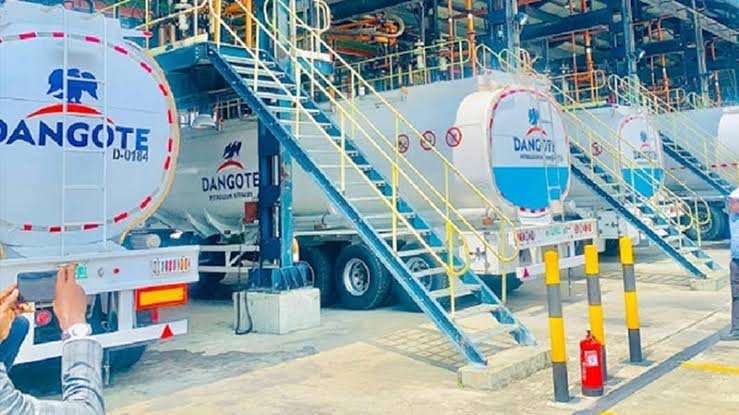
The dispute between the Dangote Petroleum Refinery and petroleum marketers over the importation, pricing and supply of Premium Motor Spirit (PMS), popularly known as petrol, has intensified, with the refinery considering restrictions on supplies to major marketers that continue to import the product.
The proposed measure could take effect as early as this week, subject to further consultations and possible intervention, as petrol prices rise sharply in parts of the country, with pump prices approaching N1,400 per litre.
Sources close to the refinery told Daily Trust that one of its major concerns was the alleged blending of imported PMS with petrol purchased from the Dangote refinery by some major marketers before the products are distributed to consumers.
The alleged practice, according to the sources, could make it difficult for consumers and other stakeholders to establish the actual source and quality of petrol sold at filling stations.
The development has further strained relations between the refinery and oil marketers, who remain divided over the role of imported petrol in Nigeria’s downstream petroleum market.
The refinery has maintained that continued importation undermines domestic refining and puts unnecessary pressure on local producers. Marketers, however, argue that imports are necessary to guarantee supply, promote competition and prevent overdependence on a single supplier.
The refinery is also said to be concerned about the adequacy of laboratory and quality-control infrastructure for independently testing and certifying imported petroleum products.
A source familiar with the refinery’s position said it was concerned about investing heavily in the production of high-quality petroleum products only for them to be mixed with imported products whose quality had not been independently verified.
“It is difficult to understand why we would invest heavily in producing high-quality petroleum products for Nigerians, only for those products to be mixed with imported products of uncertain quality and the resulting product to be associated with the refinery,” the source said.
The disagreement comes as Nigeria’s dependence on imported petroleum products remains a major policy issue following the commencement of operations at the Dangote refinery, which has a nameplate capacity of 650,000 barrels per day and has become a major supplier to the domestic market.
The refinery has consistently advocated reduced dependence on imported refined petroleum products, arguing that increased domestic refining would conserve foreign exchange and strengthen Nigeria’s energy security.
Marketers, however, maintain that imports provide a competitive alternative and help cushion the impact of supply disruptions whenever domestic refineries experience operational challenges or are unable to immediately meet market demand.
The dispute has intensified amid rising petrol prices across major cities.
In Lagos, petrol is currently selling for between N1,300 and N1,350 per litre at different filling stations, with some outlets reportedly approaching the N1,400 mark.
Checks showed that pump prices had risen from about N1,280 to between N1,310 and N1,320 per litre at several stations. MRS sold at N1,310, Sunbeth at N1,319, while Mobil and Conoil sold at N1,320 per litre. Heyden sold at N1,310.
The price increase has also triggered concerns among commercial transport operators, who say rising fuel costs are eroding their earnings and forcing them to reduce the number of trips made daily.
Kunle Fadipe, a commercial driver operating between Ikeja and Costain, said he spent N70,000 on petrol at N1,320 per litre but could only make three trips.
He said commuters were also complaining about higher transportation costs resulting from the rising price of petrol.
Another driver, Imole Oyefunso, who operates between Mile 12 and Ojuelegba, said his fuel expenditure had risen to N32,000 for five trips, compared with about N12,000 previously.
He said drivers had been reluctant to increase fares because patronage was already low.
Similarly, Sunday Chidioke, who buys petrol at N1,310 per litre at Heyden, said the increase had significantly reduced his profit margin.
In Kano, major filling stations reportedly adjusted their pump prices from N1,285 to about N1,310 per litre, while NNPC retail outlets increased prices from N1,285 to N1,305.
AA Rano reportedly raised its price to N1,355 per litre, while Aliko station increased its price to N1,350.
“This happened just hours ago because I bought it at N1,280 in the morning,” a motorist in Kano said.
In Abuja, petrol is also selling for about N1,350 per litre at some filling stations.
Meanwhile, a major petroleum marketer who spoke on condition of anonymity rejected the allegation that marketers were blending substandard imported PMS with products purchased from the Dangote refinery.
The marketer described the proposed restriction as an attempt to discourage petrol imports and give the Dangote refinery greater control over the domestic market.
“He’s just trying to block importation, that’s all. He’s just trying to block importation,” the marketer said.
According to the marketer, the fundamental disagreement is more about competition, supply and pricing than product quality.
The marketer argued that petrol consumption is sensitive to price, noting that higher pump prices naturally lead to lower demand.
The marketer further alleged that restricting alternative sources of supply could enable the refinery to sell petrol at higher prices.
“All he wants is to stop supply through imports so he can sell at a higher price, and he’s the only person selling. That’s monopoly,” the marketer said.
The marketer also disputed claims that Nigeria no longer needs imported petrol because the Dangote refinery has sufficient capacity to meet domestic demand.
He cited recent operational challenges at the refinery as evidence of the need to maintain alternative sources of supply, arguing that imports could help prevent shortages whenever domestic production is disrupted.
Another marketer said the latest development was not entirely new, claiming that the Dangote refinery had stopped coastal loading to marketers about three weeks ago.
The marketer also alleged that the refinery adjusted its gantry price three times between August 21 and August 29, 2026, resulting in a cumulative increase of N100 per litre, or about 8.6 per cent, despite movements in international crude oil benchmarks.
The latest developments have therefore deepened the debate over Nigeria’s downstream petroleum market, particularly the balance between encouraging domestic refining, maintaining competition and ensuring affordable and reliable petrol supplies for consumers. (Daily Trust)


