


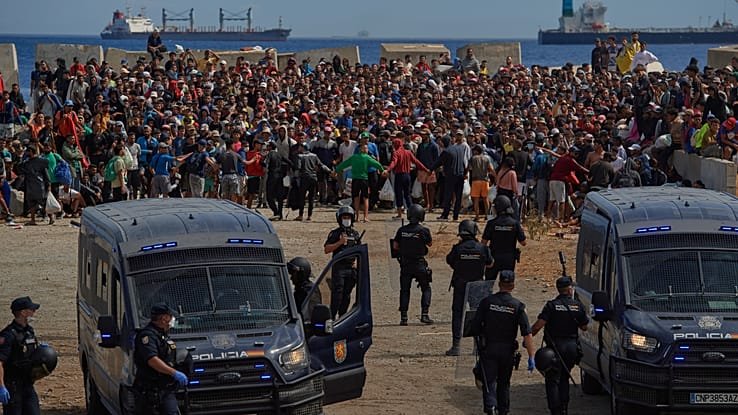
Police in Spain’s North African enclave of Ceuta clashed with anti-migrant protesters on Thursday as tensions continued to rise following a mass influx of migrants from neighbouring Morocco last month.
The confrontation occurred on a beach where migrants have been sleeping after demonstrators moved into the area. Police charged the protesters after some migrants’ belongings were set on fire, according to images broadcast by Spanish public television.
Earlier in the day, dozens of demonstrators staged a sit-in to temporarily block Red Cross vehicles from reaching the beach to deliver food and other assistance to hundreds of migrants staying there.
Waving Spanish flags, protesters chanted “They should leave” and “Out with the Red Cross” before police moved in to disperse them.
The unrest followed clashes late Wednesday, when police used tear gas to prevent confrontations between protesters and migrants camping on the beach.
Ceuta, which covers just 18 square kilometres, has witnessed repeated demonstrations by residents over what they describe as worsening security and hygiene conditions associated with the migrant influx.
Tensions intensified further early Thursday after a military vehicle carrying four soldiers was allegedly “ambushed” by about 70 migrants, according to a police spokesman.
The migrants reportedly attacked the vehicle with stones and other objects, forcing the soldiers to flee and call for police assistance. Officers subsequently detained 12 Moroccan nationals, the spokesman said.
One soldier sustained minor injuries after being hit by a stone. Authorities have not established an immediate motive for the incident.
“The tension in the city of Ceuta is very high” because there is “no response” from the government and “we feel abandoned,” Kissy Chandiramani, the autonomous city’s finance councillor, told radio station SER.
However, she urged residents to remain calm, saying people had the right to protest but warning that increasing hostility would not resolve the crisis.
The current tensions follow a chaotic influx in late July, when more than 70,000 migrants entered Ceuta by swimming or crossing on foot from Morocco. The mass arrival reportedly left scores dead and reignited debate within the European Union over migration.
Although most of those who entered returned to Morocco within hours, thousands remain in Ceuta, with many living on the streets.
Spain’s left-wing government estimates that between 3,500 and 7,000 migrants remain in the territory, while Ceuta’s conservative administration puts the figure at at least 10,000.
Justice Minister Felix Bolaños told lawmakers in Madrid that authorities were working “without rest” to restore normality and appealed for calm.
Prime Minister Pedro Sanchez’s government has faced mounting criticism from Ceuta’s authorities and residents, who accuse Madrid of responding too slowly to the mass arrival.
The government has recently expanded accommodation facilities and accelerated efforts to determine which migrants can legally be returned to Morocco.
Spain’s Interior Ministry said Thursday that additional personnel would be deployed to help identify migrants. The government has also approved an additional €25 million to support the care of unaccompanied minors, who are entitled to special legal protections.
In an effort to coordinate the response, the Cabinet approved on Tuesday the creation of a “single command” for Ceuta, to be led by Territorial Policy Minister Angel Victor Torres.
The crisis has further deepened Spain’s political divisions ahead of a general election expected next year, with conservative and far-right opposition parties demanding the return of all migrants.
The government, however, says each migrant must be assessed individually to determine whether they qualify for asylum or are eligible for deportation. Authorities also face obligations to provide special protection for thousands of unaccompanied minors.
Sanchez has also faced criticism for continuing with his summer holiday as the crisis developed and for convening the national security council to address the situation only after returning earlier this week.
“People in Ceuta have been putting up with this alone for a month,” opposition Popular Party leader Alberto Núñez Feijóo wrote on X on Thursday.
“Nothing was done to prevent the invasion … and nothing is being done to stop the public-order crisis that is worsening every day,” he added.


