



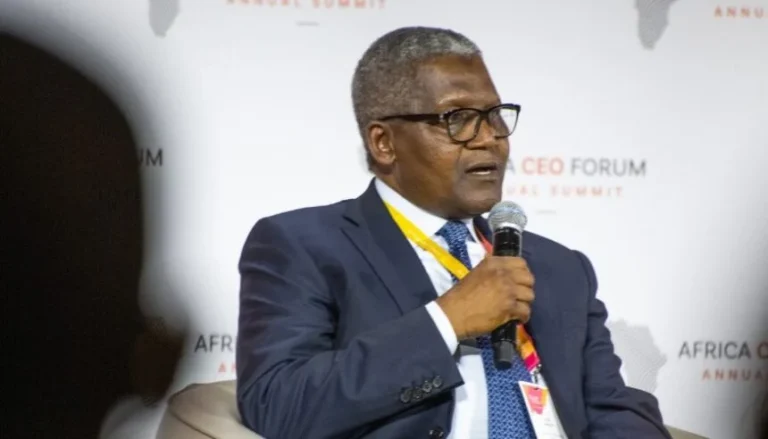
Africa’s industrialisation drive will remain constrained unless governments address chronic electricity shortages, strengthen domestic financial institutions and create policies that support local manufacturing, President and Chief Executive of Dangote Industries Limited, Aliko Dangote, has said.
Dangote said the continent’s inability to provide reliable power and affordable long-term financing was preventing businesses from processing raw materials locally, creating jobs and retaining greater economic value within their economies.
The industrialist spoke at the 2026 Financial Times Africa Summit in London during a conversation with the newspaper’s Africa Editor, David Pilling, where he outlined the structural challenges confronting African businesses seeking to compete globally.
He identified electricity supply as the most urgent infrastructure challenge, arguing that the continent’s vast mineral deposits, agricultural resources and growing population would remain underutilised without the capacity to support large-scale production.
“For Africa, what we need the most today is actually power,” Dangote said, adding that governments must prioritise strong financial institutions, agricultural policies and industrial strategies to accelerate economic transformation.
He estimated that about 650 million Africans still lacked access to electricity, describing the situation as a major obstacle to industrial development.
According to him, inadequate power supply discourages investment in processing facilities, particularly in the mining sector, where companies often find it difficult to establish factories near extraction sites. The result, he said, is that African countries continue to export raw materials instead of developing industries that could generate more revenue and employment.
Dangote also highlighted the difficulties of securing financing for major industrial projects in Africa, citing the development of the Dangote Petroleum Refinery in Lagos as an example of the risks businesses face when conventional project financing is unavailable.
He disclosed that the Group had to finance the refinery largely from its own balance sheet because securing conventional project finance for an investment of that scale was extremely difficult.
The project was further complicated by currency depreciation, with the naira moving from about ₦136 to the dollar to as high as ₦1,800 during its development. Dangote said approximately 90 per cent of the Group’s revenue was denominated in naira, exposing the business to significant foreign exchange risks as construction and infrastructure costs mounted.
He warned that prolonged financing negotiations could delay projects, increase costs and undermine their commercial viability, stressing the need for African financial institutions capable of supporting long-term industrial investments.
Against this backdrop, Dangote said the Group had outlined a $50 billion investment programme for 2026 to 2030, aimed at expanding its operations and demonstrating the potential of African businesses to execute major industrial projects.
“The legacy we are trying to set up is how do we industrialise our continent?” he said.
He explained that the investment ambition extended beyond the growth of the Dangote Group, expressing the hope that its projects would encourage other African entrepreneurs and investors to commit more resources to manufacturing, infrastructure and other productive sectors.
Dangote also called for policies that would enable local manufacturers to compete with established international producers, warning that cheap imports could undermine domestic industries before they developed the capacity to compete effectively.
He, however, distinguished support for African manufacturing from restrictions on trade among African countries, advocating stronger regional economic cooperation under the African Continental Free Trade Area.
According to him, African countries should expand trade among themselves while developing a common framework to protect domestic industries against unfair external competition.
The industrialist questioned why a continent endowed with extensive agricultural land, mineral resources and a youthful population continued to experience widespread poverty.
“Why should we remain poor?” he asked, arguing that Africa’s development challenges stemmed largely from insufficient investment in productive capacity rather than a lack of natural resources.
Dangote expressed optimism that the continent could achieve greater economic independence if governments, businesses and investors worked together to address infrastructure deficits, improve access to capital and establish policies that promote local production.
He maintained that industrialisation would be critical to creating employment, diversifying African economies and ensuring that a greater share of the value generated from the continent’s resources remained within its borders.


