


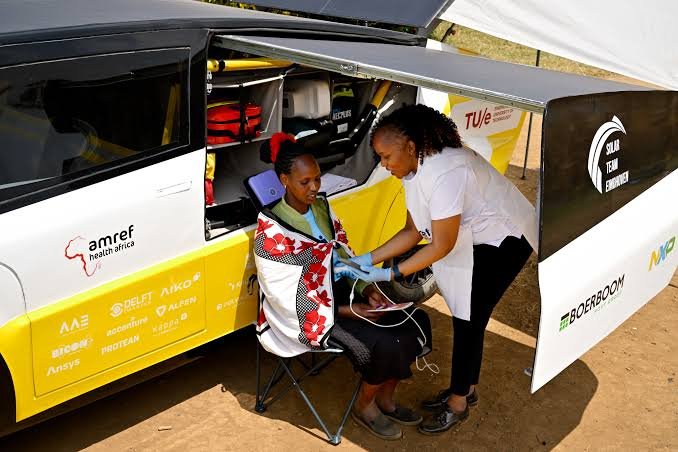
A solar-powered ambulance developed by Dutch students has successfully completed a trial run in Kenya, with its creators hoping the innovation will improve access to healthcare in remote communities.
The futuristic yellow, black and white vehicle, named Stella Juva, is fitted with solar panels on its roof that generate power for the vehicle.
Unlike conventional ambulances designed primarily to transport patients to hospitals, Stella Juva is intended to take healthcare services directly to patients, particularly in areas where medical facilities are scarce and maternal healthcare remains a major challenge.
The vehicle is equipped with tuberculosis testing kits, refrigerated storage for vaccines, X-ray equipment and an ultrasound scanner, allowing health workers to provide essential services in remote locations.
“This vehicle will be a game changer,” said Geoffrey Sadera of Amref Health Africa, which partnered with the students on the project. The organisation focuses on improving maternal and child health.
The two-seater ambulance is built to handle off-road conditions and can reach a top speed of 120 kilometres per hour. On a sunny day, it can travel approximately 715 kilometres on a full charge.
Its solar-powered battery is also designed to keep both the vehicle and its medical equipment running at night and during cloudy weather.
Isabella Wanningen, one of the students involved in the project, described the Kenyan trial as a major success.
“We’ve driven more than 800 kilometres and tested her capabilities both in whether she is able to go off-road and how she can actually deliver healthcare,” she told AFP.
The project took about a year to complete, with several members of the student team putting their studies on hold to concentrate on developing the vehicle.
Wanningen said the team hoped the project would encourage the wider healthcare and automotive industries to embrace sustainable technology in addressing real-world challenges.
“We hope to inspire the industry, healthcare organisations and innovators to use sustainable technology to solve real-world problems,” she said.
“If we can do this with 23 students in one year, that really shows how much is possible,” she added.


