



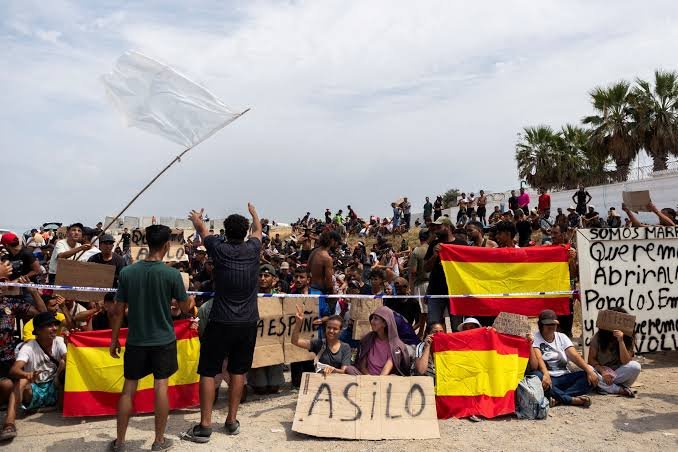
Hundreds of unaccompanied migrant children and teenagers remain homeless in Spain’s North African enclave of Ceuta, two months after thousands of migrants crossed into the territory, raising concerns over the government’s response to the growing humanitarian crisis.
As winter approaches, hundreds of young migrants gathered outside a church in early October, hoping authorities would allow them to travel to mainland Europe or provide accommodation away from beaches and streets.
Among them was a 17-year-old aspiring model from northern Morocco, who said his experience had been far more difficult than he anticipated.
“I was expecting like a really easy experience, but it’s so hard. Like I was expecting two weeks, three weeks of that, but it’s been two months and we’re still living in the streets,” he said.
Members of a neighbourhood association later escorted the children down a steep hill to a football field, where police were waiting to prevent them from overwhelming a visiting minister.
Within hours, many of the teenagers had returned to the makeshift camps and hillsides where they had been sleeping, underscoring the difficulties they continue to face.
The incident highlighted the Spanish government’s slow and often improvised response to the migration crisis in Ceuta, where thousands of minors arrived without parents or guardians.
An estimated 2,000 young people have been affected, with many sleeping on cardboard, torn sofas and other makeshift bedding in overcrowded tent camps or on the streets.
Although experts acknowledge that authorities have struggled to process the large number of arrivals, some have raised concerns that the slow response could discourage migrants and prompt them to return home.
Under Spanish law, unaccompanied minors who arrive in the country are entitled to protection through the child-welfare system, including accommodation, healthcare and education.
However, the conditions confronting many of the young migrants have raised questions about the implementation of those safeguards.
Estrella Galán, a Member of the European Parliament representing The Left, recently visited Ceuta and described the humanitarian situation as grim and deteriorating.
“Children who should be under protection and guardianship are experiencing situations of serious helplessness,” she said.
Makeshift camps housing both adults and children have spread across beaches, abandoned warehouses and hillsides, with reports of unsanitary conditions and violence.
Around 3,000 people were living in one beachside camp where the air was reportedly filled with the smell of human waste.
Some underage migrants appeared to be under the influence of drugs, while children as young as 13 were sleeping and showering alongside adult men, among whom frequent fights were reported.
Other minors have sought refuge in the steep, narrow streets of Ceuta’s predominantly Muslim neighbourhoods, attempting to find places to sleep away from the overcrowded camps.
Spanish prosecutors are investigating allegations of torture and mistreatment of migrants, adding to concerns about the safety and welfare of those stranded in the enclave.
With colder weather approaching, the continuing homelessness of unaccompanied minors has intensified scrutiny of Spain’s handling of the crisis and the extent to which vulnerable children are receiving the protection required under the country’s laws.


