



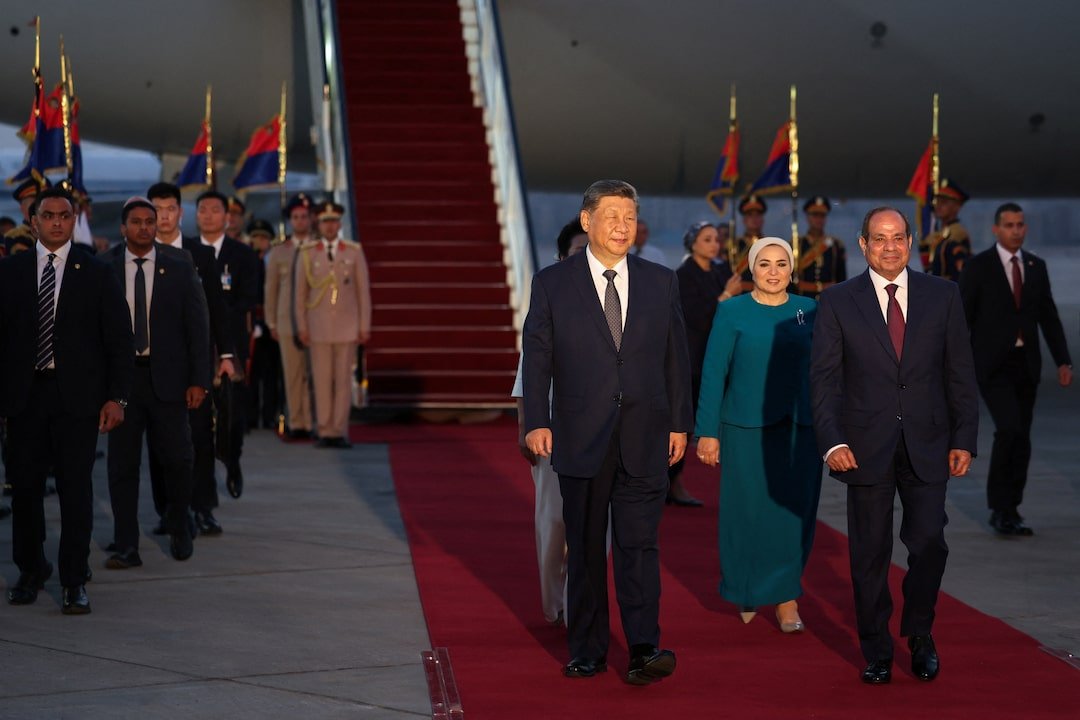
Chinese President Xi Jinping has arrived in Egypt for a two-day state visit focused on strengthening bilateral relations, with energy, artificial intelligence, transport and investment expected to dominate talks with President Abdel Fattah al-Sisi.
Xi and his wife were received at the airport in Cairo on Tuesday by Sisi and Egypt’s first lady, alongside a performance by an Egyptian folk dance troupe.
The visit comes as China and Egypt navigate growing economic and geopolitical pressures arising from the escalating Middle East conflict and the threat of expanded US sanctions against countries and financial institutions maintaining ties with Iran.
Washington last month warned that it could impose additional measures against Tehran’s partners and supporters, potentially affecting financial institutions in countries including China and Egypt.
China, a major purchaser of Iranian oil, has maintained a neutral position in the conflict while repeatedly calling for an enduring ceasefire and a diplomatic resolution.
Xi’s visit comes as Beijing seeks to protect its economic interests in the region while expanding its diplomatic influence.
“Xi’s visit comes at a time when China’s economic interests are directly exposed to the US-Iran war,” said Gamal Salama, a political science professor at Egypt’s Suez University.
Egypt, meanwhile, has long maintained close relations with the United States, including through substantial US military assistance, while also playing a major diplomatic role in the Middle East.
Cairo has called for restraint amid the regional crisis, particularly after a drone attack struck one of its ports in July.
According to Liu Jia, a research fellow at the Middle East Institute in Singapore, Beijing is seeking greater cooperation with Cairo in managing regional affairs.
China has cultivated close relations with several key Middle Eastern countries, while Egypt remains an important mediator between Israel and Palestinian groups.
Both Beijing and Cairo support the establishment of an independent Palestinian state based on a two-state solution.
“China sees Cairo as a strategic power broker,” Salama said, adding that Egypt’s relationships with Washington and other regional actors provide Beijing with “political access and diplomatic leverage” as it seeks a larger role in the Middle East.
Xi and Sisi are expected to discuss the Gaza conflict, Iran and security concerns surrounding shipping through the Red Sea and the Strait of Hormuz, according to Egyptian media reports.
In an editorial published by Egyptian media on Tuesday, Xi said he looked forward to renewing the friendship between the two countries and working with Sisi to develop a new blueprint for deepening their comprehensive strategic partnership.
The visit is Xi’s first trip to Egypt in a decade and coincides with the 70th anniversary of diplomatic relations between China and Egypt.
Economic ties are expected to feature prominently during the discussions. China is one of Egypt’s largest trading partners and a major exporter to the North African country.
Chinese customs data showed that China recorded a trade surplus of about $12 billion with Egypt during the first seven months of 2026.
The two countries are also expected to sign agreements covering artificial intelligence, transport, energy and investment in the Suez Canal Economic Zone.
Salama said the talks could pave the way for increased Chinese investment in Egypt’s emerging artificial intelligence and electronics sectors, as Cairo seeks to attract technology investment and diversify its economy.
The visit therefore represents an effort by both countries to deepen economic cooperation while strengthening their strategic coordination at a time of heightened geopolitical uncertainty across the Middle East.


