



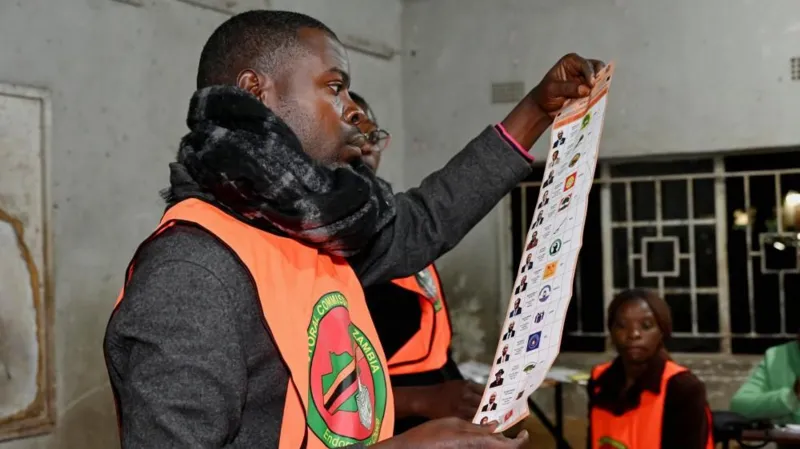
International election observers have raised concerns over Zambia’s presidential election, citing reports of intimidation, abductions, violence and an hours-long suspension of vote counting.
The observers issued the warning on Saturday as electoral authorities continued tallying votes cast in Thursday’s election, with some monitoring teams extending their missions amid heightened tensions.
President Hakainde Hichilema, 64, is seeking a second term against his main challenger, Brian Mundubile, 55, a former minister in the previous Patriotic Front government.
The Electoral Commission of Zambia suspended the counting process for about six hours on Friday following reports of violence against polling officials and the alleged theft of ballot papers. Counting resumed after the commission said the security threat had been contained.
The Southern African Development Community (SADC) observer mission, led by former Malawian Justice Minister Samuel Tembenu, said the suspension created “uncertainty and anxiety” among voters and political stakeholders.
Tembenu said the mission had received, but could not independently verify, reports of intimidation, assault, abduction and property damage across five provinces.
Some of the reports involved physical injuries and, in one case, alleged fatalities, he said.
Police confirmed that nine suspects had been arrested following the killing of a 57-year-old polling agent in a township outside Lusaka on election day, although authorities maintained that the election was generally peaceful.
“Even one loss of life is one too many,” said Reinhold Lopatka, head of the European Parliament’s election observation delegation.
Lopatka described the suspension of vote counting as seemingly “disproportionate”, noting that only a small number of the more than 13,000 polling stations had reportedly been affected.
He said European observers had received reports that opposition parties faced intimidation, including alleged pressure from security forces, while some candidates were reportedly forced to withdraw and opposition rallies were disrupted by violence.
The electoral commission began releasing constituency-level results late Friday and has pledged to announce the final result by Monday.
Former Botswana President Mokgweetsi Masisi, who led the International Conference on the Great Lakes Region observer mission, warned that the interruption in counting could undermine public confidence in the electoral process.
He urged the main political parties to de-escalate tensions, refrain from announcing unofficial results, avoid inflammatory statements and continue respecting the rule of law.
The European Union also raised concerns about the broader political environment in which the election was conducted.
EU chief observer Michael McNamara said the poll took place against a backdrop of a “constrained democratic space”, with the advantages of incumbency and the blurring of boundaries between the state and the ruling party contributing to an uneven playing field.
The EU mission also found that state-owned media coverage was heavily biased in favour of the ruling party, McNamara said.
He added that EU observers had engaged with opposition parties, government officials and the chief justice to stress that any disputes arising from the election should be resolved peacefully.
McNamara called for detailed results from individual polling stations to be made publicly available, saying greater transparency would help strengthen voters’ confidence in the process.
About 8.7 million people were registered to vote in Zambia, a copper-rich country of roughly 22 million people that has a longstanding record of peaceful transfers of power.
The election is widely seen as a referendum on Hichilema’s first five years in office. His administration has overseen a return to economic growth, although critics argue that the improvement has yet to translate into better living conditions for many households.
The government has also faced criticism over what opponents describe as a shrinking space for dissent.
World Bank data shows that more than 70 per cent of Zambia’s population lives on less than $3 a day, underscoring the economic pressures facing the next government.


