



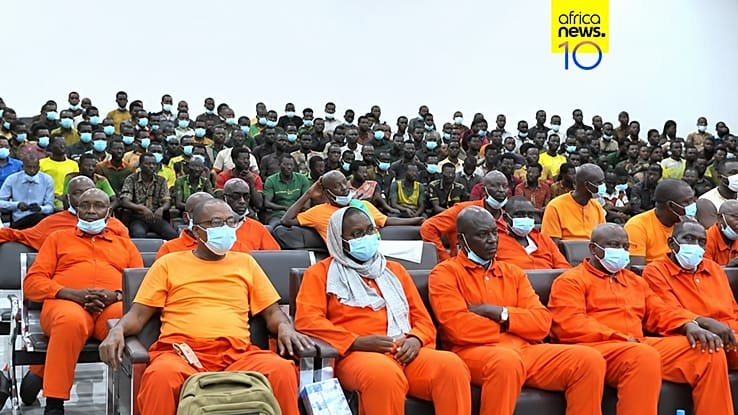
Guinea has launched a major legal crackdown on illegal gold mining, with more than 1,200 people arrested in the country’s northeastern gold-producing region facing prosecution as authorities intensify efforts to stop unauthorised mining and address the environmental damage associated with the practice.
The trial opened in Conakry on Wednesday, November 11, following the arrest of 1,263 people in the Siguiri region, where clandestine gold mining has attracted thousands of workers, including migrants from neighbouring West African countries.
The arrests followed a government ban on illegal artisanal gold mining, which took effect on November 2, as part of measures to restore order in the mining sector, protect the environment and prevent further destruction of agricultural land and waterways.
The operation has also brought some local government officials under investigation, with several administrators accused of promoting or facilitating illegal mining activities. Their alleged involvement has widened the scope of the prosecution beyond the miners themselves, raising questions about official oversight, accountability and the role of local authorities in the expansion of unauthorised mining.
The defendants include Guinean nationals and citizens of other West African countries, reflecting the cross-border nature of the informal gold mining industry.
The proceedings have generated controversy, particularly over the responsibility of local officials and whether the miners arrested should bear the full weight of the government’s crackdown.
Sidiki Berete, who is representing some of the officials, has challenged the allegations against his clients, arguing that they should not be held responsible for activities that allegedly predated their appointments.
“We cannot go after our authorities, who were appointed barely four months ago and inherited this situation. Criminal liability is personal,” he said.
He also disputed claims of corruption, maintaining that the arrested miners had denied knowing the officials or receiving authorisation from them to operate.
“As for corruption, the individuals arrested have publicly stated in court that they do not even know these officials, that there was no contact, and that they did not have their authorization. No money was involved. Therefore, there is no connection,” Berete said.
The defence position has placed the question of individual responsibility at the centre of the proceedings, particularly as the authorities seek to establish whether local administrators actively facilitated illegal mining or failed to enforce existing regulations.
The miners’ defence has also questioned the decision to prosecute those arrested, arguing that the individuals working at the mining sites should not be treated as the principal beneficiaries of illegal mining operations.
Abou Camara, a lawyer representing some of the miners, said the authorities should investigate those who organise, finance and profit from the activities rather than making the workers scapegoats.
“The real culprits are elsewhere, not my clients. We must not use my clients as scapegoats. They are not the ones [responsible]. They are far from being connected to these acts of illicit enrichment,” he said.
The defence has also drawn attention to the presence of minors among those arrested, raising concerns about the treatment of young people caught up in the mining operations.
Local media reports indicated that the proceedings involved separate judicial processes for different categories of suspects. In one of the cases before Guinea’s Court for the Repression of Economic and Financial Offences (CRIEF), 202 defendants were arraigned alongside 22 territorial administrators.
The 202 miners were accused of illegal exploitation of mineral resources, environmental degradation, destruction of property and water pollution. The prosecution is relying on provisions of Guinea’s Penal Code, Mining Code and Environmental Code, as well as legislation dealing with corruption and related offences.
The question of the miners’ ages also emerged during the proceedings, with the defence identifying 12 people it said were minors. Prosecutors disputed the claim, maintaining that all the defendants were adults.
The court subsequently ordered the consolidation of the proceedings involving the miners and territorial administrators to allow related allegations to be considered together.
However, the prosecution of the 1,263 people arrested in Siguiri is not limited to a single courtroom or one case. Their files have been distributed among different competent courts, while separate proceedings are expected to address other categories of suspects, including minors.
The authorities subsequently announced another 149 arrests in Kérouané and Siguiri, bringing the cumulative number of people apprehended in the wider operation to 1,412 as of November 9.
The scale of the arrests underscores the government’s determination to dismantle illegal mining networks, although the proceedings are also testing the capacity of the country’s judicial system to handle such a large number of defendants.
West African migrants caught in crackdown
Guinea’s crackdown has also developed into a regional issue because of the number of foreign nationals who had travelled to the country in search of employment in its gold mines.
The country’s clandestine mining sites had attracted workers from Burkina Faso, Mali, Togo, Niger, Ivory Coast and Ghana, among other West African countries.
For many of these migrants, artisanal mining provided an opportunity to earn a living in a region where gold extraction has become an important source of economic activity.
However, the enforcement of the November 2 ban has forced thousands of foreign workers to leave Guinea, with tens of thousands reportedly deported or returning to their countries following the closure of the illegal mining sites.
The development has raised concerns in neighbouring countries, particularly over the humanitarian consequences for migrants who may have lost their sources of income and faced difficulties returning home.
Mali has warned of a potential humanitarian catastrophe arising from the treatment and displacement of its citizens, while Burkina Faso has complained that some of its nationals were subjected to inhumane treatment during the enforcement operations.
The complaints have added a diplomatic dimension to what began as an environmental and mining regulation exercise.
The situation also highlights the difficulties confronting West African countries in managing informal migration and cross-border economic activities. Gold mining areas often attract workers from neighbouring countries because of employment opportunities, but weak regulation and the informal nature of the trade make it difficult to monitor the movement of labour and the activities taking place at mining sites.
Guinea’s operation therefore raises broader questions about how governments can enforce mining laws without creating additional humanitarian difficulties for migrant workers.
Environmental concerns behind the ban
Guinea’s decision to intensify the crackdown is closely linked to the environmental consequences of unregulated artisanal gold mining, particularly in Siguiri, one of the country’s major gold-producing areas.
The country possesses substantial mineral resources, including gold and bauxite, which are important contributors to its economy. However, the expansion of informal mining has created significant challenges for environmental protection and the sustainable management of natural resources.
Authorities have identified land degradation, destruction of vegetation, damage to agricultural areas and pollution of waterways among the consequences of uncontrolled mining activities.
In some locations, miners have reportedly used heavy machinery to excavate large areas of land, disturbing the soil and leaving behind extensive pits that can become dangerous to nearby communities.
The use of inappropriate mining methods and the disposal of mining waste have also raised concerns about water quality, particularly in communities that depend on rivers and other natural water sources for domestic and agricultural purposes.
Research published in 2026 in the journal Environmental and Sustainability Indicators examined the impact of gold mining in Kintinian, within the Siguiri prefecture. The study, which used satellite imagery and geographical information analysis, identified significant declines in vegetation and agricultural land associated with mining activities over the period examined.
Another study published in February 2026 in Environmental Health Insights examined water quality in mining communities in Siguiri and reported elevated concentrations of certain heavy metals, with potential public health implications.
The environmental concerns have prompted the Guinean government to consider broader reforms of the artisanal mining sector rather than relying solely on enforcement operations.
In February 2026, Prime Minister Amadou Oury Bah visited Siguiri to assess the environmental situation and the challenges associated with artisanal gold mining.
Following the visit, the government indicated that it would pursue measures to improve the organisation and modernisation of artisanal mining, with a focus on environmental protection and more responsible exploitation of mineral resources.
The November crackdown represents a more forceful phase of that intervention, as the authorities seek to stop illegal operations and bring those allegedly responsible before the courts.
However, the challenge for Guinea will be ensuring that the campaign produces lasting improvements rather than simply displacing miners from one location to another.
Artisanal mining provides livelihoods for many people, including workers who depend on the sector because of limited employment opportunities elsewhere. A sustainable response will therefore require effective regulation, improved monitoring, environmental rehabilitation and the creation of legal avenues through which small-scale miners can operate.
The prosecution of more than 1,200 suspects could become a significant test of Guinea’s commitment to enforcing its mining and environmental laws. But the outcome will also depend on whether authorities can distinguish between the workers involved in illegal extraction and the individuals or networks that organise, finance and benefit from the trade.
For a country seeking to protect its mineral wealth while attracting investment into the formal mining sector, the case goes beyond the punishment of those arrested. It touches on the wider question of how Guinea can exploit its natural resources without sacrificing the environment and the livelihoods of communities dependent on them.


