



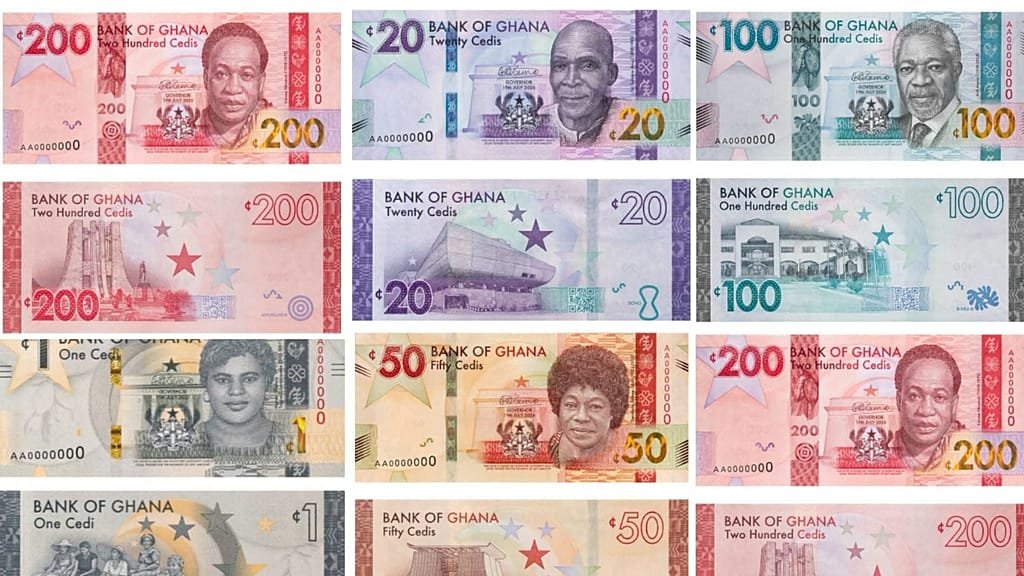
Ghana has redesigned its national currency, introducing a new series of banknotes that combines stronger security features with tributes to individuals whose contributions helped shape the country’s political, educational, religious and cultural history.
The Bank of Ghana unveiled the redesigned banknotes, known as the Ghana Cedi Heritage Series, on Thursday, November 12, 2026, as part of efforts to modernise currency management, make the notes more durable and strengthen protection against counterfeiting.
The new banknotes, which will enter circulation on December 1, 2026, retain the existing denominations but feature new portraits, historical landmarks and traditional Adinkra symbols reflecting Ghana’s national identity.
The redesign comes more than two decades after the introduction of the core designs of the existing banknotes, with the central bank arguing that changing technology, evolving currency circulation patterns and the need for more sophisticated security measures have made an upgrade necessary.
However, the introduction of the Heritage Series does not mean that the existing banknotes will immediately become invalid. The old and new currencies will circulate alongside each other, with the current notes retaining their legal tender status.
The Bank of Ghana said the gradual transition was intended to prevent unnecessary disruption to economic activities and give individuals, businesses and financial institutions sufficient time to familiarise themselves with the redesigned currency.
The eight denominations, ranging from GH₵1 to GH₵200, retain their existing monetary values. However, the new designs depart significantly from the familiar portraits and images on the current currency, giving greater prominence to individual personalities and their contributions to Ghana’s development.
The GH₵1 note honours Agnes Oforiwa Tagoe-Quarcoopome, a pioneering market trader and market queen associated with Makola Market in Accra. She is recognised as the first Makola market woman to open a bank account with the then Standard Bank of West Africa, now Standard Chartered Bank. The note also features Makola Market, highlighting the contribution of women traders to Ghana’s commercial activities.
The GH₵2 denomination celebrates religious heritage and peaceful coexistence, featuring Cardinal Peter Porekuu Dery, a prominent Ghanaian Catholic leader, alongside the historic Larabanga Mosque in northern Ghana. The combination of the two religious landmarks and personalities reflects the country’s religious diversity and the importance of tolerance among different faiths.
Education takes centre stage on the GH₵5 note, which features James Emmanuel Kwegyir-Aggrey, an influential educationist and Pan-Africanist whose work promoted access to education. The reverse side depicts Achimota School, one of Ghana’s prominent educational institutions.
The GH₵10 note honours Justice Annie Ruth Jiagge, Ghana’s first female judge and the first woman in the Commonwealth to become a judge. Her inclusion recognises the contribution of women to the country’s legal system and the broader struggle for equality. The Supreme Court building appears on the reverse side, reinforcing the theme of justice and the rule of law.
Ghana’s artistic and cultural heritage is represented on the GH₵20 note, featuring composer and music scholar Dr Ephraim Amu, known for his contribution to Ghanaian music and cultural expression. The National Theatre features on the reverse side, highlighting the importance of the arts in preserving and promoting national identity.
The GH₵50 denomination pays tribute to Theodosia Salome Okoh, the designer of Ghana’s national flag, whose work remains closely associated with the country’s independence and sovereignty. The note also features Jubilee House, the seat of Ghana’s presidency.
On the GH₵100 note, the central bank honours former United Nations Secretary-General Kofi Annan, one of Ghana’s most internationally recognised figures. The reverse side features the Kofi Annan International Peacekeeping Training Centre, reflecting his contribution to international diplomacy, peacekeeping and conflict resolution.
The highest denomination, the GH₵200 note, features Ghana’s first President, Kwame Nkrumah, whose leadership was central to the country’s independence from British colonial rule in 1957. His mausoleum in Accra also appears on the note, reinforcing the themes of national independence, sovereignty and leadership.
Traditional Adinkra symbols have also been incorporated across the series, with different symbols representing values such as knowledge, justice, freedom, peace and leadership.
The decision to feature individual historical figures marks a notable departure from the existing banknotes, which prominently display the collective portraits of the Big Six, the group of Ghanaian nationalists who became central figures in the country’s independence struggle.
The Big Six rose to prominence following their arrest by British colonial authorities in 1948 after disturbances in Accra. Their collective appearance on Ghana’s currency has for years served as a reminder of the country’s nationalist movement and its journey towards independence.
Under the Heritage Series, however, the central bank has adopted a broader approach to national recognition, extending the representation of Ghana’s history beyond the independence movement to include contributions in education, religion, culture, justice and international diplomacy. Nkrumah retains a prominent place, but now appears individually on the highest denomination rather than as part of the collective portrait.
Why the Bank of Ghana is changing the notes
Beyond the historical and cultural significance of the redesign, the central bank says the exercise is driven by practical concerns about currency security, durability and the cost of managing physical cash.
Bank of Ghana Governor Johnson Pandit Asiama said the new banknotes incorporate enhanced security features intended to make counterfeiting more difficult and enable members of the public to identify genuine currency more easily.
He explained that the improvements were necessary as technology advances and counterfeiters become increasingly sophisticated.
The notes have also been designed to withstand Ghana’s climatic conditions and the frequent handling associated with everyday transactions. According to the central bank, improved durability should extend their lifespan in circulation and reduce the frequency and cost of replacing damaged banknotes.
Another consideration is convenience. The redesigned notes are smaller and more portable than their existing counterparts, making them easier to carry and handle.
Dominic Owusu, the Bank of Ghana’s Director of Currency Management, had previously drawn attention to the size of the existing GH₵200 note, explaining that its dimensions made it difficult for some people to fit into their wallets.
The redesigned version addresses this concern as part of the central bank’s effort to make physical currency more practical for everyday use.
The initiative also comes at a time when digital payments are becoming increasingly important in Ghana’s financial system. However, the central bank maintains that physical cash remains necessary, particularly when electronic payment networks experience technical failures, cyber incidents or other disruptions.
Asiama said cash provides a dependable means of exchange when electronic systems are unavailable, allowing households and businesses to continue transactions without relying entirely on digital infrastructure.
He said the country’s currency management strategy would therefore seek to accommodate digital innovation while ensuring that physical money remained accessible, reliable and secure.
The central bank is also introducing operational improvements to support the management of the new notes. These include an internally developed Enterprise Currency Operations Management Software, designed to connect the Bank of Ghana with commercial banks and improve coordination in currency operations.
It also plans to establish additional cash centres at its regional offices in Ho and Tamale to bring currency services closer to the public.
Another feature of the rollout is the introduction of a Cedi App, which will help Ghanaians familiarise themselves with the new banknotes and their security features. The application is also intended to assist people with visual impairments in identifying the different denominations.
No need to exchange existing notes
President John Dramani Mahama, who attended the launch, urged Ghanaians to treat the new currency with pride, describing it as an important symbol of national identity and economic sovereignty.
“Carry the cedi note with pride and uphold the confidence on which it rests to continue to serve Ghana securely and well for generations to come,” he said.
The Bank of Ghana has also moved to prevent confusion over the transition, assuring the public that existing banknotes will remain legal tender when the Heritage Series enters circulation on December 1.
There will be no immediate withdrawal or invalidation of the old notes, and members of the public do not need to rush to commercial banks to exchange their money or withdraw cash simply to obtain the redesigned currency.
The two series will circulate concurrently, allowing individuals, businesses and financial institutions to adjust gradually.
The central bank plans to embark on a nationwide public education campaign across all regions and in major local languages to familiarise Ghanaians with the new designs and security features. The exercise is expected to help people distinguish genuine banknotes from counterfeits and understand how to handle the new currency.
It has also appealed to the public to stop practices that damage banknotes, including writing on them, crumpling, stapling and using them for decorative money bouquets, spraying and other forms of currency abuse.
According to the bank, proper handling will help preserve the quality of the notes, extend their lifespan and reduce the financial burden associated with replacing damaged currency.
The central bank is also working with stakeholders on a new Currency Act to replace the existing Currency Act of 1964, which it considers outdated. The proposed legislation is expected to modernise the legal framework for managing the cedi, strengthen provisions against counterfeiting and establish clearer procedures for identifying and dealing with counterfeit notes.
For Ghana, the Heritage Series represents more than a change in the appearance of its money. It combines the need to protect the national currency against modern security threats with an effort to give greater visibility to the people, institutions and values that have shaped the country’s history.
The success of the exercise, however, will depend not only on the security technology built into the new banknotes but also on public confidence, effective distribution and the ability of the central bank to ensure that the redesigned currency serves the needs of businesses and ordinary Ghanaians.


