


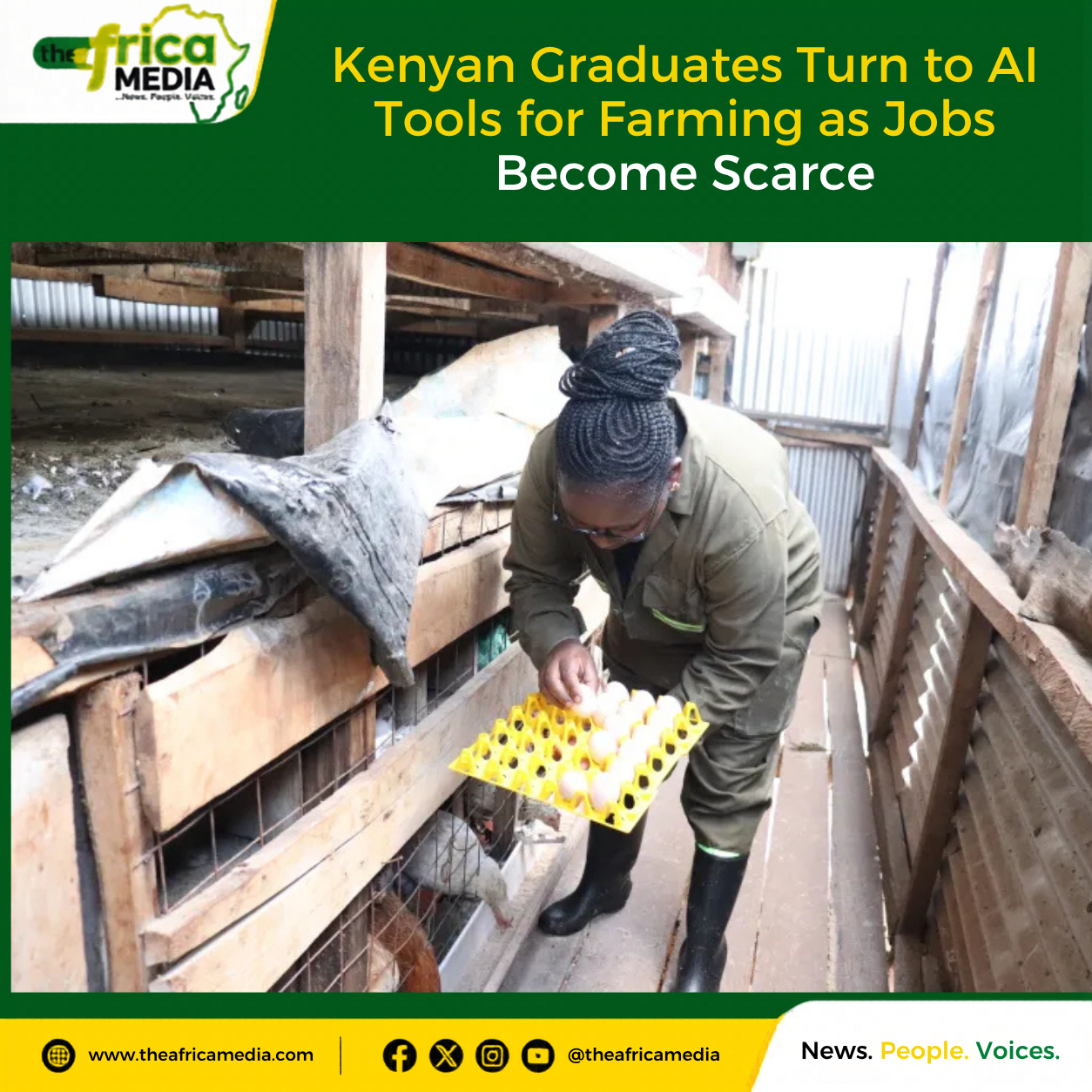
Young Kenyan graduates are increasingly turning to agriculture powered by artificial intelligence and mobile applications as formal employment opportunities continue to shrink across the country.
In Kericho County in western Kenya, 33-year-old farmer Chepkorir Rotich represents a growing number of educated youths combining traditional farming with digital tools to earn a living after struggling to secure white-collar jobs.
From job search to farming livelihood
Rotich, a mother of two and a college graduate, said her expectations of securing formal employment after school did not materialise, despite years of searching and taking low-paying contract work.
She said she previously earned as little as $200 a month in Nairobi, which she described as insufficient for urban living costs, forcing her to reconsider her career path.
Today, her daily routine involves livestock farming, vegetable production, and direct sales to customers, activities she manages with the help of social media platforms and digital marketing tools.
Social media and digital platforms reshaping agriculture
Rotich uses social media to market her produce and educate other young people about modern farming techniques. She also runs a YouTube channel where she shares agricultural practices, building an audience of tens of thousands.
She argues that agriculture is often undervalued by young people due to limited access to land and outdated perceptions of farming, noting that many begin small-scale farming even in rented spaces before expanding.
Experts say this shift reflects a broader trend of youth-led innovation in agriculture, driven by necessity and access to digital tools.
Experts highlight role of technology in farming
Agricultural economists and researchers say young people are particularly well-positioned to integrate technology into farming systems.
A lecturer at the University of Nairobi noted that new initiatives, including agroecology and AI-based learning centres, are being developed to connect youth with agricultural data systems and improve productivity through technology-driven insights.
At the same time, organisations working in agricultural innovation say content creation around farming has become a new income stream, allowing young people to monetise knowledge sharing and modern farming education online.
AI tools transforming farm management
In nearby Kaptoroi village, 32-year-old Geoffrey Kiprop, an information technology graduate, has also turned to farming after failing to secure formal employment.
He now earns a living through mixed farming, including dairy production and crop cultivation, while supplementing his income with contract-based IT work.
Kiprop uses several digital tools to manage his farm. Applications such as Plantix help him detect crop diseases using image recognition, while also providing weather forecasts and farming recommendations.
He also uses AI-based systems like Virtual Agronomist to analyse soil conditions, estimate farm size using mapping tools, and generate nutrient recommendations for crops.
For livestock management, he relies on digital farm management applications that track milk production, feed usage, and animal health records to help assess profitability.
Farming as a technology-driven alternative
Despite the opportunities provided by digital agriculture, both farmers and experts acknowledge significant challenges, including access to land, capital, and market stability.
However, they agree that consistency, adaptation, and willingness to learn are key factors in making agriculture sustainable for young people entering the sector.
As unemployment persists, more graduates across Kenya are expected to explore farming not only as a fallback option but as a technology-driven business model reshaping rural livelihoods.


