



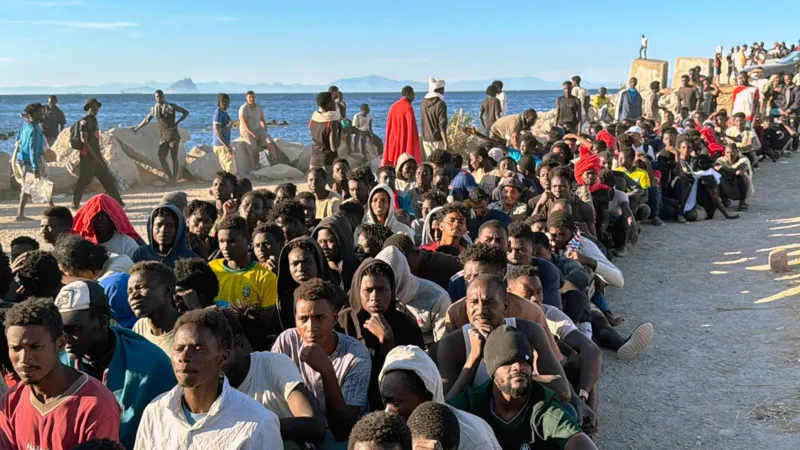
Spain’s Interior Minister, Fernando Grande-Marlaska, has announced that around 70,000 of the 72,000 migrants who entered the Spanish enclave of Ceuta since last Thursday have already returned to Morocco following an unprecedented migration surge.Speaking after an extraordinary virtual meeting of European Union interior ministers, Grande-Marlaska said Spanish authorities had responded swiftly to the crisis, adding that European partners had expressed strong support for Spain’s handling of the situation.
The emergency meeting, convened at the request of Spanish Prime Minister Pedro Sánchez and backed by 22 EU member states, ended with participating countries reaffirming their solidarity with Spain and agreeing to strengthen the bloc’s early-warning and crisis response mechanisms for future migration emergencies.
According to the minister, the meeting recognised the effectiveness of Spain’s immediate response, although he acknowledged that several member states had previously raised concerns about risk management along Europe’s southern borders.Grande-Marlaska also revealed that Spain’s National Intelligence Centre (CNI) had not warned the government about the possibility of a migration crisis on the scale experienced in recent days.
He defended the intelligence agency, saying that if authorities had received credible warnings of an event comparable to the 2021 Ceuta crisis—when about 10,000 migrants crossed into the enclave within hours—the information would have been passed to the country’s highest decision-making levels.
The minister further explained that Ceuta’s special status within the Schengen Area means that anyone seeking to leave the autonomous city for mainland Spain must undergo full document and identity checks. The recent migration surge reportedly claimed the lives of more than 80 people attempting to cross into Ceuta, making it one of the deadliest incidents along the route.
Meanwhile, the Spanish government has announced an additional €25 million in emergency funding to help Ceuta care for unaccompanied migrant children affected by the crisis. The allocation comes on top of €5.5 million approved in July for child welfare programmes.
Spain’s Minister for Inclusion, Social Security and Migration, Elma Saiz, said the funding would help ensure adequate care for vulnerable minors, while urging Spain’s autonomous regions to assist in accommodating and supporting the children.
Saiz also rejected reports suggesting the government had been warned in advance about the scale of the crisis, stating that while authorities had anticipated an increase in irregular migration during the summer months, they had received no intelligence predicting such a large influx. She nevertheless praised Morocco’s cooperation during the emergency, describing it as crucial to managing the situation and helping authorities respond effectively.
As part of the government’s response, two educational centres in Ceuta have been designated to temporarily house unaccompanied migrant minors, with special attention given to girls.Spain’s Minister for Youth and Children, Sira Rego, is expected to visit Ceuta in the coming days to assess the situation and coordinate additional support.
The government also plans to implement reforms to the country’s immigration system that would allow unaccompanied migrant children to be relocated from heavily affected territories such as Ceuta to other regions across Spain.


