



Corporate Accountability and Public Participation Africa (CAPPA) and the Africa Make Big Polluters Pay (MBPP) Coalition have warned African governments against allowing climate action plans to become a cover for fossil fuel expansion and corporate interests at the expense of vulnerable communities.
The organisations said African countries must ensure that their climate commitments translate into meaningful economic transformation, environmental protection and improved livelihoods rather than create new opportunities for multinational corporations to profit from the climate crisis.
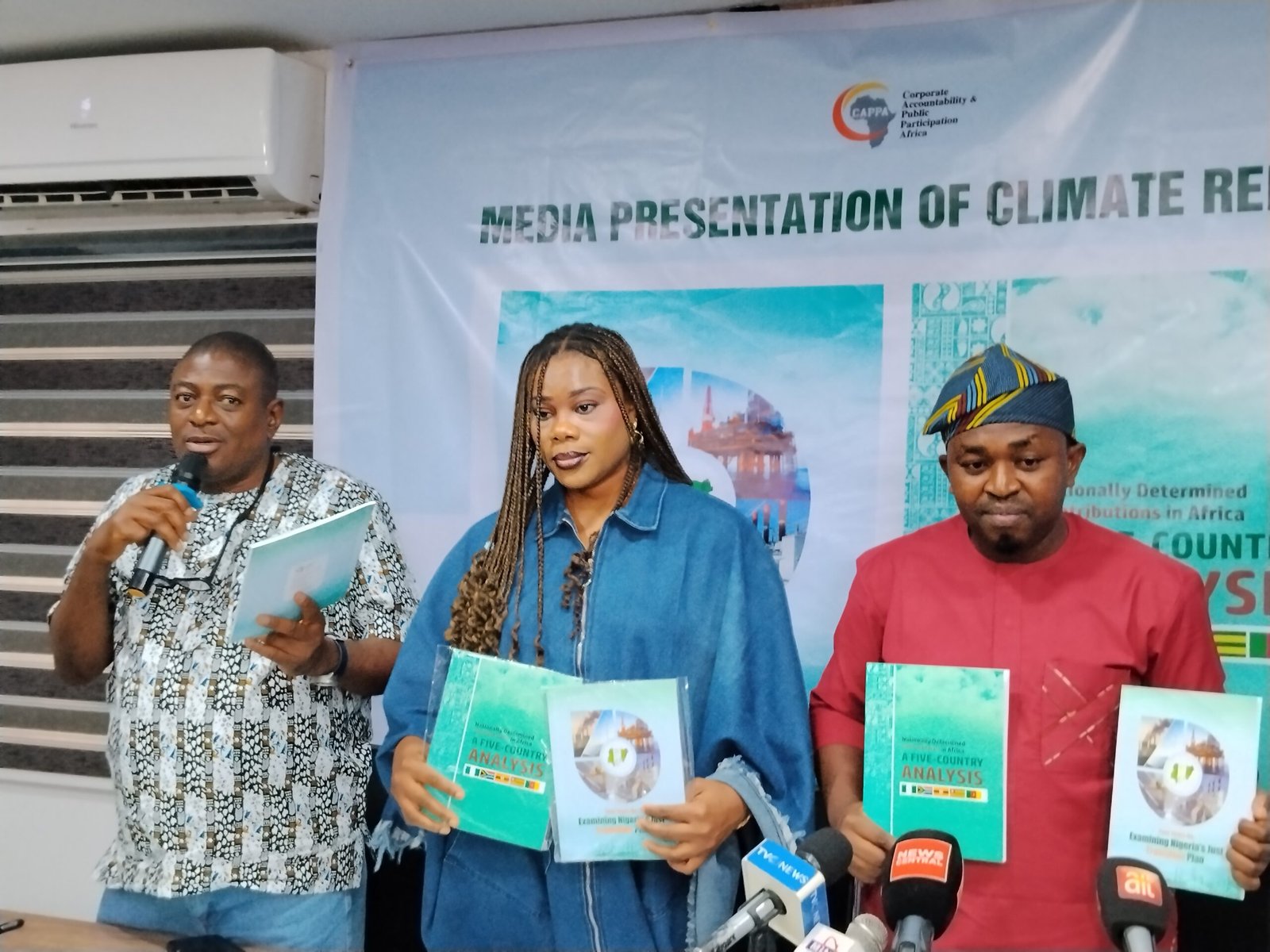
They made the call in Lagos during the launch of two reports examining Africa’s climate policies ahead of the 31st United Nations Climate Change Conference (COP31) in Antalya, Türkiye.
The reports are Four Years On: Examining Nigeria’s Just Transition Plan and Nationally Determined Contributions in Africa: A Five-Country Policy Analysis, which assesses the climate commitments of Nigeria, Cameroon, South Africa, Togo and Uganda.
In his welcome address, CAPPA’s Executive Director, Akinbode Oluwafemi, said the reports exposed contradictions between African governments’ climate ambitions and their continued support for fossil fuel infrastructure.
He questioned whether the continent’s climate policies were genuinely transforming economies and protecting citizens or creating opportunities for corporate interests while local communities bear the consequences.
Oluwafemi cited Uganda’s involvement with the East African Crude Oil Pipeline (EACOP) and Tilenga oil project, despite the renewable energy investments promoted by French multinational TotalEnergies.
He also pointed to Cameroon’s decision to award five of nine oil blocks offered to fossil fuel operators, arguing that such developments contradicted the country’s climate commitments.
The CAPPA executive director expressed concern over the growing involvement of foreign private companies in developing African climate policies, citing Togo’s engagement of Paris-based Cibola Partners to prepare technical aspects of its climate mitigation, adaptation and investment plans.
He further warned that carbon credit schemes, gas investments and climate financing structured as loans could undermine climate justice and deepen Africa’s economic challenges.
According to the organisations, climate loans risk forcing developing countries to repay substantially more than they receive, despite their relatively small contribution to historical greenhouse gas emissions.
The reports also raised concerns about the potential displacement of rural communities through projects presented as environmentally friendly, particularly carbon credit initiatives and commercial plantations.
These concerns are particularly important for Africa, which contributes relatively little to the greenhouse gas emissions responsible for global warming but faces some of the most severe consequences of climate change.
The Intergovernmental Panel on Climate Change (IPCC) has reported that climate change reduced agricultural productivity growth in Africa by 34 per cent between 1961 and 2015, more than in any other region. The impact has been reflected in declining crop productivity, changing rainfall patterns, prolonged droughts and increasingly frequent flooding, threatening food security and the livelihoods of millions of people.
For countries such as Nigeria, where agriculture remains an important source of employment and livelihood, the consequences extend beyond environmental degradation to food prices, rural poverty and pressure on already vulnerable households.
This is one of the arguments behind the organisations’ demand that African climate policies should place communities at the centre of decision-making rather than allow commercial interests to determine the direction of the transition.
The Nigeria-focused report identified weaknesses in the country’s energy transition framework, including fragmented institutional responsibilities, dependence on anticipated private investment and inadequate protections for workers and communities.
It noted that Nigeria’s ambition to achieve net-zero emissions by 2060 existed alongside its target of increasing crude oil production to three million barrels per day by 2030.
The report also questioned the growing promotion of natural gas as a transition fuel, warning that continued investments in gas infrastructure could prolong dependence on fossil fuels and divert resources from renewable energy development.
Methane, the principal component of natural gas, is a potent greenhouse gas, and its emissions contribute significantly to global warming. The organisations therefore argued that describing gas investments as climate-friendly without examining their long-term environmental implications could weaken the credibility of national transition plans.
Another concern raised in the five-country assessment is the increasing reliance on carbon markets and offsetting arrangements to meet national climate targets.
Under carbon credit schemes, companies and other polluters can compensate for their emissions by financing projects that claim to reduce or absorb carbon elsewhere, including forest conservation and plantation initiatives.
However, CAPPA and its partners warned that such arrangements could allow major polluters to continue emitting greenhouse gases while transferring the responsibility for addressing the damage to communities and ecosystems in developing countries.
Uganda’s climate plan was cited as an example, with the report questioning its reliance on commercial plantations to deliver projected emissions reductions compared with natural forest restoration.
The organisations also referenced concerns about land rights in Uganda, including forced evictions documented by the Oakland Institute in connection with a forestry and carbon credit project in Kachung.
They argued that climate interventions should not undermine the rights of rural populations, particularly indigenous communities, smallholder farmers and women whose livelihoods depend on access to land and natural resources.
Climate financing is another major issue highlighted in the reports.
Nigeria estimates that it requires US$337 billion between 2026 and 2035 to implement its climate commitments, with about 80 per cent expected from international funding.
Togo, meanwhile, has made 69.9 per cent of its climate financing requirements conditional on international support, while South Africa’s climate plan indicates that approximately 80 per cent of the international financial support recorded for 2021 and 2022 came in the form of loans.
The organisations maintained that such financing arrangements could worsen the debt burden of developing countries already struggling with limited fiscal resources.
Their concerns are supported by research published in October 2025 by Oxfam and the CARE Climate Justice Centre, which estimated that developing countries received US$62 billion in climate loans in 2022 but could repay as much as US$88 billion over the lifetime of those loans.
The research found that for every five dollars received, developing countries could repay seven dollars, raising questions about whether existing climate financing arrangements adequately reflect the principle of climate justice.
The issue has become increasingly important as international climate negotiations continue to grapple with the responsibility of wealthy industrialised countries to provide financial assistance to nations bearing the greatest consequences of climate change.
For CAPPA and MBPP Africa, the challenge goes beyond securing financial commitments. They insist that climate finance must be predictable, accessible and largely grant-based, rather than structured in ways that increase the indebtedness of vulnerable countries.
Providing further perspectives, Ndivile Mokoena, Founder and Chief Executive of Yielding Intersectional Movements in South Africa, said the gap between global climate commitments and realities on the ground reflected political and economic systems that continued to prioritise profit over human welfare and environmental sustainability.
She called for concrete implementation, adequate climate financing and meaningful support for developing countries.
Similarly, Acola Amina, Executive Director of Uganda’s Nia Environment and Zero Carbon Alliance, stressed the need for inclusive participation and collective commitment to ensure climate policies reflected the realities and needs of affected communities.
The organisations said the findings should inform the positions of African negotiators at COP31, particularly as countries discuss the implementation of commitments under the Paris Agreement and the transition away from fossil fuels.
They called on the African Group of Negotiators and progressive delegates to reject carbon offsetting as a substitute for actual emissions reductions, strengthen community land rights, introduce safeguards against corporate influence and demand grant-based climate financing.
They also urged governments to ensure that fossil fuel companies, major industrial polluters and private consultants with potential conflicts of interest do not exercise undue influence over national climate priorities.
In addition, they advocated a planned phase-down of fossil fuel dependence, increased public investment in decentralised renewable energy and legally binding protections for workers and communities affected by the transition.
For Nigeria, the organisations argued that the success of the energy transition should not be measured only by emissions reduction targets or the amount of private investment attracted, but also by improvements in access to affordable electricity, the restoration of damaged environments and the creation of sustainable livelihoods.
They maintained that a just energy transition must guarantee affordable electricity, secure livelihoods, environmental restoration and meaningful participation by communities in decisions affecting their future.
The two reports, they said, would be presented to African climate negotiators and other progressive delegates at COP31 to encourage greater accountability and ensure that the continent’s climate agenda reflects the interests of its people rather than those of powerful commercial actors.


 and the Africa Make Big Polluters Pay (MBPP) Coalition have warned African)