



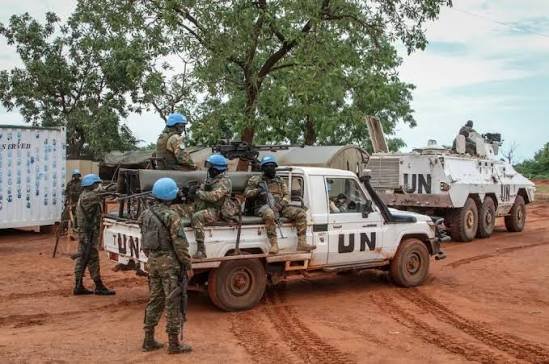
The Central African Republic (CAR) could face renewed security challenges as the United Nations considers reducing its peacekeeping presence in the country after 12 years of operations, raising concerns that a premature drawdown could leave vulnerable communities exposed to attacks by armed groups.
The UN Security Council is expected to decide on the renewal of the mandate of the Multidimensional Integrated Stabilization Mission in the Central African Republic (MINUSCA), which expires this weekend. Among the options under consideration is a gradual reduction of the mission, which was deployed in 2014 at the height of a civil war that plunged the country into years of violence and instability.
Although the security situation has improved considerably since the worst period of the conflict, armed groups remain active in several parts of the country, particularly in remote border communities where government authority is limited and access to security and humanitarian services remains difficult.
The proposed reduction has therefore raised questions about whether the Central African Republic is sufficiently prepared to assume greater responsibility for protecting civilians, securing its borders and containing armed groups without the extensive support of international peacekeepers.
MINUSCA has already started scaling back some of its operations. Between January and June, the mission closed or relocated 21 of its bases as part of adjustments to its deployment and operational priorities.
It still maintains nearly 10,000 military personnel and about 2,000 police officers, making it one of the country’s most significant security presences. Any substantial reduction would consequently have implications for military operations, civilian protection and the ability of the United Nations to respond quickly to security emergencies in areas where armed groups remain active.
The security concerns are particularly pronounced along the country’s borders with Chad, Sudan and the Democratic Republic of Congo, where armed groups continue to exploit weak state presence, difficult terrain and cross-border movements to sustain their activities.
In the southeast, remnants of the Lord’s Resistance Army (LRA), the Ugandan-origin rebel group that has operated across parts of Central Africa for decades, also remain a threat. Attacks attributed to the group between June and September reportedly killed four people, while approximately 68 civilians, including 40 children, were abducted.
The situation in the northeast has become more worrying following the violence in Am-Dafock, a border town in the Vakaga prefecture adjoining Sudan. An attack on June 30 reportedly left 29 people dead and displaced about 17,500 people, many of whom sought refuge around a temporary MINUSCA base.
The violence also exposed peacekeepers to direct attacks. Six UN personnel were injured when armed groups attacked the mission’s temporary operating base in the area.
The incident illustrates how instability in neighbouring Sudan, where fighting between the Sudanese Armed Forces and the Rapid Support Forces has created a major humanitarian and security crisis, is increasingly affecting the Central African Republic.
The UN has warned that the Sudanese conflict is creating new security pressures along the border, with armed groups taking advantage of the situation to expand their activities.
Valentine Rugwabiza, the UN Special Representative for the Central African Republic and head of MINUSCA, told the Security Council in October that the country was experiencing a resurgence of deadly violence in the east despite progress in disarming armed fighters and completing the latest electoral cycle.
She cautioned against a premature withdrawal of peacekeepers, arguing that the country still required international support to prevent a reversal of the security gains recorded in recent years.
UN divided over the pace of withdrawal
The debate over MINUSCA’s future is not simply about whether the mission should remain in the country but how quickly it should transfer its responsibilities to the Central African authorities.
The Security Council’s consideration of the mandate has exposed differences among its members over the appropriate size of the mission and the conditions that should guide its eventual withdrawal.
France, which is leading negotiations on the renewal, has circulated a draft resolution proposing another year for MINUSCA, while reducing its authorised military strength from 14,046 to 12,000 personnel.
The United States has pushed for a more substantial reduction, proposing a ceiling of 11,000 troops, while other Council members have expressed concern that excessive cuts could undermine the mission’s ability to respond to security emergencies.
The disagreement reflects competing priorities: reducing the financial and operational burden of a long-running peacekeeping operation while ensuring that the country does not return to widespread violence.
The UN Secretary-General has recommended a conditions-based transition, under which responsibilities would progressively move to the Central African government and other UN agencies without creating gaps in civilian protection.
His September report recommended bringing back 372 military personnel previously repatriated because of financial constraints, which would raise the mission’s deployment to approximately 11,000.
However, a subsequent assessment in October recommended increasing the deployment to around 12,000 to meet operational requirements, particularly in response to deteriorating security conditions in the northeast and along the borders with Chad and Sudan.
This recommendation highlights the contradiction confronting the Security Council: while some members favour reducing the peacekeeping presence, developments on the ground have created demands for additional military capacity.
At its October 20 meeting, several Council members supported a gradual and coordinated transition, warning that a hurried withdrawal could create security and protection gaps.
The proposed reduction in troop numbers is therefore being considered alongside measures to strengthen the country’s security institutions, improve the capacity of national forces and transfer responsibilities in a manner that reflects actual conditions in different parts of the country.
The mission’s existing mandate covers civilian protection, support for the peace process, restoration of state authority, humanitarian assistance, human rights and the rule of law.
Its presence has also been important in supporting the deployment of government officials and security personnel to remote communities where state institutions have struggled to establish effective control.
Touadéra wants phased withdrawal
President Faustin-Archange Touadéra has called for a phased withdrawal of MINUSCA, rather than an abrupt termination of the mission.
The position reflects the government’s desire to assume greater responsibility for national security after years of dependence on international peacekeeping forces.
The Central African authorities have also argued for a transition that respects national ownership and allows the country’s security institutions to develop the capacity to take over responsibilities currently performed by international personnel.
However, the transfer of security responsibilities remains a major challenge.
The country has made progress in disarmament, demobilisation and reintegration, with nearly 2,000 former fighters reportedly disarmed. Yet the continued presence of armed groups and allegations of violations by some security personnel underline the difficulties involved in building a professional and accountable national security system.
The government has been working with international partners on security sector reform, including efforts to reorganise the armed forces and establish a more effective command structure.
MINUSCA has also supported the deployment and training of national security forces, as well as the restoration of government authority in areas previously controlled or influenced by armed groups.
The Security Council is expected to maintain pressure on the government to strengthen these institutions as part of the transition process.
A difficult transition for the country
The Central African Republic has experienced repeated political crises and armed conflicts since gaining independence from France in 1960.
The latest major crisis began in 2013, when the predominantly Muslim Seleka rebel coalition seized power, prompting retaliatory violence by predominantly Christian anti-Balaka militias.
The conflict triggered mass displacement, widespread human rights abuses and the collapse of government authority across large parts of the country.
MINUSCA was established by Security Council Resolution 2149 on April 10, 2014, to protect civilians, support the political transition, facilitate humanitarian assistance and help restore state authority.
Over the years, the mission has remained a central part of international efforts to stabilise the country, although its operations have faced financial constraints, security challenges and occasional tensions with the government.
The current debate comes after the completion of the country’s latest electoral cycle, which has encouraged some Security Council members to argue that conditions are becoming favourable for a gradual transfer of responsibilities.
However, the continued insecurity in the northeast and southeast suggests that improvements in the political process have not necessarily translated into lasting security across the entire country.
The challenge is particularly significant for civilians in isolated communities, where the departure of peacekeepers could leave residents with limited protection against armed groups.
For the United Nations, the decision on MINUSCA will therefore involve balancing the need to reduce the mission’s long-term presence with the responsibility to protect the gains made after more than a decade of peacekeeping.
The Security Council is expected to vote on the draft renewal resolution on November 12, with the proposed extension running until November 15, 2027.
Whether the mission’s troop strength is reduced or maintained, the effectiveness of the transition will ultimately depend on the ability of the Central African government to provide security, extend public services and establish lasting state authority in areas where armed groups remain active.


 could face renewed security challenges as the United Nations considers reducing its peacekeeping presence)