



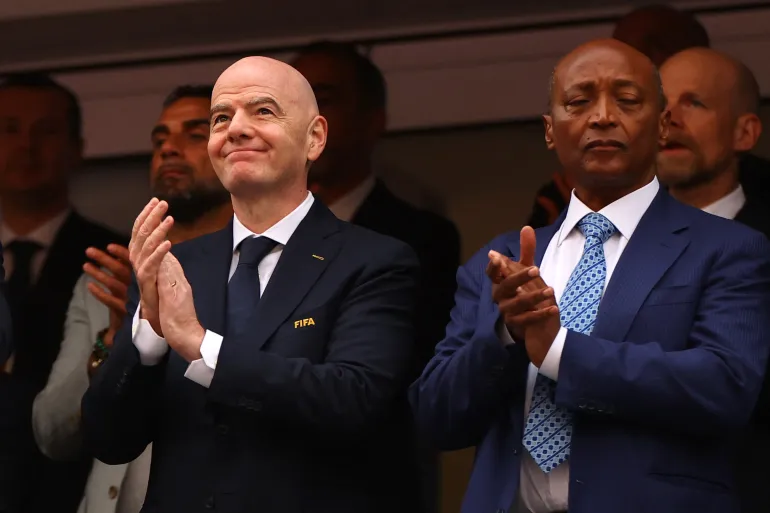
Several of Africa’s most influential football administrators have publicly reaffirmed their support for FIFA President Gianni Infantino, even as he faces mounting criticism over his abandoned proposal to sell a stake in future FIFA World Cup revenues.
The endorsements come ahead of a crucial meeting of the Confederation of African Football (CAF) Executive Committee, where officials are expected to discuss the now-withdrawn FIFA Forward Enterprise initiative, a proposal that sought to raise approximately $4.2 billion through a new commercial rights entity.
Although football governing bodies from Europe, Asia and the Confederation of North, Central America and Caribbean Association Football (CONCACAF) have expressed concerns over Infantino’s leadership following the controversy, CAF has yet to adopt an official position.
The backing of Africa’s 54 FIFA member associations could prove decisive as Infantino prepares for FIFA’s presidential election scheduled for March next year. Among those who have publicly expressed support are CAF Vice President Fouzi Lekjaa of Morocco, FIFA Council members Hany Abo Rida of Egypt, Hamidou Djibrilla of Niger and Ahmed Yahya of Mauritania. Also backing Infantino is Veron Mosengo-Omba, the newly elected president of the Democratic Republic of Congo Football Federation and former CAF General Secretary.
Their statements praised Infantino’s decision to abandon the controversial investment proposal while reaffirming confidence in his leadership and continued commitment to African football. CAF had initially announced that it would study the FIFA Forward Enterprise proposal before taking a position. However, Infantino withdrew the plan following widespread opposition from several football confederations, though the issue remains on the agenda for Thursday’s CAF Executive Committee meeting.
Infantino has maintained strong support across much of Africa since his election in 2016, largely due to his commitment to significantly increasing financial assistance to FIFA member associations through the FIFA Forward development programme. Many African football federations rely heavily on FIFA funding to finance competitions, improve infrastructure and support grassroots football.
FIFA currently guarantees each of its 211 member associations baseline funding of $8 million over every four-year cycle, while CAF also provides annual financial grants to its members. Officials from several African football associations argue that such funding is essential because many governments lack the financial capacity to adequately support the sport.
Said Ali Athouman, president of the Comoros Football Federation, said limited sponsorship opportunities make FIFA funding indispensable for smaller football nations. Similarly, Football Association of Malawi president Fleetwood Haiya noted that countries like Malawi still require significant investment in stadiums and football infrastructure while governments prioritise pressing national needs such as healthcare.
CAF President Patrice Motsepe had also voiced strong support for Infantino shortly before the controversy emerged, describing him as a loyal friend of Africa and praising his longstanding commitment to the development of football across the continent.
As pressure continues to mount on FIFA’s leadership following the failed commercial proposal, Africa’s continued backing could play a significant role in determining Infantino’s political future ahead of the next FIFA presidential election.


