



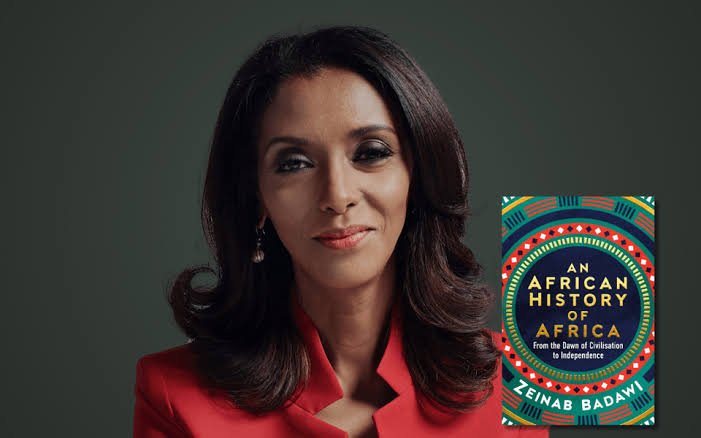
British-Sudanese journalist and author Zeinab Badawi is preparing a children’s edition of her acclaimed book, An African History of Africa: From the Dawn of Humanity to Independence, as part of efforts to introduce younger readers to the continent’s history.
The adult edition, published in 2024, has sold more than 110,000 copies, according to Badawi.
The new book, titled Africa: History and Heroes, will use simplified text and illustrations to explore major periods in African history, including the rise of powerful kingdoms, trading centres and influential leaders, as well as the continent’s journey towards independence.
Badawi said the book would focus not only on the challenges Africa has faced but also on its historical achievements and institutions.
“I make no apologies for the fact that I focused on great moments in Africa’s history, not just on the tragic,” she said.
“I also wanted to celebrate the fact that African Africa has individuals, institutions, customs, traditions which are worthy of respect, worthy of study, and worthy of knowledge.”
She said illustrations would play an important role in helping younger readers engage with the subject.
“You have to engage the young reader through vivid illustrations and I have a wonderful illustrator who I think captures the essence of the characters I have focused on in the children’s book,” she said.
“History is best understood if it is seared into the imagination and that is especially true for young readers,” she added.
Badawi said she wanted children to learn about African history from an early age and understand it as an integral part of global history.
Her original book developed from a BBC series and involved travels to about 30 African countries, where she met historians, anthropologists and specialists in African culture.
She said African scholars brought perspectives that went beyond academic credentials, drawing on their experiences, languages, oral traditions and knowledge of local cultures.
“They bring something very different to the table. They bring great scholarship. They have PhDs from Harvard, Oxford, the Sorbonne,” she said.
“But they bring more than just that because they grew in Africa and are steeped in the oral tradition of their countries. They are aware of the songs, the dance, the culture. They speak the vernacular languages. And so if you don’t include them in the telling of the history, you will miss something.”
Badawi, who is president of SOAS University of London, said one of her objectives was to challenge the long-standing perception that Africa lacked a history of its own.
She argued that African history had often been presented through a European perspective, while many Africans themselves had limited knowledge of the continent’s past.
“So I really wanted to tackle this ignorance, which, frankly, even I had in many ways,” she said.
Meanwhile, a French translation of the original book is due to be published in France on Friday.
Badawi said she hoped the translation would expand the book’s reach, particularly among French-speaking audiences in Africa.
She noted that France and Britain were major colonial powers in Africa and said she saw a need for a French edition to make the work accessible to more readers across the continent.
Available next action: Create a downloadable DOCX file here in this chat containing the editable prose above


