



Centuries after the end of transatlantic slavery, the people have not forgiven the United Kingdom for its role in the slave trade, with demands for a formal apology and reparations continuing to generate debate between Britain and countries whose ancestors suffered from the trade.
Though the slave trade was a massive, centuries-long forced migration that trafficked an estimated 10 million to 12.5 million enslaved Africans across the Atlantic Ocean to the Americas between the 15th and 19th centuries, its painful legacy remains fresh in the minds of millions of people, particularly in Africa and the Caribbean.
The consequences of the trade went beyond the millions of Africans who were forcibly removed from their communities and transported across the Atlantic. It disrupted African societies, weakened traditional institutions, separated families and contributed to the economic and social inequalities that continue to shape relations between Africa, Europe and the Caribbean.
For many descendants of enslaved Africans, the issue is not simply about remembering a dark chapter in history but also about securing recognition of the injustice and addressing the consequences that have been passed from one generation to another.
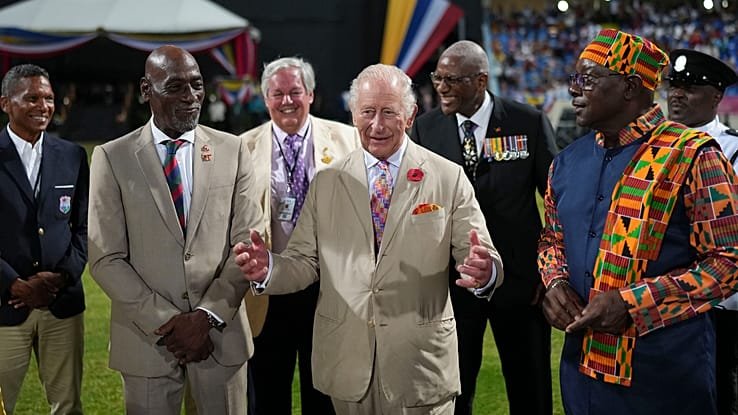
As the demand for a formal apology grows, King Charles, during one of his Caribbean tours, addressed the history of slavery with expressions of sorrow, regret and acknowledgment of past suffering, but stopped short of issuing a formal apology.
However, Caribbean leaders and advocates were not satisfied with expressions of regret alone and have continued to push for a formal apology and meaningful discussions on reparations.
The debate has therefore moved beyond expressions of sympathy to questions of responsibility, historical justice and what Britain and other former colonial powers should do to address the enduring consequences of slavery.
So, as King Charles attends the Commonwealth meeting, Buckingham Palace has said that he will address the slavery discussion with “unflinching honesty” in his speech.
Today, Charles will confront “the most shameful aspects” of British history. The Palace also stressed the King’s “respect for the wider discussions that will be taking place between relevant governments on this issue.”
The comments came amid renewed pressure on Britain to acknowledge its historical responsibility for the transatlantic slave trade, with the question of reparations emerging as a major point of disagreement among Commonwealth countries.
The Palace, however, made it clear that the King would not be announcing a change in government policy, saying it would not be appropriate for Charles to “address matters of particular policy relating to the UK government’s position.”
This distinction is important because, although the monarch is the head of state and a symbolic figure within the Commonwealth, decisions on apologies, compensation and other forms of reparatory justice rest primarily with the elected British government.
The King’s expected intervention comes at a particularly sensitive moment for relations between Britain and its former colonies. The Commonwealth Heads of Government Meeting (CHOGM), taking place in Antigua and Barbuda, brings together leaders of 56 member countries, many of which experienced British colonial rule and the consequences of the slave trade.
The Caribbean Community (CARICOM) has been particularly vocal in demanding that the issue of reparatory justice receive serious attention. Its members argue that the effects of slavery did not disappear with abolition and that former colonial powers should take responsibility for the economic, social and institutional damage associated with the trade.
The position of Caribbean leaders is that an apology should not be treated as an end in itself but as the beginning of a process towards addressing historical injustices.
President of Guyana, Mohamed Irfaan Ali, has also made clear that acknowledging the suffering caused by slavery is not enough, arguing that a formal apology would represent an important next step.
During his visit to Guyana, Charles acknowledged the historical suffering and described slavery as one of the darkest periods in human history. However, the absence of an apology has continued to attract criticism from campaigners and sections of the Caribbean public.
Indeed, the King’s Caribbean tour has not been without protests. Although he received warm receptions from many residents, demonstrators used his visits to renew calls for Britain to apologise and support reparations.
Their position reflects a growing frustration that expressions of regret by British leaders and members of the Royal Family have yet to translate into a clear commitment to addressing the demands of affected communities.
Britain’s historical involvement in the transatlantic slave trade was substantial. Estimates indicate that British ships transported approximately 3.2 million enslaved Africans across the Atlantic. The wider transatlantic trade saw about 12.5 million Africans embark on ships bound for the Americas, while an estimated 10.7 million survived the journey and disembarked.
The figures offer an indication of the scale of the human tragedy, but they do not fully capture the suffering associated with the trade. Enslaved Africans were separated from their families, deprived of their freedom and forced to work under brutal conditions, particularly on plantations producing sugar, cotton and other commodities for European markets.
The wealth generated from slavery helped build industries, commercial institutions and fortunes in Britain and other European countries. For advocates of reparations, this historical connection is central to their argument that the benefits of slavery were accumulated in Europe while its consequences were largely borne by African and Caribbean societies.
However, the British government’s position on financial compensation remains a major obstacle to reaching an agreement.
Prime Minister Andy Burnham has indicated that he is open to Britain discussing a formal apology, representing a significant development in the country’s approach to the issue. However, he has ruled out financial reparations.
In a further development ahead of the Commonwealth meeting, Burnham said Britain would begin a structured dialogue with countries and communities affected by the transatlantic slave trade to discuss the possibility and form of a formal apology.
The British government’s argument is that such an apology should be discussed with the countries and communities concerned rather than determined unilaterally by London.
This approach has attracted attention because it creates an opportunity for affected countries to participate in discussions about what an apology should contain and how it should be delivered.
The chair of the CARICOM Reparations Commission, Professor Sir Hilary Beckles, welcomed the proposed dialogue, describing the issue as one of the most important matters confronting Caribbean governments and their people.
CARICOM has maintained that reparatory justice is a matter of historical responsibility and recognition of the enduring consequences of slavery, rather than simply a demand for financial payments.
The debate also extends beyond financial compensation. Reparations campaigners have called for investment in education, healthcare, infrastructure and cultural institutions, alongside the return of artefacts taken from African and Caribbean communities during colonial rule.
Some advocates also want Britain to support programmes that would help descendants of enslaved Africans confront the economic disadvantages associated with centuries of exploitation.
For them, reparations should be understood as a broader programme of restorative justice rather than an attempt to place a monetary value on the lives lost during slavery.
The experience of other European countries has also featured in the debate. In 2023, King Willem-Alexander of the Netherlands formally apologised for his country’s historical involvement in slavery and asked for forgiveness during a ceremony marking the anniversary of the abolition of slavery in Dutch colonies.
That development has strengthened arguments among campaigners that Britain should be prepared to take a similar step, particularly given its extensive involvement in the transatlantic trade.
But there are also political and diplomatic considerations. Britain maintains that its current generation should not be held financially responsible for historical actions committed by previous generations. Those demanding reparations, however, argue that the consequences of slavery remain visible in present-day inequalities and that historical responsibility cannot be dismissed simply because the original perpetrators are no longer alive.
For African countries, the discussion is equally significant. Although the Caribbean remains at the forefront of the current campaign, the slave trade originated in Africa and involved the forced removal of millions of people from different parts of the continent.
The debate therefore presents an opportunity for African governments to work more closely with Caribbean countries in demanding recognition of the historical experience of their people and a meaningful response from former colonial powers.
The Commonwealth meeting could provide an important platform for such discussions, although the issue is not expected to displace the gathering’s wider agenda on trade, investment, climate change, security and development.
There is also the question of what an apology would actually achieve. Would a formal statement from the British monarch or government satisfy communities that have spent decades demanding justice? Would it open the way for negotiations on reparations, or simply become another expression of regret without any practical consequences?
These are questions that will remain central to the discussions, particularly as Caribbean leaders insist that recognition must be accompanied by concrete action.
For King Charles, the challenge is to acknowledge the historical suffering without appearing to avoid the difficult questions surrounding Britain’s responsibility. His position as head of the Commonwealth gives his words considerable symbolic importance, but the constitutional limits of his office mean that he cannot independently determine the British government’s response.
Ultimately, whether an apology can settle the transatlantic slavery discussion will depend on what follows the King’s speech. Expressions of sorrow and regret may help rebuild trust, but they are unlikely to end a debate that has continued for generations.
What Caribbean and African campaigners are seeking is not merely an acknowledgment that slavery happened, but recognition of its lasting consequences and a willingness to engage with those demanding redress.
The Commonwealth meeting may therefore mark an important moment in the relationship between Britain, Africa and the Caribbean. Whether it becomes a turning point or another missed opportunity will depend less on the King’s choice of words than on the willingness of governments to move from historical acknowledgment to meaningful engagement.


