


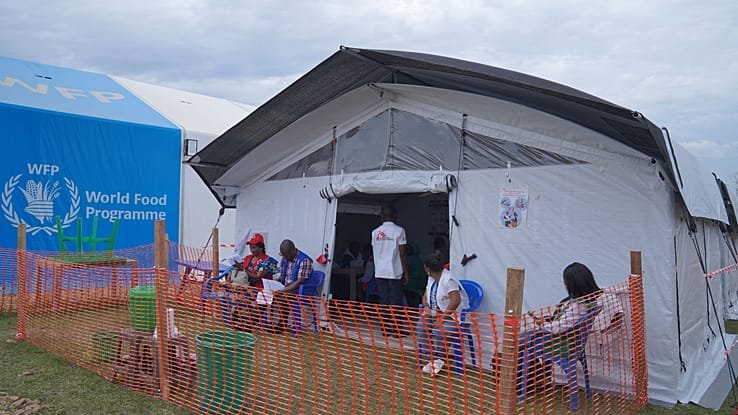
The Democratic Republic of Congo has begun vaccinating health workers and other frontline personnel against Ebola in Bunia, the epicentre of the country’s fastest-growing outbreak of the disease.
The vaccination campaign, launched on Saturday, is prioritising healthcare workers with the Ervebo vaccine, which has been shown to be effective against the more common Zaire strain of Ebola.
Nikole Landu, a healthcare worker who received the vaccine, said she opted for vaccination because of her constant contact with sick patients.
“I wanted to get vaccinated because I am in constant contact with sick people and I am at high risk of catching this disease,” Landu said.
“So the vaccine I received today will help protect me. I might still get the disease, but I’m less likely to develop a severe case,” she added.
Health authorities said Ervebo could provide some protection against the Bundibugyo virus because the two viruses are related. However, research is still ongoing to determine whether the vaccine can prevent illness in people infected with the Bundibugyo strain.
The vaccine is being administered under a compassionate-use programme, which permits the use of a medical product in serious disease situations even when it has not been specifically approved for that particular indication.
Authorities said the initial rollout covers the Bunia and Mongbwalu health zones in Ituri province, two of the areas most affected by the outbreak.
As of Saturday, government figures put the number of confirmed cases at 7,541, including 3,639 deaths. The outbreak is concentrated in Ituri and has become the deadliest among the country’s 17 recorded Ebola outbreaks.
The spread of the disease has been compounded by insecurity, displacement, a strike by health workers and extensive population movements, making containment efforts more difficult.
The World Health Organization has warned that the outbreak remains out of control and could surpass the 2014–2016 West Africa Ebola epidemic, which killed more than 11,000 people, mainly in Guinea, Liberia and Sierra Leone.
Military governor of Ituri, Maj. Gen. Gaby Kasongo Mulumba, said prioritising frontline health workers was necessary because of their exposure to the virus and their central role in the response.
“Together, we can defeat Bundibugyo virus disease and protect our community,” Mulumba said after receiving the vaccine in Bunia on Saturday.
The Ervebo vaccine was also rolled out last month in Kisangani, the capital of Tshopo province, with the campaign expected to cover 14 health zones across Tshopo, Bas-Uele and Haut-Uele provinces.
The WHO said last month that 70,000 doses of Ervebo had been approved for use in Congo.
Of the doses, about 50,000 are earmarked for frontline and health workers, while the remaining 20,000 will be used in a clinical trial to determine whether the vaccine protects against the Bundibugyo virus, which is responsible for the current outbreak and has no licensed vaccine or treatment.


