



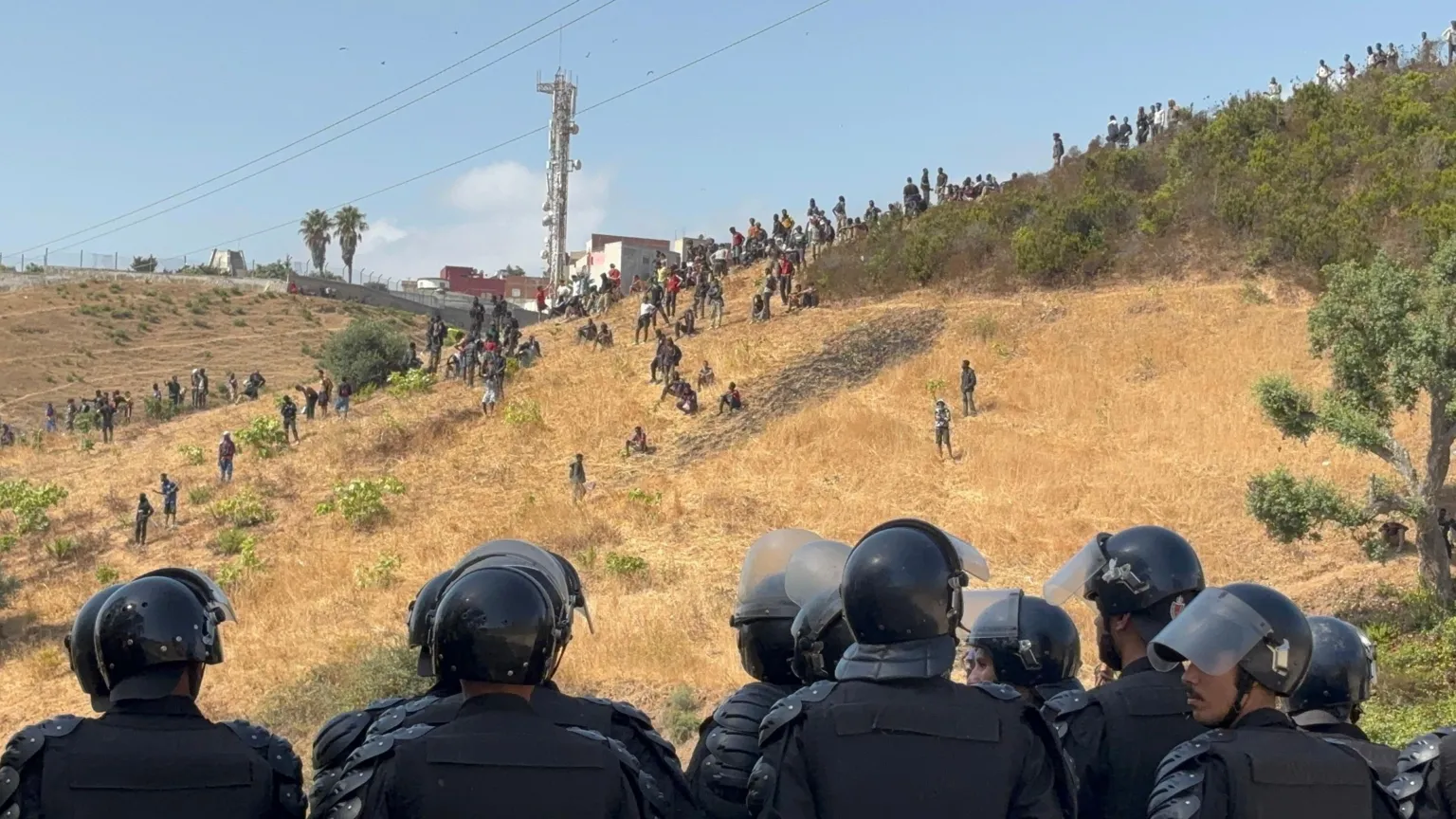
Moroccan authorities have detained more than 100 migrants attempting to reach the Spanish North African enclave of Ceuta, as security forces stepped up patrols following warnings of a fresh mass crossing.
More than 100 people were stopped on Saturday as they tried to make their way towards the border near the Moroccan town of Fnideq, according to Moroccan security sources cited by Spanish media and Reuters.
The sources said 111 people had been detained in and around Fnideq, known as Castillejos in Spanish, about three kilometres from the border. Most of those detained were migrants from sub-Saharan Africa.
Moroccan police, including riot-control units, reportedly used tear gas to disperse groups of migrants who had gathered on nearby hills overlooking the route to Ceuta.
The operation came about two weeks after a major influx of migrants into the Spanish territory, when roughly 78,000 people reportedly reached Ceuta by sea within hours. The city’s mayor said about 100 people died during the incident.
Following the influx, Spanish and Moroccan authorities reinforced security along the border amid reports circulating on social media that another mass crossing attempt was planned for this weekend.
Moroccan authorities said earlier in the week that they were monitoring “the circulation of social media posts and messages of unknown origin” calling for a mass crossing on Saturday. Rabat warned that both organisers and participants could face prosecution.
Spanish newspaper El País reported that security at the entrance to the breakwater was “10 times stronger than the previous day”.
Morocco deployed additional forces to the area, including army personnel, navy speedboats and drones, alongside a metal fence and a floating barrier installed earlier in the week.
Spain, meanwhile, deployed more than 1,500 security officers to patrol the area.
The immediate crisis has eased since the mass influx in late July, but the episode has heightened tensions among European countries with open internal borders and triggered criticism of the Spanish government’s handling of migration.
Italy suspended its Schengen arrangement with Spain, with Finland and Denmark backing the move, while the Czech Republic called for Spain’s membership to be temporarily suspended.
Spanish Prime Minister Pedro Sánchez rejected the criticism, noting that Ceuta is not part of the Schengen area.


