



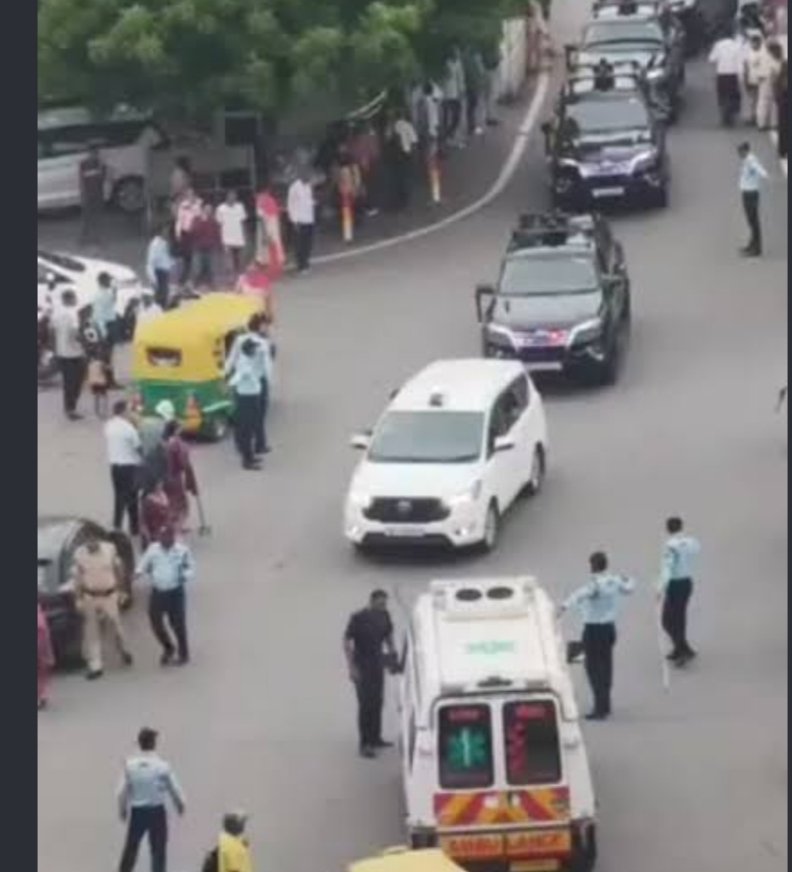
Public outrage has erupted in India’s Assam state after a critically ill patient died after an ambulance carrying him was stopped by police to allow Chief Minister Himanta Biswa Sarma’s convoy to pass.
The patient, identified as Rasuraj Chakraborty, was being transported in a 108 ambulance from Sribhumi district to Silchar Medical College and Hospital for advanced treatment when it was stopped at the Ramnagar ISBT point in Silchar.
Chakraborty, a resident of Bangar in Sribhumi district, was suffering from a serious liver-related ailment and had reportedly been taken to the hospital after his condition deteriorated.
He was confirmed dead at Silchar Medical College and Hospital on October 1, 2026.
According to reports, police officers managing traffic at the Ramnagar ISBT point halted the ambulance to facilitate the movement of Sarma’s convoy.
Video footage of the incident circulated on social media, triggering widespread criticism and outrage across Assam.
Four police personnel linked to the incident have since been suspended.
However, Sarma said on Thursday that the brief stoppage of the ambulance was not responsible for Chakraborty’s death, stressing that the patient had been suffering from a critical liver condition.
“The patient was suffering from a critical liver ailment and his death is not related to the brief halt of the ambulance for a few seconds,” Sarma said.
The Chief Minister nevertheless apologised publicly and said ambulances, emergency vehicles and members of the public should not be inconvenienced because of the movement of his convoy or that of any minister.
Sarma said he did not favour travelling with a convoy but that deputy commissioners and police officers usually arranged the security movement.
He added that the Chief Minister was “merely a chief servant” and declared that “in the new Assam there is no place for VIP culture.”
Earlier on Thursday, the Chief Minister’s Office directed all district commissioners and senior police officers to ensure that members of the public were not inconvenienced by official convoy movements.
The directive noted that clear instructions had previously been issued to district officials to ensure that ambulances, fire tenders and other emergency vehicles were not obstructed during the movement of VIP convoys.
“It is once again emphasised that under no circumstances should the movement of ambulances or other emergency vehicles be impeded on account of VIP motorcade arrangements,” the directive stated.


