


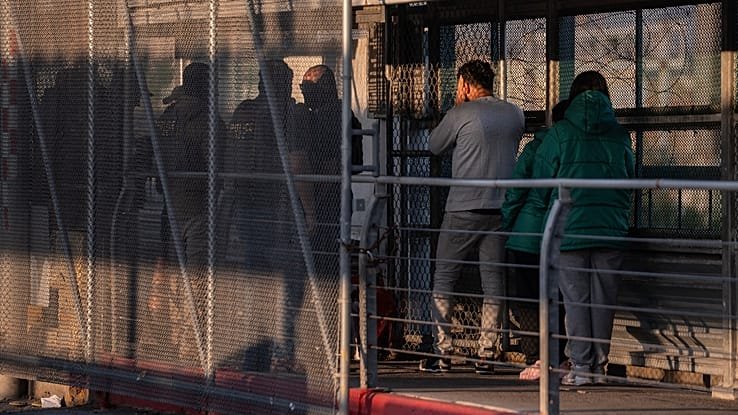
The United States has deported more than 25,000 migrants to countries with which they have no previous ties under agreements negotiated with 35 countries, according to a major international investigation into Washington’s expanding third-country deportation programme.
The investigation, published Monday by Forbidden Stories in collaboration with France 24, Radio France Internationale (RFI) and other international media organisations, found that the US administration has allocated about $410 million to facilitate the transfers.
The programme expanded after President Donald Trump returned to office in January 2025, with Washington reaching agreements with developing countries to receive migrants who cannot legally be returned directly to their countries of origin.
Data compiled by Forbidden Stories and its media partners showed that at least 25,447 people had been deported to third countries as of August 31, 2026.
Mexico received the largest number, with about 20,000 deportees, while the remainder were transferred to 27 other countries across Latin America, Africa and the Pacific. Agreements have also been concluded with seven additional countries.
The terms of the agreements vary, including the nationalities that can be accepted and whether countries will receive deportees with criminal records.
An earlier investigation by AFP reported that Washington had used visa restrictions and other measures against some African countries as leverage in negotiations over the acceptance of deportees.
Lawyers interviewed by AFP said some deportees faced prolonged detention and uncertainty over their legal status in countries where they had no family or other connections.
Forbidden Stories reported that 49 of Africa’s 54 countries had been approached over the possibility of accepting third-country deportees.
The investigation also identified the State Department’s Office of Remigration, established in May 2025, as the unit responsible for handling many of the negotiations and payments.
The office is headed by diplomat Christian Jove Ehrhardt, whose activities have included visits to Cameroon, which signed a memorandum of understanding with the US in December to accept deportees.
A week after the agreement, Cameroon also signed a five-year health assistance programme valued at nearly $400 million.
The following month, the US State Department announced an additional $30 million for the UN Refugee Agency (UNHCR) in Cameroon, saying the funds would support the voluntary return of refugees and efforts to combat illegal immigration.
The first flight carrying deportees under the arrangement arrived in Cameroon on January 14.
Other agreements have involved direct financial payments to receiving governments.
Palau, a Pacific island nation with a population of fewer than 18,000 people, agreed in December 2025 to accept up to 75 third-country nationals in exchange for $7.5 million. So far, however, only three people have been transferred under the arrangement.
In Eswatini, 32 people have arrived since July 2025 out of a potential 160 under an agreement worth more than $5 million. The investigation said the country had accepted some deportees with criminal records.
Internal State Department records cited by Forbidden Stories showed that $81 million of the $410 million allocated for the programme was earmarked for governments that signed the agreements.
More than $178 million was designated for the International Organisation for Migration (IOM), while $123 million was allocated to UNHCR and other organisations involved in supporting the transfers.
The involvement of UN agencies has drawn scrutiny. UNHCR told the investigators that it was not a party to the bilateral deportation agreements and that US funding was being used in accordance with its mandate to strengthen asylum systems.
An IOM spokesperson said the agency’s decision to accept funding was based on whether its involvement would improve the lives of affected migrants.
“In these instances, we believe strongly it does,” the spokesperson said.


