



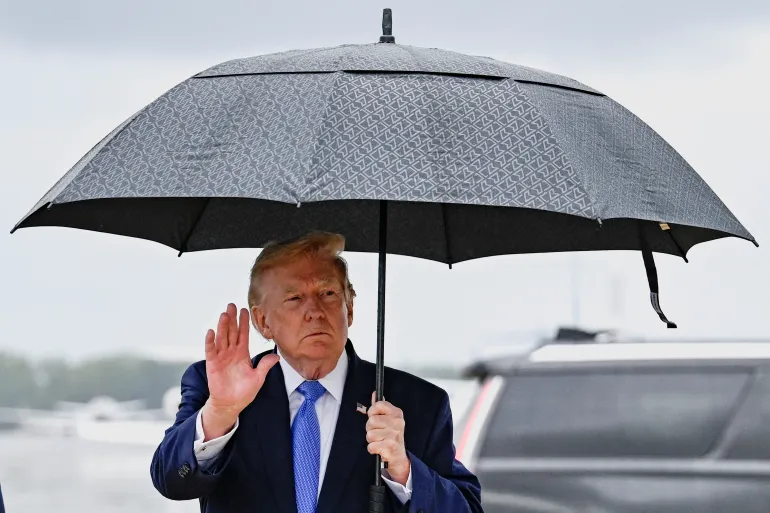
New negotiations between the United States and Iran are set to begin today, Monday, August 3, after President Donald Trump decided to hold off on new strikes on Iran in pursuit of a deal. The US Iran talks begin today follow a weekend of intense diplomatic pressure from regional allies urging Trump to give negotiations a chance.
Trump said on Sunday that a plan had been in place for the US to launch what he called “the biggest attack since World War II” against Iran, but that he halted it to allow room for diplomacy. Trump Explains the Decision to Hold Off “Obviously, they don’t want to be attacked. They knew the extent of the attack because they saw it forming, ” Trump told reporters aboard Air Force One on Sunday. “Now what we’re doing is talking to them in the form of a negotiation. It begins tomorrow afternoon,” a reference to today’s talks. He gave no details about the venue or participants.
Trump pulled back from the threat of an attack on Saturday, saying the “perimeter” of a deal was already in place. He said Iran and US partners Saudi Arabia, the United Arab Emirates and Qatar had all urged him to hold off on strikes. “When the allies asked to call it off, you’ve got to sort of say, ‘Well, let’s see.’ And the reason they ask is they think there’s a deal,” he said. “There’s a deal on [the Strait of] Hormuz, and then there will be a deal on the nuclear, or you might call it the denuclearisation of Iran. “Trump also said Saudi Crown Prince Mohammed bin Salman had personally urged against the strikes, warning of possible unintended consequences. “I mean, will they be flooded with people pouring into their country and disaster? A lot of bad things can happen,” Trump said.
Regional Diplomacy Intensifies Ahead of TalksTrump’s announcement came hours after Iranian Foreign Minister Abbas Araghchi held a second phone call with Saudi Foreign Minister Prince Faisal bin Farhan Al Saud, joined by Pakistani Army Commander Asim Munir, to discuss recent diplomatic efforts. In a Telegram post, Araghchi said the officials exchanged views on the current situation and on initiatives aimed at maintaining and strengthening security and stability in West Asia, stressing the need for regional cooperation and political solutions.
Earlier Sunday, Iran’s official news agency IRNA reported that negotiations between Tehran and Oman over the Strait of Hormuz were in their final stages, citing Araghchi. Iranian Foreign Ministry spokesperson Esmaeil Baghaei said the talks focused on agreeing a new route through the strait, clarifying that this had no link to whether the Strait of Hormuz itself would be opened or closed, calling that a separate discussion.
Background: A War Marked by On-and-Off Diplomacy The war began on February 28, when the US and Israel launched surprise strikes against Iran, though months of on-and-off diplomacy have produced periods of relative calm. A previous ceasefire deal, which included reopening the Strait of Hormuz, a vital conduit for global energy supplies, later fell through. Iran has since tightened its control over the waterway as the two countries resumed attacks against each other in recent weeks.
Oil Prices Fall as Escalation Fears Ease Oil prices dropped sharply in early trading after Trump abandoned plans for a new military operation against Iran, easing fears of further disruption to Gulf energy supplies. Brent futures fell $4.08, or 4.64 percent, to $83.85 a barrel on Sunday. West Texas Intermediate lost $4.01, or 4.74 percent, trading at $80.66, according to Reuters.The decline reversed part of last month’s surge, when both benchmarks had gained more than 20 percent as renewed US-Iran fighting and attacks on commercial vessels near Oman intensified concerns over shipping through the region.


