



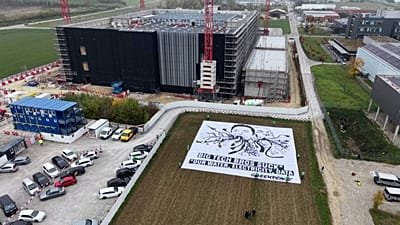
Environmental campaigners have mounted a dramatic protest against the growing influence of major technology companies in Switzerland, unfurling a 676-square-metre banner near a data centre development site to draw attention to the environmental costs of the rapid expansion of artificial intelligence and digital infrastructure.
The giant display, featuring images of billionaire technology executives Elon Musk and Jeff Bezos alongside the slogan, “Big Tech Bros suck our water, electricity, data”, was spread across a field beside a facility being developed by US data centre operator STACK Infrastructure in Beringen, in the canton of Schaffhausen.
Drone footage of the demonstration showed campaigners laying out the enormous banner, in an action intended to challenge what Greenpeace describes as the unchecked growth of large-scale data centres and the increasing demands they place on electricity, water and other local resources.
The environmental organisation is calling for a nationwide moratorium on new mega data centres in Switzerland until binding regulations are introduced to protect energy supplies, water resources and the public interest.
At the centre of the protest is growing concern that the expansion of data centres, driven by rising demand for cloud computing, artificial intelligence and digital services, could place additional pressure on infrastructure and natural resources, while leaving communities to bear much of the environmental cost.
Greenpeace said Beringen has become a symbol of the rapid and largely unregulated expansion of mega data centres in Switzerland. Two major facilities are planned in the area, one being developed by STACK Infrastructure and another proposed by a subsidiary of Turkish energy company Enka.
According to the environmental organisation, the two projects could consume approximately one and a half times the annual electricity used by the entire canton of Schaffhausen once fully operational. The developments are also expected to require substantial quantities of water for cooling their thousands of servers.
The scale of the projected consumption has raised questions about whether local electricity networks and water supplies can accommodate the facilities without putting additional pressure on households, businesses and other users.
A report by Swiss public broadcaster SRF in August estimated that the two projects could require a combined 85 million litres of water annually. Their electricity demand could also increase the canton’s overall consumption by as much as 140 per cent under full operation.
For Greenpeace, the concerns go beyond the immediate environmental footprint of the buildings. The organisation is questioning whether the economic benefits of hosting the facilities will justify the demands they place on public infrastructure, particularly if the businesses and customers using the centres are largely international technology companies.
It has also raised concerns about the management of waste heat generated by the thousands of servers expected to operate within the facilities. Data centres produce considerable heat during operation and require sophisticated cooling systems to maintain the temperatures needed for uninterrupted computing.
Greenpeace argues that more should be done to ensure that this excess heat is captured and reused, rather than allowing a potentially valuable energy resource to go to waste.
The organisation is also seeking greater transparency over which companies will use the facilities, what types of data will be processed and how the developments will contribute to the local economy.
However, the criticism has been contested by the companies involved. STACK Infrastructure has maintained that its Beringen facility is designed to operate efficiently, with electricity sourced entirely from renewable energy. The company has also said its cooling system would use approximately one decilitre of water per kilowatt-hour of electricity consumed. It maintains that the project has been developed in cooperation with Swiss authorities and that its grid connection was approved after consideration of regional electricity requirements.
The debate illustrates the difficulty of balancing the growing demand for digital infrastructure with environmental protection and local resource management.
Data centres have become essential to the modern economy, supporting cloud storage, online banking, digital communications, streaming platforms, artificial intelligence applications and business operations. As more companies move their activities online and AI systems require increasingly powerful computing resources, demand for large-scale server facilities has grown.
The International Energy Agency has identified data centres as an increasingly important source of electricity demand, with global consumption expected to rise significantly as artificial intelligence and other digital services expand.
AI infrastructure is particularly energy-intensive because training and operating advanced models require large numbers of specialised processors running continuously. The facilities must also maintain cooling systems, backup power and other supporting infrastructure to ensure reliable operations.
While the expansion offers opportunities for investment, technological development and improved digital services, environmental campaigners argue that governments must establish clear standards to prevent the benefits from being concentrated among technology companies while the costs are transferred to local communities.
The controversy in Beringen has already generated opposition among residents and political groups. According to Swiss media reports, about 1,800 people have signed a petition calling for binding requirements to protect water resources, guarantee electricity network stability and ensure the reuse of waste heat from the proposed facilities.
The local debate has also extended to the canton of Schaffhausen, where lawmakers and environmental campaigners are pushing for stricter conditions governing the construction and operation of large data centres.
Authorities have been considering additional requirements relating to water efficiency and greenhouse gas emissions, reflecting growing pressure to ensure that new developments meet stronger environmental standards.
The international dimension of the Greenpeace demonstration is equally significant. Similar protests have taken place in other European countries as the environmental consequences of the technology industry’s infrastructure expansion attract increasing public attention.
The campaign is seeking to establish a broader regulatory framework that would require technology companies to demonstrate how their projects will affect electricity supplies, water availability, emissions and local communities before construction approvals are granted.
For Switzerland, the debate also raises questions about digital sovereignty and the country’s dependence on foreign technology companies for critical digital infrastructure.
Some Swiss policymakers have argued that developing domestic data centres is necessary to ensure that sensitive national information and important digital services remain under local control. They contend that stopping new developments could undermine the country’s ability to maintain independent digital infrastructure.
Others argue that digital sovereignty should not come at the expense of environmental sustainability and that operators must meet strict conditions on renewable energy use, cooling systems, waste heat recovery and resource efficiency.
The competing positions underline the challenge facing governments as they attempt to regulate an industry that has become central to economic competitiveness and technological development.
Greenpeace, however, insists that the expansion must not proceed without stronger safeguards. Its proposed nationwide moratorium would remain in place until Switzerland establishes binding rules and a coordinated national approach to approving mega data centres.
The organisation wants authorities to ensure that future projects serve broader public interests rather than being driven solely by the commercial ambitions of major technology companies.
The protest in Beringen has therefore brought a growing global debate closer to the communities directly affected by the expansion of digital infrastructure.
As investment in artificial intelligence and cloud computing accelerates, the question confronting governments is no longer simply how to attract data centre operators, but how to ensure that the infrastructure powering the digital economy does not place unsustainable demands on electricity, water and other essential resources.
For Greenpeace, the giant banner was intended to make that concern impossible to ignore.


