



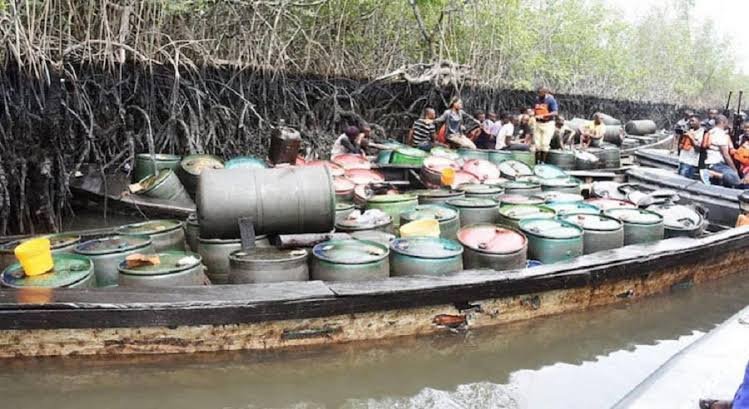
The Nigerian Navy has uncovered an estimated 68,175 litres of suspected stolen crude oil at illegal storage and refining sites in Rivers State, intensifying its offensive against oil theft and other activities threatening the country’s petroleum industry and economic interests.
The discoveries were made during two separate intelligence-led operations in Ogbogolo Community, Ahoada West Local Government Area of Rivers State, by personnel of Nigerian Navy Ship (NNS) SOROH under Operation DELTA SENTINEL.
The operations, conducted on October 24 and November 7, targeted illegal petroleum storage and refining activities within the Orashi Forest and adjoining areas following what the Navy described as credible intelligence on the activities of suspected oil thieves and illegal refiners.
A statement signed by the Director of Naval Information, Navy Captain Abiodun Folorunsho, disclosed that the first operation on October 24 led to the discovery of two crude oil storage sites containing four dugout pits, 29 sacks and a 25-litre keg.
The facilities were estimated to contain 8,675 litres of suspected crude oil, according to the Navy.
In a subsequent operation on November 7, naval personnel uncovered two illegal refining sites comprising two large and 36 smaller dugout pits, alongside other storage facilities containing an estimated 59,500 litres of suspected stolen crude oil.
The combined volume discovered during the two operations stood at 68,175 litres, representing another significant intervention by the Navy in its efforts to dismantle the network of illegal petroleum storage and refining facilities operating across the Niger Delta.
Folorunsho said the discovered petroleum products and associated items were handled in accordance with established procedures, although the Navy did not provide details of any arrests made during the operations or identify individuals linked to the facilities.
He said the discoveries demonstrated the Service’s sustained intelligence-led efforts under Operation DELTA SENTINEL to dismantle illegal petroleum storage and refining infrastructure, disrupt crude oil theft networks and deny economic saboteurs access to the nation’s natural resources.
“By maintaining operational pressure in identified areas of criminal activity, the Service continues to support the protection of critical oil and gas infrastructure and the safeguarding of Nigeria’s economic interests,” he stated.
The latest discoveries come amid continuing efforts by security agencies to contain crude oil theft, illegal bunkering and unauthorised refining activities in the Niger Delta, where criminal networks have continued to exploit the region’s extensive waterways, creeks and forest corridors.
Despite several military interventions and increased surveillance of oil-producing communities, illegal refining and crude oil theft remain major concerns for Nigeria’s petroleum industry.
The activities not only deprive the Federal Government and oil-producing communities of legitimate revenue but also expose the environment to pollution through the uncontrolled handling of crude oil and the discharge of toxic waste associated with illegal refining.
Illegal refining operations typically involve the use of makeshift equipment, including dugout pits, locally fabricated ovens, reservoirs and storage facilities, to process crude oil obtained through unauthorised connections or other illicit means.
The products are subsequently distributed through informal supply networks, creating an underground petroleum economy that undermines legitimate operators and complicates efforts to secure the country’s oil and gas assets.
For Nigeria, which depends heavily on petroleum earnings for foreign exchange and public revenue, the persistence of these activities presents both an economic and security challenge.
The scale of the challenge is reflected in the Nigerian Navy’s own operational figures. In October, the Service disclosed that it recovered more than 2.25 million litres of petroleum products, arrested over 70 suspects and rescued 24 kidnapped persons during operations conducted between July and September 2026.
The third-quarter operations, also carried out under Operation DELTA SENTINEL, resulted in the recovery of 1,555,983 litres of suspected stolen crude oil, 595,470 litres of Automotive Gas Oil, 85,690 litres of Premium Motor Spirit and 15,774 litres of Dual Purpose Kerosene.
The operations also led to the seizure of four vessels and five boats, the destruction of 14 boats and the deactivation of illegal refining facilities across the Navy’s operational areas.
These figures underscore the scale of the security operations required to protect Nigeria’s petroleum resources and the continued presence of illegal activities within the Niger Delta’s oil-producing communities.
Earlier in July, the Navy also dismantled a major illegal refining complex around the Egboama/Ogbogolo axis of Ahoada West, Rivers State, recovering more than 205,000 litres of suspected stolen crude oil and illegally refined petroleum products.
That operation, conducted by personnel of NNS SOROH under Operation DELTA SENTINEL, led to the discovery of three illegal refining sites comprising six refining ovens, three reservoirs and four dugout pits.
The repeated discoveries in the Ahoada West axis highlight the importance of sustained surveillance and intelligence gathering in areas identified as vulnerable to crude oil theft and illegal refining.
However, security experts have consistently stressed that the fight against oil theft requires more than the periodic discovery and dismantling of illegal refining facilities. It also demands effective intelligence sharing, investigation of the financial networks behind the trade, prosecution of offenders and sustained monitoring of vulnerable oil infrastructure.
The involvement of local collaborators, the movement of stolen petroleum products through remote waterways and the ability of illegal operators to establish new facilities after security raids have also complicated efforts to eliminate the criminal enterprise.
Consequently, the effectiveness of anti-oil theft operations will depend not only on the volume of crude oil and petroleum products recovered but also on the ability of security agencies to identify and dismantle the networks financing, transporting and marketing the stolen resources.
The Nigerian Navy, in its latest statement, reaffirmed its commitment to sustaining the operations in collaboration with relevant stakeholders to combat crude oil theft, disrupt illegal refining activities and protect the nation’s maritime and economic interests.
It maintained that operational pressure would be sustained in identified areas of criminal activity as part of broader efforts to secure critical oil and gas infrastructure.
The recovery of the estimated 68,175 litres in Ogbogolo therefore represents another intervention in the ongoing campaign, although the broader challenge of preventing the re-establishment of illegal refining facilities remains central to Nigeria’s efforts to protect its petroleum resources.


