



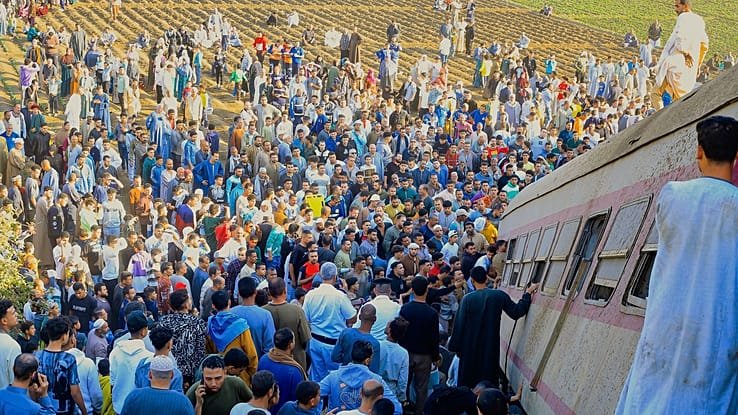
Outside al-Wasta Central Hospital in Beni Suef province, where some of the injured were taken for treatment, survivors said passengers were shocked and struggled to breathe because of the dust resulting from the collision.
Nearby villagers eventually got them out, they said, as rescue efforts began following the devastating accident.
For those who survived, the moments after the collision were marked by confusion, fear and desperate attempts to escape from the damaged carriages. Some passengers were trapped inside the wreckage, while others struggled to find their way out amid the dust and debris.
Farha Gamal, a survivor who was inside the Fayoum train, said she saw some passengers who appeared dead while others were struggling to find their way out of the carriage.
“There were other carriages that were completely mangled,” she said in an interview.
Her account offered a glimpse into the frightening scenes that followed the collision, as residents from nearby communities joined emergency responders in pulling passengers from the wreckage and helping the injured.
Seven people were killed and at least 125 others injured when two trains collided on Sunday south of the Egyptian capital, Cairo, the Chief Prosecutor’s office said in a statement.
The train’s conductor was among those killed, while several carriages were damaged and derailed in the impact.
The Health Ministry said more than 70 injured passengers had been discharged after receiving the required medical treatment, although dozens remained in hospitals for further care and observation.
The crash occurred in al-Ayyat district in Giza province, about 52 kilometres (32 miles) south of Cairo, when a train travelling to the southwestern Fayoum province crashed into the rear of a train heading to the southern province of Aswan, according to the Transportation Ministry.
The Egyptian National Railways identified the trains as service number 134, travelling from Giza to Fayoum, and service number 2010, operating from Cairo to Aswan. The collision happened between Kafr Ammar and Al-Raqqa stations, with the impact causing several carriages to leave the tracks.
Initial findings from the accident site indicated that the Giza-Fayoum train struck the last carriage of the Cairo-Aswan train while the latter was stationary on the same track and travelling in the same direction.
The circumstances that allowed the collision to happen, including whether there was a signalling failure, operational error or other technical problem, had yet to be established.
The Chief Prosecutor’s office said late Sunday that investigators had arrived at the site to examine the circumstances surrounding the accident. The investigation is expected to establish the sequence of events leading to the collision and determine whether any individuals or railway authorities were responsible.
President Abdel-Fattah el-Sissi said in a social media post that he had ordered a prompt investigation into the crash, with those found responsible for negligence expected to be held accountable.
The Egyptian authorities also moved to intensify emergency medical operations, with ambulances transporting victims to hospitals in Giza and neighbouring Beni Suef province.
According to the Health Ministry, 72 ambulances participated in the evacuation and rescue operations. Al-Wasta Central Hospital received 87 casualties, including three fatalities, while Al-Ayyat Central Hospital received 34 injured passengers. Atfih Central Hospital received 11 cases, including four fatalities.
The injuries included bruises, abrasions, fractures to the limbs, pelvis and vertebrae, as well as wounds to the head and face and injuries to the chest and ribs.
Medical teams conducted examinations and scans on the injured to determine the extent of their injuries and provide treatment according to their conditions.
Some patients requiring additional medical attention were transferred to Beni Suef University Hospital and Beni Suef Specialist Hospital, while others remained under observation in the affected hospitals.
The government also made arrangements to assist passengers whose journeys were disrupted by the accident. The Ministry of Transport deployed buses to convey passengers between Al-Wasta and Al-Ayyat stations, as well as between El-Moneib and Al-Ayyat, pending the restoration of normal railway operations.
Meanwhile, the Financial Regulatory Authority (FRA) ordered the Railway and Metro Accident Insurance Pool to accelerate compensation payments to the families of those killed and injured in the collision.
The authority’s chairman, Islam Azzam, approved an increase in compensation for deaths and permanent total disability from 30,000 Egyptian pounds to 50,000 Egyptian pounds as an exceptional measure. Other injury claims would be processed under existing compensation arrangements following the submission of the necessary medical reports.
Prime Minister Mostafa Madbouly also expressed condolences to the families of the victims and directed relevant authorities to provide them with the necessary support.
Beyond the immediate rescue and medical response, the latest accident has once again raised questions about safety standards and the reliability of Egypt’s railway network, which has experienced several deadly accidents over the years.
Egypt has one of the oldest and largest railway networks in the Middle East and Africa. Its railway system remains an important means of transportation for millions of people, particularly those travelling between Cairo and cities in the country’s southern regions.
However, the network has struggled with ageing infrastructure, maintenance problems and operational weaknesses, resulting in repeated accidents and public concerns about passenger safety.
The latest collision is particularly significant because it occurred in al-Ayyat, an area already associated with one of Egypt’s worst railway disasters.
In February 2002, a fire swept through an overcrowded passenger train travelling from Cairo to southern Egypt, killing more than 300 people, with some reports putting the death toll above 360. The disaster remains one of the deadliest railway accidents in the country’s history.
More recently, in March 2021, two passenger trains collided near Sohag in southern Egypt, killing 18 people and injuring about 200 others. The accident prompted renewed calls for improved railway safety and accountability, while prosecutors ordered the arrest of eight railway employees during investigations into the incident.
There have also been other accidents involving derailments and collisions. In September 2026, two freight trains collided in the same al-Ayyat district, injuring a driver and his assistant and causing a locomotive and two wagons to derail.
Official statistics also indicate that railway safety remains a significant concern despite efforts to improve the system. Egypt recorded 170 train accidents in 2025, compared with 220 in 2024, representing a 22.7 per cent decline, according to figures from the Central Agency for Public Mobilization and Statistics.
The 2025 accidents resulted in 39 deaths and 139 injuries, while incidents involving people on or near railway tracks caused considerably more casualties.
The Egyptian government has been investing heavily in railway modernisation, including improvements to infrastructure, signalling systems, locomotives and passenger services.
The railway development programme is part of a wider effort to improve transportation infrastructure, increase operational efficiency and reduce the risks associated with an ageing network.
However, the latest accident demonstrates that investment in modern infrastructure must be accompanied by effective maintenance, strict enforcement of operating procedures, reliable signalling systems and proper monitoring of train movements.
For passengers and their families, the immediate concern remains the recovery of those injured and the establishment of what went wrong.
Emergency teams and cranes were dispatched to the accident scene to remove the wreckage and restore train services to their normal schedule as soon as possible, the Egyptian Railway Authority said.
The authorities have not yet established a definitive cause of the collision, and the outcome of the technical investigation will be important in determining whether the accident resulted from human error, equipment failure or shortcomings in railway operations.
For survivors such as Farha Gamal, however, the investigation comes after an experience that has left a lasting impression. The sight of damaged carriages, trapped passengers and people struggling to escape is a reminder of how quickly an ordinary train journey can turn into a life-threatening emergency.
As Egypt continues its railway modernisation programme, the latest tragedy has renewed attention on the need to ensure that passengers can travel without fear of preventable accidents.
The challenge for the authorities will be to translate investigations, infrastructure spending and promises of accountability into practical improvements that prevent another deadly collision.


