



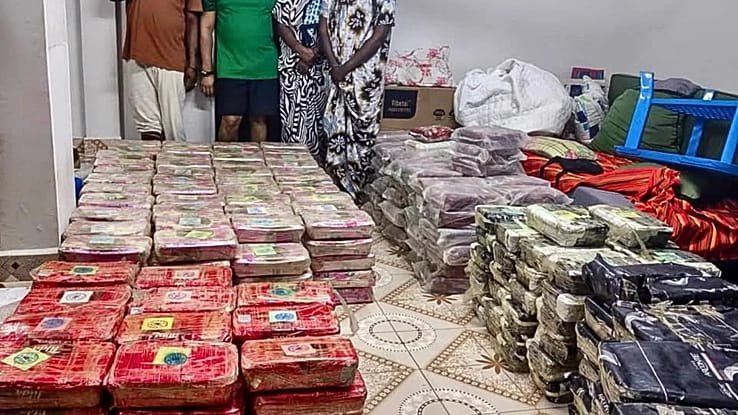
Kenya’s growing battle against international drug trafficking has recorded another major breakthrough, with police seizing 454 kilogrammes of methamphetamine valued at $27 million in a joint operation with Tanzanian authorities. The latest interception along the country’s coastal region highlights the increasing security challenge posed by organised drug networks operating across East Africa, as law enforcement agencies intensify efforts to dismantle trafficking routes and prevent the region from becoming a major hub for illicit substances.
The drugs were discovered in Msambweni, on Kenya’s coast, following investigations that began with the arrest of a suspect in Tanzania last week.
According to police, the suspect was transferred to Kenya and helped investigators locate the consignment. The individual was also allegedly connected to an earlier seizure of 250 kilogrammes of suspected methamphetamine and cocaine in Tanzania.
Three other suspects, including two Tanzanians and a Ugandan, were arrested during the operation. All four remain in police custody pending court appearances.
Officers also confiscated two vehicles and a motorcycle believed to be linked to the operation.
The operation illustrates the importance of intelligence-sharing and cooperation between neighbouring countries in confronting organised criminal networks, particularly those that exploit porous borders and coastal routes to move drugs between jurisdictions.
The arrest in Tanzania and subsequent discovery of the drugs in Kenya also point to the cross-border nature of the trafficking operation. Rather than operating within the boundaries of one country, such networks often depend on coordinated movements, local contacts and transportation arrangements to conceal consignments and evade security agencies.
For Kenya, the latest seizure is significant not only because of the estimated street value of the drugs but also because of the quantity recovered and the suspected international connections of those arrested.
The seizure comes amid growing concern over drug trafficking along East Africa’s coastline.
Last month, Kenyan authorities destroyed more than a tonne of methamphetamine intercepted by the country’s navy off the coast of Mombasa last year.
The destruction followed the seizure of approximately 1,024 kilogrammes of methamphetamine in February 2025, after a naval operation intercepted a vessel suspected of transporting the drugs through the Indian Ocean. The consignment was valued at about $63 million.
The incident was one of the country’s most significant recent drug interceptions and reinforced concerns about the use of maritime routes to transport illegal substances into and through East Africa.
Kenya’s extensive coastline along the Indian Ocean, together with its major seaports and proximity to international shipping routes, makes maritime security a critical component of the country’s anti-narcotics campaign.
Drug trafficking networks are believed to exploit commercial shipping activities, smaller vessels and remote coastal landing points to move consignments, making detection and interception particularly challenging for security agencies.
The latest operation has also drawn attention to the difficulty of tracking drug consignments moving between coastal communities and neighbouring countries. The two villages identified in the investigation, Shirazi and Ganja La Simba, are relatively close to the Indian Ocean, raising questions about whether small boats or traditional dhows may have been used to facilitate the suspected trafficking activities.
Kenya’s Directorate of Criminal Investigations (DCI) Director, Mohamed Amin, confirmed the recovery and said investigations were continuing to establish the full extent of the suspected trafficking network.
Further information released by the DCI on Monday indicated that the latest consignment originated from Pakistan and had no connection with the more than one-tonne methamphetamine shipment intercepted by the Kenyan Navy in October 2025. Investigators said the two consignments involved different countries of origin and separate trafficking networks.
The distinction is important because the two major seizures, although separated by about a year, demonstrate the different channels through which international drug networks are suspected of operating in the region.
The 2025 interception involved a flagless dhow carrying 1,024 kilogrammes of methamphetamine, approximately 630 kilometres off the coast of Mombasa. The Kenyan Navy intercepted the vessel during Operation Bahari Safi, following intelligence shared by regional maritime security agencies.
Six Iranian nationals were arrested aboard the vessel, while the drugs, estimated to be worth $63 million, were subsequently brought to Mombasa for investigation and prosecution.
The consignment was destroyed in September 2026 at a cement plant in Mombasa after the completion of the necessary legal processes.
Kenya’s Interior Cabinet Secretary, Kipchumba Murkomen, said during the destruction exercise that the government was determined to dismantle the networks behind international drug trafficking, including those financing and benefiting from the trade.
The government has also strengthened its institutional response by elevating the former Anti-Narcotics Department into the National Anti-Narcotics Bureau, increasing its personnel from approximately 200 to 405, according to the Daily Nation.
The bureau is expected to strengthen intelligence gathering, investigations and coordination among agencies involved in combating narcotics trafficking.
Kenya’s Deputy President Kithure Kindiki has equally identified illegal drugs and alcohol abuse as major national threats, pledging tougher legislation and increased enforcement.
In October, Kindiki described illicit alcohol and drug abuse as among the three biggest threats to Kenya’s future, warning that criminal networks involved in the production and distribution of harmful substances would face stronger government action.
He said the government was preparing tougher legal measures targeting manufacturers, distributors, financiers and other individuals involved in the illicit trade. The proposed measures also include provisions for seizing assets linked to criminal activities.
The government has meanwhile intensified intelligence-led operations against illegal alcohol and drug networks, with security agencies conducting raids across different parts of the country.
The concern extends beyond law enforcement to the public health consequences of drug abuse, particularly among young people. Methamphetamine, commonly known as meth or crystal meth, is a highly addictive synthetic stimulant that can cause serious physical and psychological damage.
Prolonged use can lead to dependence, severe psychiatric complications, cardiovascular problems and other potentially life-threatening conditions. The availability of such substances in local markets therefore poses a significant challenge to healthcare systems, families and communities.
The Institute for Security Studies has also drawn attention to the changing dynamics of drug trafficking in East Africa, particularly the use of the Western Indian Ocean as a route for moving narcotics between Asia, Africa and international consumer markets.
The United Nations Office on Drugs and Crime has similarly documented the use of maritime routes, including traditional dhows, in the movement of heroin and synthetic drugs through the region. Its reporting has identified Kenya as both a transit point and a market for illicit substances.
Kenya’s geographical position makes the challenge particularly complicated. Its coastline, major port facilities and proximity to Tanzania, Uganda and other East African countries provide legitimate opportunities for regional commerce but can also be exploited by criminal networks.
The Port of Mombasa is one of the region’s most important commercial gateways, serving Kenya and several landlocked neighbouring countries. The volume of maritime traffic and cross-border trade creates a demanding security environment in which authorities must distinguish legitimate commercial activities from organised smuggling operations.
The latest seizure in Msambweni therefore reinforces the need for stronger intelligence cooperation, effective border surveillance and closer coordination among security agencies across East Africa.
While the recovery of 454 kilogrammes of suspected methamphetamine represents a significant achievement, the larger task is identifying the financiers, suppliers and international connections behind the consignment.
Police say investigations into the latest seizure are continuing.
For Kenya, the effectiveness of its campaign against drug barons will ultimately depend not only on the quantity of narcotics intercepted but also on the ability of investigators to dismantle the networks responsible for financing, transporting and distributing the drugs.
The latest operation has demonstrated the value of cooperation between Kenya and Tanzania. Whether that cooperation can lead to the disruption of wider trafficking networks will be an important test of the region’s determination to confront the growing threat of organised drug crime.


