



As the United States seeks to advance its presence in Africa, it has raised concerns over Madagascar’s growing military cooperation with Russia, warning that similar partnerships in West Africa have failed to curb militant violence.
Lieutenant General John Brennan, deputy commander of US Africa Command (AFRICOM), said Washington was concerned that Russia could extend its influence beyond the Sahel, where military-led governments have increasingly turned to Moscow for security assistance.
Brennan’s warning reflects growing strategic competition over influence in parts of Africa, particularly countries whose geographical locations give them importance to international trade and maritime security.
Mali, Burkina Faso and Niger have cut military ties with traditional Western allies and sought Russian support in their fight against jihadist groups. However, attacks have continued despite the shift, raising questions about the effectiveness of the security arrangements promoted by Moscow.
Brennan warned against extending what he described as the “Sahel model” to Madagascar and neighbouring Mozambique, citing their strategic importance to international shipping. He argued that Russia’s approach to security cooperation in the region had not delivered the results its African partners expected.
The US official made the remarks as part of Washington’s wider engagement with countries in the region, where maritime security, counterterrorism and the protection of economic interests have become increasingly important.
The Mozambique Channel, which separates Madagascar from mainland Africa, is a major maritime corridor connecting shipping routes across the Indian Ocean. It carries significant international commercial traffic, making its security important to countries beyond the immediate region.
Washington is particularly concerned about the activities of Islamic State-linked militants in northern Mozambique, where an insurgency in Cabo Delgado has threatened communities, energy projects and regional stability.
Brennan said the militants were developing greater maritime capabilities, with recent piracy-related incidents along the Mozambican coast drawing the attention of regional security partners. He warned that such activities could pose a threat to shipping and international commerce if not contained.
In remarks reported by PUNCH, he said the growing maritime capacity of Islamic State-linked fighters in Mozambique was a concern and stressed the need to protect the Mozambique Channel from groups seeking to disrupt global trade. <Cite refs={[“turn208058view3”]}/>
The security concerns have given the United States an additional reason to strengthen its relations with Madagascar and Mozambique, both of which occupy important positions along the western Indian Ocean.
In early November, Brennan led a US delegation to Madagascar for discussions on maritime security and defence cooperation. The team visited Antananarivo and the port city of Antsiranana, including the country’s naval facilities and Regional Maritime Information Fusion Centre.
According to AFRICOM, the November 2–4 visit focused on improving maritime security, strengthening defence cooperation and supporting Madagascar’s ability to monitor and protect its territorial waters. The command said the engagement was intended to help the country safeguard its marine resources and keep international shipping routes open.
The delegation subsequently travelled to Mozambique for engagements with government and defence officials, including discussions on counterterrorism, maritime security and the protection of major energy investments in Cabo Delgado.
However, Russia’s growing presence in Madagascar appears to be a major concern for Washington.
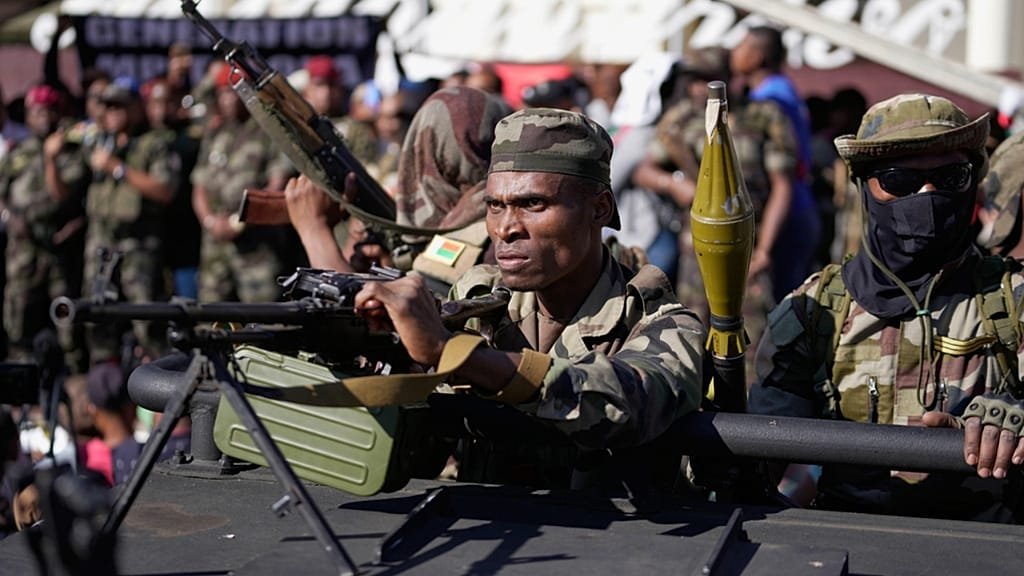
Russia has supplied the island nation with weapons and military personnel since the military takeover in October 2025, when Colonel Michaël Randrianirina assumed power following weeks of protests and the departure of former President Andry Rajoelina.
In December 2025, a Russian military aircraft reportedly arrived in Madagascar carrying 40 personnel and 43 crates of weapons, according to information provided by the country’s National Assembly Speaker, Siteny Randrianasoloniaiko, to Bloomberg. The supplies reportedly included assault rifles, sniper rifles and anti-tank systems.
The Russian involvement has since extended to military training. Personnel associated with Russia’s Africa Corps have been involved in training Malagasy soldiers, while Moscow has continued to deepen its engagement with the country’s military leadership.
President Randrianirina has also pursued closer relations with Moscow. In February, he travelled to Russia for talks with President Vladimir Putin, marking the first official visit to Moscow by a Malagasy leader in nearly five decades.
During the visit, Randrianirina expressed interest in cooperation across several sectors, including defence, energy, infrastructure and economic development. The engagement was an indication of the new leadership’s willingness to diversify Madagascar’s international partnerships.
The relationship has continued to develop. At the Russia-Africa summit in Moscow last month, the two countries signed agreements covering defence, trade and tourism. Randrianirina has also reiterated his support for stronger relations between Russia and African countries.
For Moscow, closer ties with Madagascar offer an opportunity to expand its influence in the western Indian Ocean, a strategically important area with access to major maritime routes and significant natural resources. For Madagascar’s military-led administration, Russian support provides an alternative source of military equipment, training and diplomatic engagement.
The partnership is also part of Russia’s wider effort to strengthen its position on the continent, particularly in countries where relations with traditional Western partners have weakened.
Its growing involvement in the Sahel has already changed the security and diplomatic calculations of several African governments. The military authorities in Mali, Burkina Faso and Niger have moved closer to Moscow after ending or reducing cooperation with Western countries, particularly France.
But the persistence of jihadist violence in those countries has complicated claims that the Russian-backed security approach can deliver lasting stability. This is the experience Brennan cited in warning Madagascar against following a similar path.
The US position, however, does not necessarily mean that African countries should be restricted to partnerships with Western governments. Brennan acknowledged that Washington’s partners were free to choose their international relationships, but urged them to understand the risks associated with Russia’s security model.
Madagascar has not publicly responded to the latest US warning. Its leadership must, however, balance the benefits of military and economic cooperation with Moscow against the diplomatic and strategic implications of closer relations with Russia.
The issue is particularly significant because of the country’s location. Beyond its role in international shipping, Madagascar’s waters contain valuable marine resources, while its proximity to Mozambique places it close to a region facing serious security challenges.
Whether Russia’s expanding military relationship with Madagascar will translate into a lasting strategic presence remains to be seen. But Washington’s warning, alongside its renewed security engagement with Madagascar and Mozambique, shows that the western Indian Ocean is becoming an increasingly important area of international competition.


