



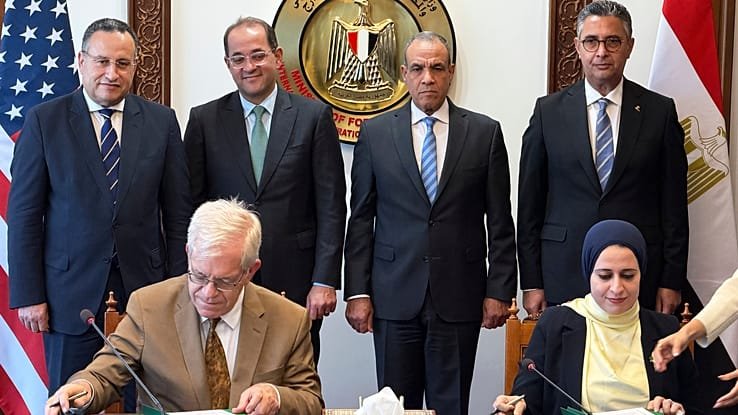
Egypt and the United States have signed a framework agreement on “Strategic Objectives” aimed at advancing mutual prosperity, strengthening economic cooperation and creating new opportunities for private sector investment in key sectors of the Egyptian economy.
The agreement, which could see Washington provide up to $625 million over five years, is expected to deepen bilateral cooperation in water management, energy, infrastructure, education, healthcare, artificial intelligence and food security.
Foreign Minister Dr. Badr Abdelatty attended the signing ceremony on Wednesday, November 4, alongside the ministers of finance, supply and internal trade, and higher education and scientific research, underscoring the involvement of several key ministries in the proposed areas of cooperation.
Dr. Samar Al Ahdal, Deputy Foreign Minister for International Cooperation, signed on behalf of Egypt, while Robert Silverman, Chargé d’Affaires at the US Embassy in Cairo, signed for the American government.
Al Ahdal said the US contribution could reach $625 million over five years, representing a significant component of Washington’s economic cooperation with Egypt.
“The total amount of the US contribution under the agreement amounts up to $625 million over a period of five years,” said Al Ahdal.
Silverman described the agreement as the first of what Washington hopes will become a series of annual agreements, with $125 million in grants committed in the first round.
He said the arrangement was designed to support Egypt’s modernisation ambitions while opening up additional opportunities for American businesses seeking to invest in the country.
“We hope this agreement will expand modernisation here, particularly in the high-tech sectors, and also to find new opportunities for private sector US investment in Egypt,” said Silverman.
His remarks suggest that the agreement is not limited to the provision of financial assistance but is also intended to strengthen commercial relationships between the two countries, particularly through the involvement of American companies in Egypt’s development programmes.
Foreign Ministry spokesman Ambassador Nader Zaki said the agreement was designed to promote tangible economic growth by bringing American institutional experience and technological innovation into critical areas of the Egyptian economy.
According to him, the partnership would support efforts to improve the country’s water, energy and infrastructure systems, while also modernising education, healthcare and governance.
It is also expected to contribute to the development of skilled Egyptian professionals, strengthen institutional capacity and create employment opportunities, particularly in sectors considered important to the country’s long-term economic development.
Priority areas include water management, artificial intelligence and energy, alongside efforts to improve food security through science-based agriculture.
The selection of these sectors reflects some of the major economic and development challenges confronting Egypt, particularly the need to modernise essential infrastructure, improve public services and attract investment into productive sectors.
For Egypt, water management is particularly important because of its dependence on the River Nile, which supplies the overwhelming majority of its freshwater resources. The country faces growing pressure from population growth, urbanisation, agricultural demand and the effects of climate change.
Agriculture remains a major consumer of available water resources, making efficient irrigation systems, modern farming techniques and improved water management essential to sustaining food production.
The proposed cooperation could therefore provide opportunities for the introduction of technologies that improve water efficiency, reduce wastage and support agricultural productivity.
Food security is another significant concern for Cairo. Egypt is one of the world’s major wheat importers and remains exposed to fluctuations in international food prices, supply disruptions and changes in global commodity markets.
The emphasis on science-based agriculture suggests that both countries intend to explore ways of improving domestic agricultural production through modern technology, research, improved farming practices and more efficient use of resources.
Such interventions could become important as Egypt seeks to reduce its exposure to external food supply shocks and strengthen the resilience of its agricultural sector.
The energy component is equally important. Egypt has been working to strengthen its electricity infrastructure, improve energy efficiency and attract investment into its energy industry. Cooperation in this area could create opportunities for American technology providers and investors in power generation, renewable energy, infrastructure development and other related services.
Artificial intelligence is another area with considerable potential. Its application in public administration, healthcare, education, agriculture and industrial production could help improve productivity and service delivery. However, achieving these benefits will require investment in digital infrastructure, technical training and the development of a skilled workforce.
The agreement’s emphasis on education and workforce development is therefore significant. Egypt needs professionals capable of supporting the transition towards a more technology-driven economy. Collaboration with American institutions and companies could provide opportunities for skills development, research partnerships and technology transfer.
Similarly, improvements in healthcare infrastructure and governance could help strengthen public institutions and improve the delivery of essential services.
A significant development in US-Egypt relations
The agreement also comes against the background of a longstanding economic and military relationship between Washington and Cairo.
The United States has provided Egypt with substantial financial assistance since the signing of the 1979 peace treaty between Egypt and Israel. The assistance has traditionally been divided into economic support and military financing, although the balance has changed considerably over the years.
Egypt has generally received about $1.3 billion annually in US military assistance, a programme that has continued for decades and remains an important component of the strategic relationship between the two countries.
Economic assistance, however, has followed a different pattern. The US has provided funding for programmes covering education, healthcare, economic development and institutional reforms, with annual allocations varying over time.
According to the Congressional Research Service, Egypt received $125 million in US Economic Support Fund assistance in the 2024 fiscal year, while the military financing allocation stood at $1.3 billion.
The distinction is important because the new framework agreement is focused on economic development and commercial cooperation, rather than military financing.
The US Embassy has also previously described $125 million as the annual economic assistance provided to Egypt through development programmes. The new arrangement, therefore, appears to build on an existing area of bilateral cooperation, with greater emphasis on private sector participation, technology and measurable economic outcomes.
There is, however, a need for further clarification on the precise financial structure of the new agreement. While Al Ahdal put the potential US contribution at up to $625 million over five years and Silverman referred to $125 million in grants in the first round, a November 5 Reuters report, citing the US Embassy’s announcement, described the agreement as a $125 million arrangement. The specific allocation of the funding and the conditions governing subsequent annual commitments have not been fully disclosed.
This makes the implementation details particularly important. The two governments will need to provide clarity on whether the five-year figure represents a firm funding commitment or an anticipated ceiling subject to annual approvals and project requirements.
The agreement’s success will ultimately depend on how the resources are deployed, the quality of projects selected and the extent to which Egyptian businesses and workers benefit from the partnership.
For Washington, the arrangement also offers an opportunity to expand the presence of American companies in one of the largest economies in the Middle East and North Africa. By linking development assistance with private investment, the US hopes to create commercial opportunities while supporting Egypt’s economic modernisation.
Egypt, on its part, needs foreign investment, technology and development partnerships to address infrastructure gaps, strengthen domestic production and create employment for its growing population.
The OECD’s 2026 report on Egypt’s agricultural policies highlights the country’s continuing vulnerability to food import dependence. It identifies Egypt as the world’s largest wheat importer and notes that its agricultural import bill reached $19 billion in 2024. This underlines the importance of improving domestic agricultural productivity and strengthening food security.
Beyond the immediate financial value, the new agreement will therefore be judged by its ability to translate bilateral commitments into practical improvements in the Egyptian economy.
The challenge for both governments will be ensuring that the proposed cooperation goes beyond signing ceremonies and announcements. Clear project timelines, transparent funding arrangements, effective monitoring and measurable results will be necessary to demonstrate the benefits of the partnership.
For Egyptian businesses and ordinary citizens, the real value of the agreement will not be determined by the amount announced but by whether it leads to better infrastructure, improved public services, more jobs, stronger agricultural production and greater opportunities for local enterprises.
With water security, energy supply, food production and technological development becoming increasingly important to Egypt’s economic future, the partnership provides an opportunity for both countries to deepen their cooperation.
Whether the proposed $625 million framework delivers on its promise of mutual prosperity will depend largely on how effectively the two governments turn the agreement into concrete development projects.


